
What is D4RT
D4RT (Dynamic 4D Reconstruction and Tracking) is a dynamic 4D reconstruction model launched by Google DeepMind. Through a unified "spatiotemporal query" interface, the model integrates tasks such as 3D reconstruction, camera tracking, and dynamic object capture, using global scene representation and parallel computation to achieve efficient processing. D4RT is 18 to 300 times faster than existing technologies, and can accurately reconstruct dynamic scenes and predict object trajectories. D4RT provides powerful technical support for fields such as embodied intelligence, autonomous driving, and augmented reality, marking an important advance for AI from 2D recognition to 4D spatiotemporal insight.
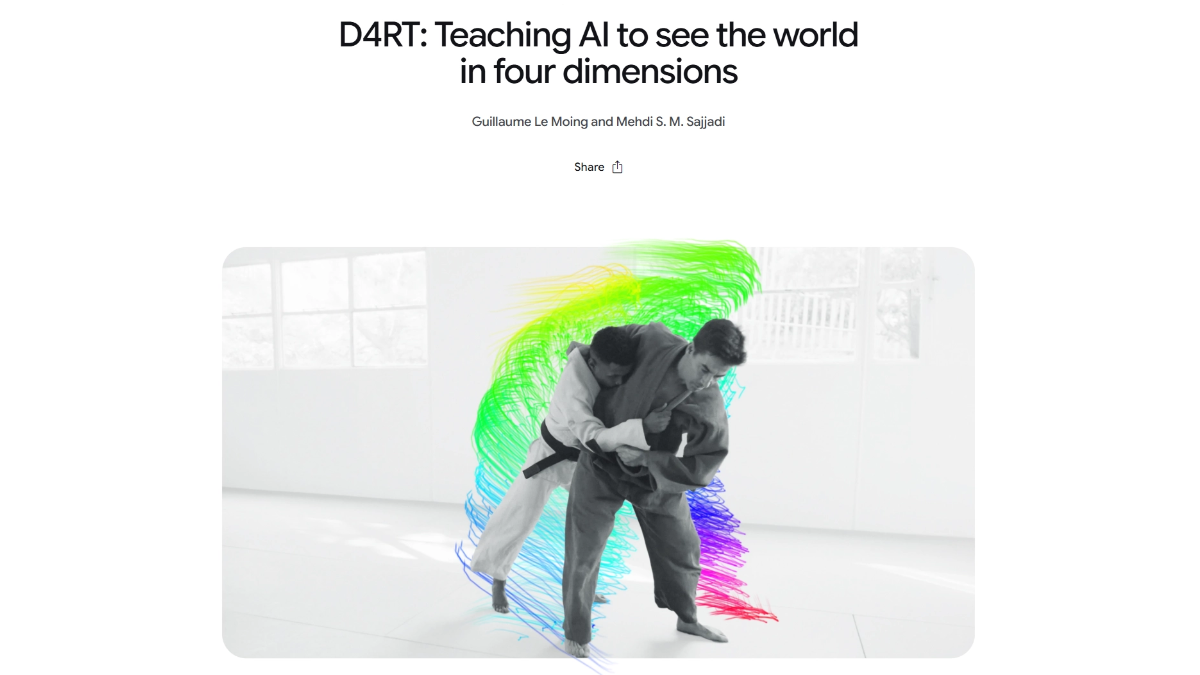
D4RT's Main Features
-
Full pixel-level dynamic tracking: D4RT can track the 3D trajectory of every pixel in a video, and can accurately reconstruct spatiotemporal positions for both stationary objects and high-speed motion.
-
Real-time 3D reconstruction: The model reconstructs the 3D structure of dynamic scenes in real time, generates high-quality point cloud data, and supports viewing the scene from any viewpoint.
-
Camera pose estimation: D4RT can accurately estimate the camera's motion trajectory and pose in a video, providing support for multi-view reconstruction.
-
Future trajectory prediction: Based on its understanding of dynamic scenes, D4RT can predict the position and motion trajectory of objects at future time points.
-
Interactive 4D reconstruction: Users can obtain information at any time point and spatial position through the query interface, enabling highly flexible scene analysis and reconstruction.
D4RT's Technical Principles
-
Global scene representation: D4RT uses a large Transformer encoder to compress the entire video into a global scene representation (Global Scene Representation), serving as the video's "long-term memory" and providing a foundation for subsequent queries.
-
Spatiotemporal query mechanism: By designing a general query interface, D4RT supports the model in independently querying the 3D position of any pixel at any time point. The query includes pixel coordinates, timestamps, camera viewpoint, and the surrounding 9×9 image patch, providing rich contextual information.
-
Parallel computation optimization: Because each query is independent, D4RT can fully use the parallel computation capabilities of GPUs/TPUs to process a large number of queries simultaneously, achieving efficient inference 18 to 300 times faster than traditional technologies.
-
Lightweight decoder: D4RT's decoder is based on a lightweight design and can quickly respond to query requests without complex frame-by-frame decoding, greatly improving efficiency.
D4RT's Project Address
- Project official website:https://deepmind.google/blog/d4rt-teaching-ai-to-see-the-world-in-four-dimensions/
- arXiv technical paper:https://arxiv.org/pdf/2512.08924
D4RT's Application Scenarios
-
Embodied intelligence and robotics: D4RT can help robots perceive dynamic environments in real time, accurately predict object motion, and improve interaction and navigation capabilities.
-
Autonomous driving: D4RT significantly enhances the safety and environmental understanding capabilities of autonomous driving systems by tracking and predicting the trajectories of dynamic objects in real time.
-
Augmented reality (AR): D4RT supports AR devices in reconstructing real scenes in real time, enabling seamless integration of the virtual and the real, and providing low-latency interactive experiences.
-
Video editing and entertainment: D4RT makes video editing more flexible. Users can freely switch viewpoints, replace backgrounds, and even change the direction of light sources, enhancing creative possibilities.
-
Industry and manufacturing: D4RT is used for dynamic production monitoring and quality inspection, tracking item dynamics in real time, optimizing production processes, and detecting defects.