
What is CursorCore
CursorCore is a programming assistance framework based on large language models (LLMs), using conversational interaction to help programmers write and modify code more efficiently. The framework integrates various kinds of information in the programming process, including code history, current code, and user instructions, predicts the required code modifications, and reduces the programmer's workload. CursorCore provides a new conversational framework Assistant-Conversation, develops the data generation pipeline Programming-Instruct to automate the collection of training data, and proposes the APEval benchmark to evaluate model performance. Based on fine-tuning multiple models, the CursorCore series of models shows superior performance in programming assistance tasks.
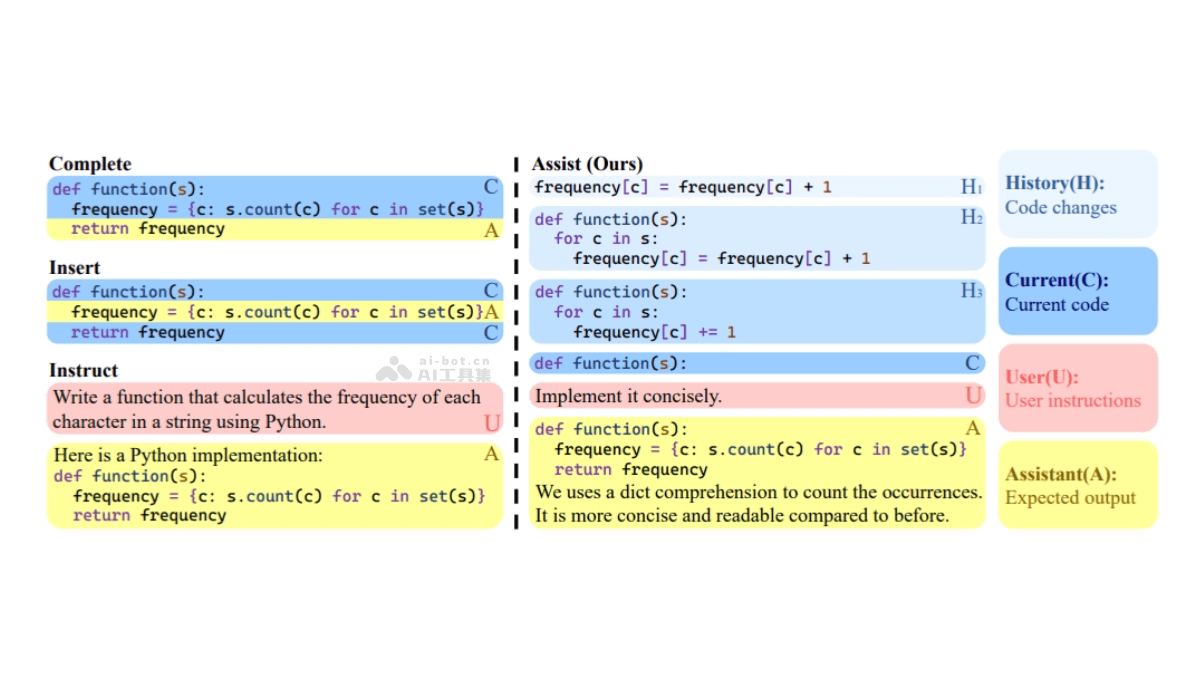
CursorCore's main features
- Conversational programming assistance: Based on simulating a programmer's coding process, CursorCore can understand user instructions and code context, and provide assistance such as code completion, modification, and error repair.
- Code history integration: The framework processes and learns from a programmer's code modification history, and predicts and recommends subsequent code changes.
- Automated data generation: Based on the Programming-Instruct pipeline, it automatically generates training data from platforms such as GitHub without manual annotation.
- Performance evaluation: Uses the APEval benchmark to comprehensively evaluate model performance across different programming tasks.
CursorCore's technical principles
- Large language models (LLMs): CursorCore is built on advanced LLMs, and the models can understand and generate code.
- Integration of multiple information sources: The framework can process and integrate multiple information sources such as code history, current code, and user instructions.
- Conversational framework (Assistant-Conversation): Based on simulating a dialogue between a programmer and a programming assistance tool, it achieves more natural interaction and more accurate code prediction.
- Data generation pipeline (Programming-Instruct): Automatically generates training data from different data sources (such as GitHub commits and online judge platforms).
- Fine-tuned models: Fine-tunes the base LLMs based on the generated data to adapt to programming assistance tasks.
- Benchmark (APEval): Designs new evaluation criteria to comprehensively test model performance in programming assistance tasks, including code completion, editing, and instruction-following abilities.
CursorCore's project address
- GitHub repository:https://github.com/TechxGenus/CursorCore
- HuggingFace model library:https://huggingface.co/papers/2410.07002
- arXiv technical paper:https://arxiv.org/pdf/2410.07002
CursorCore's application scenarios
- Daily coding: When developers write new code or modify existing code, they use CursorCore to get real-time code suggestions and automatic completion.
- Code review: During the code review stage, CursorCore helps reviewers quickly identify potential issues in the code and propose improvement plans.
- Learning and teaching: For programming beginners or students, CursorCore serves as an educational tool, providing immediate coding guidance and feedback to help them learn and practice programming concepts.
- Rapid prototyping: During the rapid prototyping stage, developers use CursorCore to accelerate feature implementation and quickly generate code prototypes by describing requirements in natural language.
- Maintaining legacy code: For maintaining legacy codebases, CursorCore helps developers understand code intent and provides suggestions for refactoring and optimization.