
What is Cursor Router
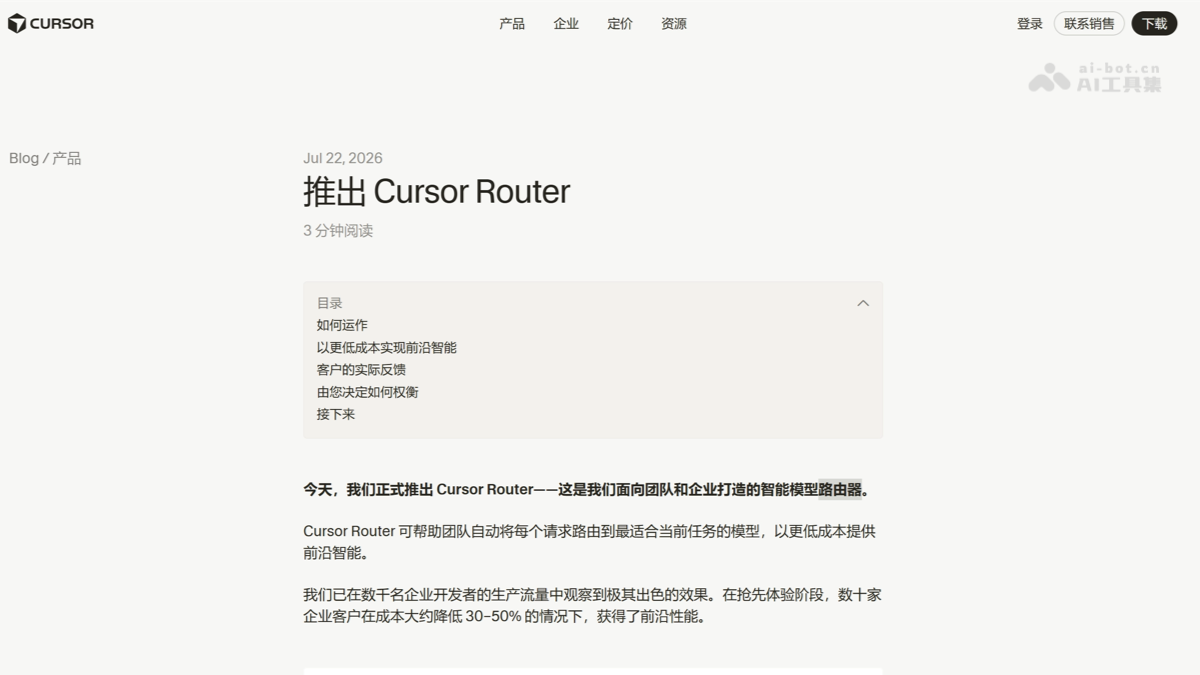
Cursor Router is Cursor an intelligent model router launched for teams and enterprises, trained on over 600,000 real requests, automatically routing each coding request to the most suitable model. Cursor Router offers three modes: Intelligence, Balance, and Cost, maintaining frontier performance while saving 30%–60% in costs, validated through large-scale online A/B testing, with user satisfaction and code retention rate as core evaluation metrics.
Main features of Cursor Router
- Intelligent request classification: Based on dimensions such as query content, context, task complexity, and domain, it automatically analyzes each request and routes it to the most suitable model.
- Three routing modes:
-
Intelligence mode: Pursues the highest intelligence output, with about 60% cost reduction
-
Balance mode: Balances performance and cost, with satisfaction higher than Opus 4.8 and about 36% cost reduction
-
Cost mode: Prioritizes cost control
-
- Cache-aware decisions: Both training and evaluation take cache hits into account, and the cost savings data already includes the cache miss costs caused by routing.
- Continuous model adaptation: Designed to support frequent releases of new models, making it easy to update the router to access newer, stronger models.
How to use Cursor Router
- Team/enterprise users: Cursor Router is available to Cursor Team and Enterprise users, and can be enabled by selecting the Auto routing mode in settings.
- Mode switching: Switch between the three modes Intelligence, Balance, or Cost in Cursor settings to adjust the trade-off between cost and intelligence.
- Automatic operation: Once enabled, no manual intervention is needed; the system automatically completes request classification and model routing in the background.
Core advantages of Cursor Router
- Significant cost reduction: Actual usage data from enterprise customers shows that costs are 30%–52% lower than using Opus 4.8 across the board, with no quality degradation.
- Quality rises rather than falls: Online A/B testing shows that Auto Intelligence mode has satisfaction close to Fable and about 15% higher than Opus 4.8.
- Validated in real scenarios: Based on online testing with millions of real requests rather than small-scale offline evaluation, it is closer to actual development workflows.
- Model-neutral: Not tied to a single model, it flexibly uses each model's strengths, using cost-effective models for simple tasks and reasoning models for complex tasks.
Comparison of Cursor Router with similar competitors
| Dimension | Cursor Router | GitHub Copilot |
|---|---|---|
| Routing mechanism | Intelligent classifier automatically routes across multiple models | Mainly relies on a single model (GPT-4o, etc.) |
| Cost optimization | Explicitly provides 30%–60% cost savings | Charges a fixed subscription fee, with no dynamic cost-reduction mechanism |
| Mode selection | Three modes (Intelligence/Balance/Cost) | No explicit routing mode switching |
| Evaluation method | Large-scale online A/B testing + code retention rate | No publicly disclosed comparable online routing evaluation data |
| Applicable to | Team/Enterprise Edition | Available for Personal/Team/Enterprise editions |
Use cases of Cursor Router
-
Cost control for large development teams: Engineering teams with thousands of people can significantly reduce the monthly expenditure on AI programming tools through intelligent routing.
-
Full-stack multi-task development: The same project includes both simple code completion and complex architecture design, and different models are automatically matched to handle them.
-
Budget-sensitive enterprise deployment: While maintaining code quality, prioritize Cost or Balance mode to control the AI budget.
-
Fast-iterating technical teams: Frequently integrate newly released models, and automatically gain the latest model capabilities without manually adjusting configurations.
-
Cross-domain project development: Involving different domains such as front-end UI, back-end logic, and algorithm reasoning, automatically route to the task types each model is best at.