
What Is Ctrl-World
Ctrl-World is an embodied world model jointly launched by Chen Jianyu's team at Tsinghua and Chelsea Finn's team at Stanford. It won first place globally in embodied task capability and second place globally in video generation quality in the authoritative WorldArena evaluation. The model adopts an action-conditioned architecture and physical engine constraints, explicitly injecting robotic arm action parameters into the generation process, achieving centimeter-level trajectory precision, 0.986 policy evaluation consistency, and 0.93 depth accuracy, making virtual testing nearly equivalent to real testing. It provides a high-fidelity "digital twin" environment for robot policy training and evaluation, greatly reducing R&D costs.
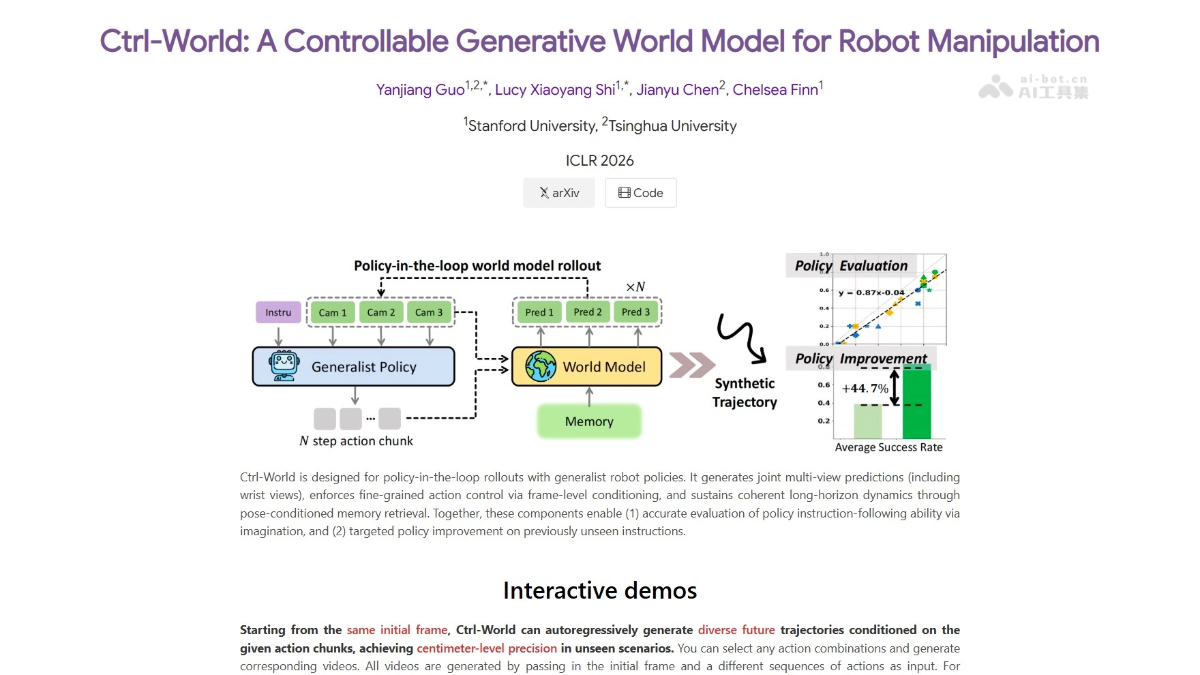
Ctrl-World's Main Features
- Policy Evaluation: Supports testing robot policies in a virtual environment, with evaluation results reaching up to 0.986 consistency with the real physical environment. Developers can complete policy validation without building expensive real environments.
- Action Planning: Based on physically accurate trajectory generation, it plans executable action sequences for robots and supports precision manipulation tasks under closed-loop control.
- Data Synthesis: Supports generating physically plausible video-action data that can be directly used to train real robot policies, solving the pain point of traditional synthetic data where "virtual training, real-world failure" occurs.
- Multi-View Prediction: Jointly generates multi-view RGB videos, depth maps, and point clouds, providing robots with complete spatial perception capabilities.
Ctrl-World's Technical Principles
- Action-Conditioned Architecture: Explicitly injects physical parameters such as robot joint angles and gripper opening and closing degrees into the generation process, forcing the learning of the causal physical chain between actions and state changes, and fundamentally avoiding errors that violate physical laws such as object penetration and levitation-based grasping.
- Embedded Physical Engine Constraints: Introduces physical engine supervision during training, internalizing Newtonian mechanical laws as hard generation constraints, ensuring that model outputs are not only visually realistic but also conform to physical conservation laws such as mass, friction, and collision.
- Memory-Enhanced Multi-View Prediction: Maintains long-horizon temporal consistency through sparse historical frame retrieval and pose-conditioned projection; at the same time, it jointly predicts multi-view RGB, depth maps, and point cloud structures, achieving precise 3D spatial cognition and centimeter-level trajectory precision.
Ctrl-World's Project Address
- Project Official Website:https://ctrl-world.github.io/
- GitHub Repository:https://github.com/Robert-gyj/Ctrl-World
- arXiv Technical Paper:https://arxiv.org/pdf/2510.10125
Ctrl-World's Application Scenarios
- Virtual Simulation Testing: Developers can directly evaluate robot policy performance in Ctrl-World without building expensive real physical environments, greatly reducing R&D costs and time cycles.
- Policy Training Data Synthesis: The model generates physically plausible video-action sequences that can be directly used to train real robot policies, solving the problems of high cost and low efficiency in real data collection.
- Action Planning and Closed-Loop Control: Ctrl-World can generate precise action sequences for robotic arms, support precision manipulation tasks such as grasping, stacking, and insertion, and adjust planning based on real-time feedback during execution.
- Robot Skill Learning: By generating diverse scene and object interaction data, it helps robots learn manipulation skills with strong generalization ability, adapting to unseen object shapes, spatial positions, and task instructions.