
What is Cosmos
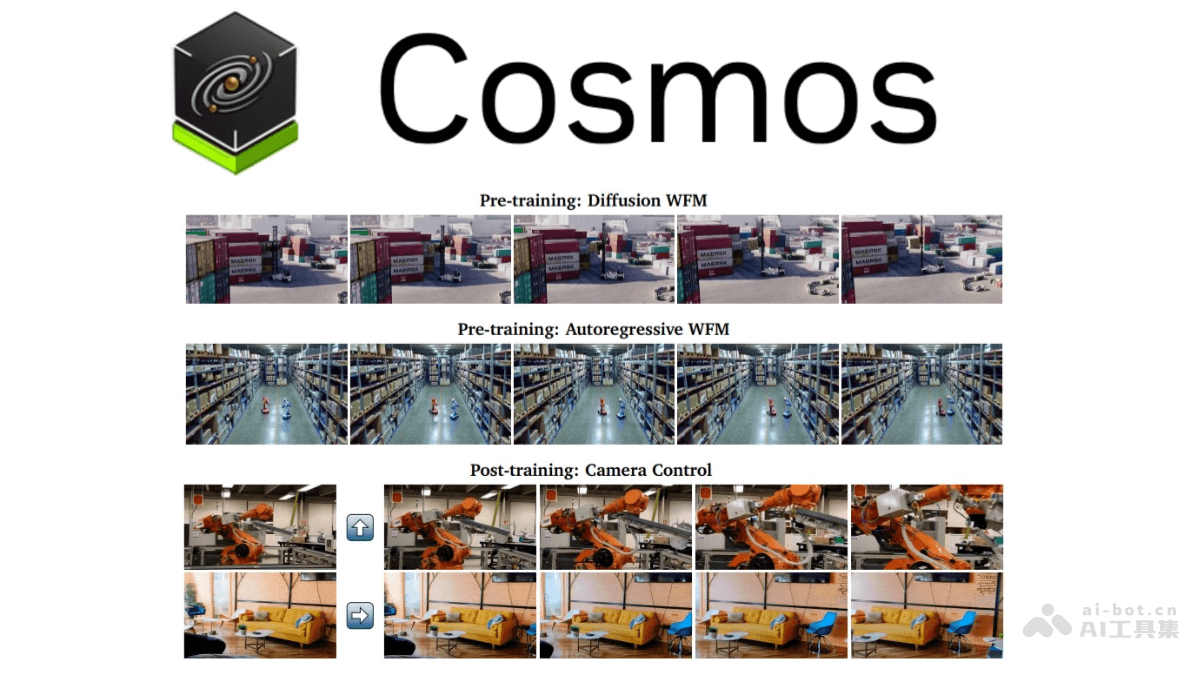
Cosmos is a generative world foundation model platform launched by NVIDIA, accelerating the development of physical artificial intelligence (AI) systems, especially in the fields of autonomous driving and robotics. Cosmos can accept prompts in the form of text, images, or videos to generate highly realistic virtual world states, providing unique video output for autonomous driving and robotics applications. The platform integrates generative world foundation models, advanced tokenizers, and accelerated video processing pipelines, helping developers generate large amounts of physics-based synthetic data and reducing reliance on real-world data. Cosmos also provides safety guardrails to ensure data security and compliance. Developers can fine-tune Cosmos models to create customized AI models that meet specific application needs.
Main Features of Cosmos
- Generate virtual world states: Cosmos can generate highly realistic virtual world states based on prompts in the form of text, images, or videos, suitable for autonomous driving and robotics applications.
- Generative models: The platform quickly generates data similar to real-world scenes based on generative models, helping developers train and evaluate existing AI models.
- Advanced tokenizers and data processing: Cosmos integrates advanced tokenizers and an accelerated video processing pipeline, allowing the generated data to play a greater role in subsequent model training.
- Safety and compliance: The platform also provides safety guardrails to ensure data security and compliance.
- Open model license: Cosmos will be made available under an open model license in the Hugging Face and NVIDIA NGC catalogs, supporting developers in creating customized applications.
Technical Principles of Cosmos
- Generative World Foundation Model (WFM): Cosmos uses advanced generative model technology, including diffusion models and autoregressive Transformer models, to generate synthetic data highly similar to real-world scenes.
- Advanced Tokenizer (Cosmos Tokenizer): This tokenizer uses a complex encoder-decoder structure, combining 3D causal convolutions and attention mechanisms to efficiently process spatiotemporal information. It can decompose images and videos into high-quality tokens with high compression rates, providing AI models with more efficient visual data.
- Accelerated video processing pipeline (NeMo Curator): Cosmos integrates an accelerated video processing pipeline that can process large amounts of video data in a short time. For example, NeMo Curator can process 20 million hours of video data in 14 days.
Cosmos Model Series
Nano model
- Features: Suitable for low-latency and real-time applications.
- Parameter scale: Approximately 4 billion parameters.
- Application scenarios: Suitable for application scenarios requiring fast response, such as real-time video analysis and simple robot control tasks.
Super model
- Features: Provides a high-performance baseline.
- Parameter scale: Approximately 7 billion parameters.
- Application scenarios: Suitable for applications requiring higher performance and accuracy, such as environmental perception and decision support for autonomous vehicles, as well as simulation and training for complex robot tasks.
Ultra model
- Features: Pursues the highest quality and precision.
- Parameter scale: Approximately 14 billion parameters.
- Application Scenarios: Suitable for applications with extremely high requirements for precision and quality, such as high-precision autonomous driving simulation, complex industrial robot operation simulation, etc.
Cosmos Project Address
- Project Website:https://research.nvidia.com/publication/2025-01_cosmos
- Github Repository:https://github.com/NVIDIA/Cosmos
- HuggingFace Model Library:https://huggingface.co/collections/nvidia/cosmos
- Technical Paper:https://d1qx31qr3h6wln.cloudfront.net/publications/NVIDIA%20Cosmos
Cosmos Application Scenarios
- Driving Environment Simulation: Cosmos can generate synthetic data under various weather and road conditions, providing rich scenarios for the training of autonomous driving systems.
- Policy Model Optimization: By generating a large number of realistic driving scenarios, Cosmos can help autonomous driving systems perform reinforcement learning in simulated environments, optimize decision-making policy models, and test performance under different scenarios.
- Complex Environment Adaptability Training: Cosmos can provide robots with real-time simulation of complex environments, enabling their perception systems to be trained with synthetic data.
- Navigation and Task Execution: Based on the virtual world states generated by Cosmos, robots can better understand and adapt to their surrounding environment, achieving more precise navigation and task execution.
- Realistic Scene Generation: Cosmos can generate highly realistic virtual world states, suitable for virtual reality games and simulation training. For example, developers can use Omniverse to create 3D scenes, then convert them into realistic scenes through Cosmos, enabling robots to train in simulated environments.
- Industrial Digital Twin: By combining NVIDIA's Omniverse and Cosmos, industrial digital twin environments can be created for simulation, testing, and optimization of factories and warehouses. This enables better manual design, operation, and optimization in complex production facilities and distribution center networks.
Cosmos Application Cases
- Uber Autonomous Driving Development: As one of the first companies to adopt Cosmos, Uber has accelerated the progress of safe and scalable autonomous driving solutions based on generative AI capabilities. It provides rich synthetic data for Uber's autonomous driving system, helping it conduct model training and optimization under different driving scenarios, and improving the safety and reliability of autonomous driving technology.
- XPeng Motors Simulation Training: XPeng Motors also adopted the Cosmos platform to conduct simulation training for autonomous driving algorithms by generating synthetic driving data under various weather and road conditions. For example, in scenarios such as simulated severe weather including rain, snow, and haze, as well as different road conditions such as urban roads and highways, the autonomous driving system can learn how to better perceive the environment, make decisions, and execute operations, improving the algorithm's performance in real street scenes.
- 1X Robot Dynamic Planning: 1X Company uses Cosmos's simulation engine to provide robots with high-fidelity modeling capabilities for mechanics, kinematics, and dynamic interaction. Through closed-loop simulation, 1X robots can perform dynamic planning and environmental adaptability optimization in virtual environments, achieving more precise navigation and task execution in practical application scenarios.