
What Is Cosmos 3
Cosmos 3 is the world's first fully open-source, full-modality physical AI foundation model launched by NVIDIA. It uses a hybrid Transformer architecture that integrates visual reasoning, world generation, and action prediction capabilities. The model can natively understand and generate text, images, videos, sound effects, and action content, with industry-leading physical simulation accuracy. NVIDIA has simultaneously launched the Cosmos Coalition alliance, whose members include Runway, Black Forest Labs, and others, to jointly advance the development of next-generation world models. Cosmos 3 Super and Nano versions are now available, with the Edge version coming soon.
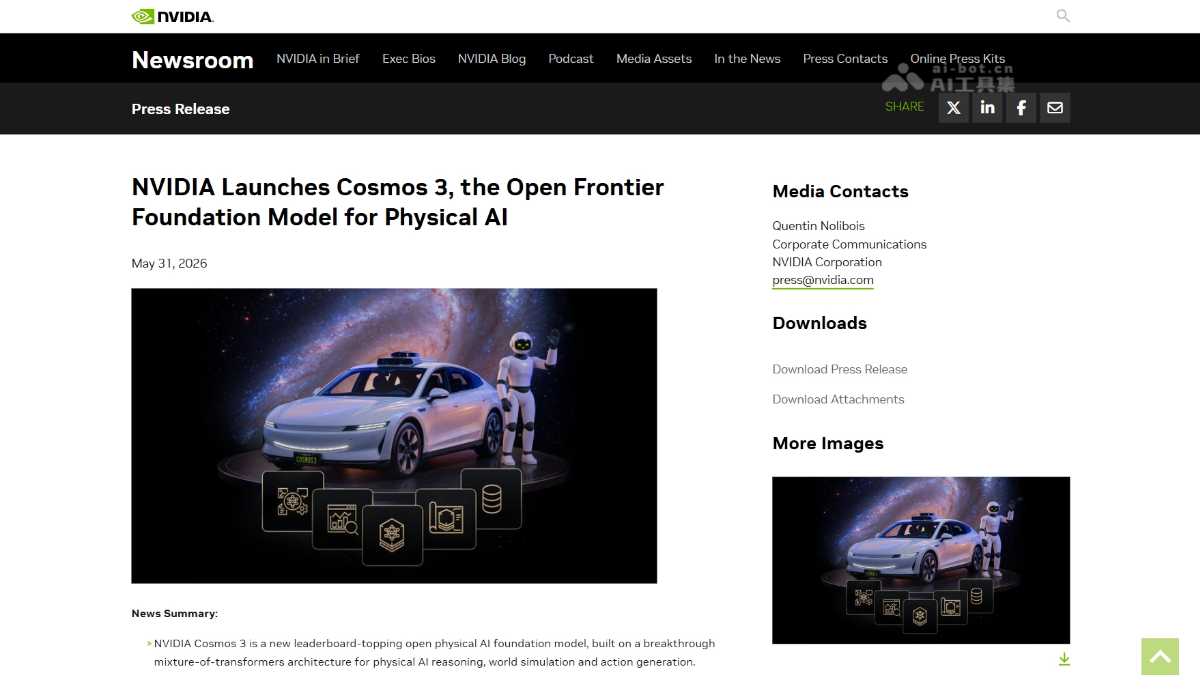
Main Features of Cosmos 3
-
Native full-modality understanding and generation: Unified processing of text, images, videos, ambient sound effects, and action trajectories, without the need for separate module stitching.
-
Physical world simulation: Acts as a world model to simulate physical environments and predict future states of scenes, supporting model training and evaluation.
-
Action policy generation: Assists in training robots and autonomous driving systems to complete action trajectory planning for specific tasks.
-
Multimodal visual reasoning: Cross-modal understanding of object interactions, motion patterns, and spatiotemporal correlations.
-
Synthetic data generation: Generates high-quality training data based on physical accuracy, reducing the cost of real data collection.
Technical Principles of Cosmos 3
- Mixture-of-Transformers architecture: Cosmos 3 combines a reasoning Transformer with a specialized generation Transformer. The model first analyzes object interactions, motion patterns, and spatiotemporal correlations to understand the underlying logic of the physical world, and then uses this as a basis to complete video generation and action trajectory prediction. This architectural design creates a closed loop between reasoning and generation, ensuring that the output content conforms to physical laws.
- Training on massive multimodal physical AI datasets: The model is trained on billions of samples covering text, images, videos, sound effects, and action trajectories, building a deep understanding of the physical world and enabling developers to build physical AI systems with less data and lower cost.
How to Use Cosmos 3
-
Access the platform: Visit https://www.nvidia.com/en-us/ai/cosmos/,体验 Cosmos 3 features.
-
Obtain the model: Download the open-source model weights from Hugging Face.
-
Custom development: Use Hugging Face Diffusers and GitHub resources to customize the model and generate synthetic data.
-
Deploy inference: Deploy the model through NVIDIA NIM microservices, or choose cloud partners such as Baseten, CoreWeave, and Microsoft Azure to accelerate inference.
Core Advantages of Cosmos 3
-
Fully open source: Model weights and architecture are completely open, allowing free customization and secondary training.
-
Leading physical accuracy: Ranked first among open-source models in world generation benchmarks such as Artificial Analysis, Physics-IQ, PAI-Bench, and R-Bench.
-
Improved training efficiency: Compresses physical AI training and evaluation cycles from months to days.
-
Three-in-one capability: Simultaneously serves the three roles of vision-language model, world model, and world action model backbone network.
-
Industry alliance support: Cosmos Coalition brings together the world's top AI labs and robotics companies to build an ecosystem together.
Project address of Cosmos 3
- Project official website:https://www.nvidia.com/en-us/ai/cosmos/
- HuggingFace model repository:https://huggingface.co/collections/nvidia/cosmos3
Comparison of Cosmos 3 with similar competing products
| Dimension | Cosmos 3 | Google Gemini 2.5 Pro |
|---|---|---|
| Open-source nature | Fully open source (model weights + architecture) | Closed-source API |
| Modality coverage | Text/image/video/audio/action | Text/image/audio/video |
| Physical AI focus | Designed specifically for physical world simulation and action generation | General-purpose multimodal large model |
| Action generation | Native support for robot/autonomous driving action trajectories | Does not support native action output |
| Physical accuracy benchmark | Physics-IQ, PAI-Bench open-source No. 1 | Not specifically evaluated for physical AI |
| Training data | Billions of pieces of physical AI multimodal data | Mainly general internet data |
| Deployment method | NIM microservices/cloud partners/on-premises | Vertex AI API |
| Ecosystem alliance | Cosmos Coalition (Runway, BFL, etc.) | Google's own ecosystem |
Application scenarios of Cosmos 3
-
Robot training: Provides world model simulation and action policy pretraining for industrial robots and humanoid robots.
-
Autonomous driving development: Simulates complex traffic scenarios, generates corner case training data, and accelerates AV model iteration.
-
Visual AI agents: Empowers the perception-reasoning-decision closed loop in scenarios such as industrial inspection, intelligent security, and warehouse management.
-
Synthetic data factory: Replaces expensive real-world data collection and generates training samples with physical consistency in batches.
-
Physical world research: Provides open foundation models for academic institutions and advances theoretical research on embodied intelligence and world models.