
What is CorrDiff
CorrDiff is a generative AI model launched by NVIDIA, used to downsample low-resolution global weather data into high-resolution data, improving the accuracy and efficiency of weather forecasting. It processes data using a two-step method: first, it predicts the conditional mean of atmospheric variables through a UNet architecture, and then refines and corrects the prediction results based on a diffusion model. Compared with traditional methods, each inference is 1000 times faster and energy consumption is reduced by 3000 times. CorrDiff can synthesize high-resolution details that do not exist in low-resolution data, providing more accurate extreme weather predictions for weather forecasting.
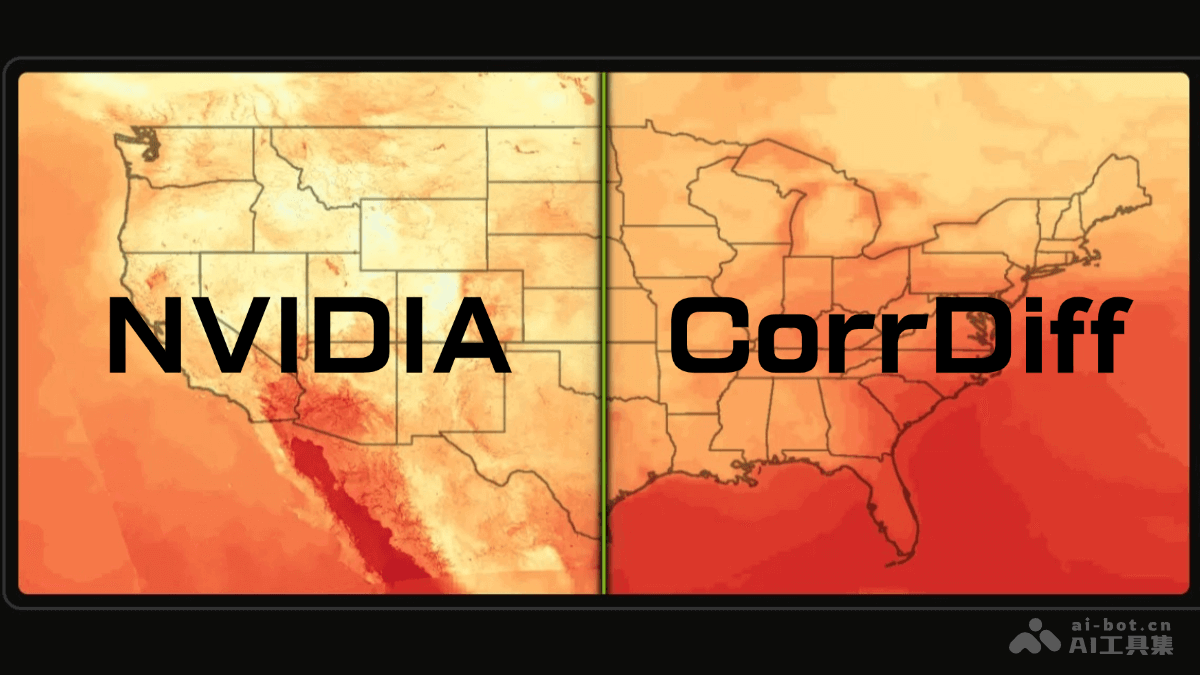
CorrDiff's main features
- High-resolution data generation: CorrDiff can increase resolution from 25 kilometers to 2 kilometers, generating finer meteorological data, suitable for predicting extreme weather events (such as typhoons).
- Two-step prediction method: CorrDiff processes data using a two-step method. The first step predicts the conditional mean through a UNet architecture, and the second step corrects the prediction results based on a diffusion model, generating high-resolution details and extreme values.
- Efficient computing and energy saving: Compared with traditional methods, CorrDiff's computing speed is increased by 1000 times and energy consumption is reduced by 3000 times. For example, tasks that previously required a large CPU cluster to complete can now be efficiently completed with a single NVIDIA GPU.
- Supports multiple meteorological variables: CorrDiff can predict common meteorological variables and can synthesize variables that do not exist in low-resolution data, such as radar reflectivity, which is extremely critical for determining the location and intensity of rainfall.
- Deterministic and probabilistic prediction: CorrDiff can provide high-fidelity deterministic and probabilistic predictions, accurately recovering the spectra and distributions of extreme events.
- Easy to deploy and scale: As part of NVIDIA Earth-2, CorrDiff provides standardized APIs and pre-built containers, supporting rapid deployment on cloud platforms, data centers, or workstations.
CorrDiff's technical principles
- UNet prediction: The first step uses the UNet architecture, a network commonly used in image processing, which can effectively extract features and predict the conditional mean of atmospheric variables.
- Diffusion correction: The second step corrects the prediction results based on a diffusion model. The diffusion model generates high-resolution details and extreme values through the process of adding noise to an image and then gradually removing the noise. Similar to Reynolds decomposition in fluid mechanics, it can effectively handle multi-scale atmospheric data.
CorrDiff's project address
- Project official website:https://build.nvidia.com/nvidia/corrdiff/modelcard
- arXiv technical paper:https://arxiv.org/pdf/2309.15214
CorrDiff's application scenarios
- Extreme weather event prediction: CorrDiff can refine low-resolution (such as 25 kilometers) global weather data to high resolution (such as 2 kilometers), more accurately predicting extreme weather phenomena, such as typhoons, rainstorms, and hurricanes.
- High-resolution weather forecasting: Through generative learning technology, the model completes the details in coarse-resolution input data, generating finer weather forecast results.
- Disaster risk assessment and response: The high-resolution data generated by CorrDiff can be used to assess the potential impact of extreme weather events, providing decision support for urban planning, infrastructure construction, and disaster response.
- Generate multiple meteorological variables: CorrDiff can predict common meteorological variables and can synthesize variables that do not exist in low-resolution data, such as radar reflectivity, which is crucial for determining the location and intensity of rainfall.