
What is ControlNeXt
ControlNeXt is a novel AI image and video controllable generation framework, jointly developed by The Chinese University of Hong Kong and SenseTime. It adopts lightweight control modules and an innovative cross normalization technique, significantly reducing computational resources and training difficulty while maintaining the high quality and diversity of generated content. ControlNeXt supports a wide range of conditional control signals, such as human pose, edge maps, etc., and can flexibly integrate with various base models and LoRA weights, achieving style transformation without additional training, significantly improving the efficiency and flexibility of AI generation models.
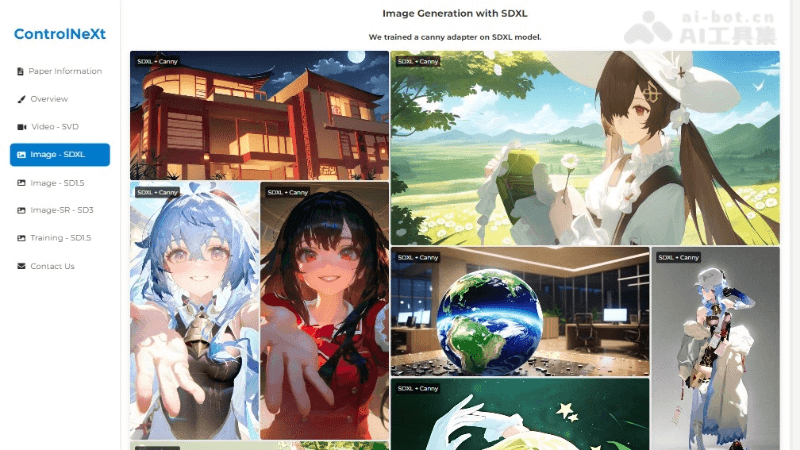
Technical Principles of ControlNeXt
- Lightweight Control Module: ControlNeXt introduces a lightweight convolutional network to extract conditional control features, replacing the massive control branch in traditional ControlNet.
- Parameter Efficiency Optimization: Fine-tunes a small subset of parameters in the pre-trained model, significantly reducing the number of trainable parameters and improving parameter efficiency.
- Cross Normalization: Proposes a new cross normalization technique to replace zero convolution, addressing the data distribution inconsistency of newly introduced parameters when fine-tuning large pre-trained models.
- Improved Training Strategy: During training, most components of the pre-trained model are frozen, and only a small subset of pre-trained parameters are selectively trained, helping to avoid overfitting and catastrophic forgetting.
- Integration of Conditional Control: ControlNeXt integrates conditional control into a single selected intermediate block in the denoising branch, normalized through Cross Normalization and directly added to the denoising features.
- Plug-and-Play Functionality: Due to its lightweight design, ControlNeXt can serve as a plug-and-play module integrated with various base models and LoRA weights, enabling style changes without additional training.
ControlNeXt Project Address
- Project Website:https://pbihao.github.io/projects/controlnext/index.html
- Github Repository:https://github.com/dvlab-research/ControlNeXt
- Technical Paper:https://arxiv.org/pdf/2408.06070
How to Use ControlNeXt
- Environment Preparation:Ensure an appropriate computing environment, including necessary hardware (such as GPU) and software (such as Python, deep learning frameworks, etc.).
- Obtain the Model:From the officialGitHub repositorydownload the pre-trained ControlNeXt model.
- Install Dependencies:Install the dependency libraries required for running ControlNeXt, such as PyTorch, diffusers library, etc.
- Data Preparation:Prepare the data required for training or generation tasks, including images, videos, or conditional control signals (such as pose, edge maps, etc.).
- Model Configuration:Configure model parameters according to task requirements, including selecting the base model, setting the type and strength of conditional control, etc.
- Training or Generation:Use ControlNeXt for model training or directly generate images/videos. If training, you need to define the training loop, loss function, optimizer, etc.; if generating, you need to provide conditional inputs and execute model inference.
Application Scenarios of ControlNeXt
- Film and Television Production: In the film and television industry, ControlNeXt can be used to generate special effects or animations, reducing production costs and time.
- Advertising Design: In the advertising field, ControlNeXt can quickly generate advertising materials that conform to brand style and marketing needs.
- Artistic Creation: Artists and designers can use ControlNeXt to explore new artistic styles and create unique visual works.
- Virtual Reality and Game Development: In the fields of virtual reality and video games, ControlNeXt can be used to generate realistic 3D environments and characters.
- Fashion Design: Fashion designers can use ControlNeXt to preview clothing designs, rapidly iterate, and showcase new styles.