
Over the past thirty years, trillion-dollar-market-cap Systems of Record such as Salesforce, SAP, and Workday have defined the core of enterprise digitalization. They record "what is," that is, the final state of entities such as customers, orders, and employees. Today, as AI agents become the core, a fundamental contradiction has emerged: they need to understand“why”, and traditional systems are collectively blind to this.“Context graphs” are precisely the key to breaking the deadlock. Context graphs can capture in real time the“decision trajectories”scattered across conversations and experience (reasoning, exceptions, precedents), and transform them into queryable, learnable core assets. This marks enterprise software's move from“recording state”into“recording reasoning”era. It is not only AI's "memory bank" but also the cornerstone of an enterprise's autonomous "world model." Traditional giants are trapped by data silos and find it hard to break in. This creates a structural opportunity for AI-native companies: by capturing decision logic that has never been recorded, they can build the next generation of trillion-dollar-level——“Systems of Decision”。
What Is a Context Graph
Definition
A context graph is defined as a dynamic, queryable knowledge graph that can systematically record the complete context of all key decisions in enterprise operations. Unlike traditional databases, which store only the final state ("what happened"), the core of a context graph lies in capturing the "why" in the decision-making process.
A context graph is a network composed of entities, decision events, and causal relationship links. Entities represent the business objects that an enterprise cares about, such as customers, accounts, orders, service tickets, policies, and approvers; decision events refer to "key moments," that is, the moments when AI agents or humans make important judgments and actions; the "why" links record in detail all relevant factors and the reasoning process that triggered the decision. For example, when an AI agent approves a renewal request that exceeds the standard discount policy, the context graph will record the fact that "a 20% discount was approved" and also record all relevant context, such as the three SEV-1 incidents the agent retrieved from PagerDuty, the customer's threat to cancel service discovered in Zendesk, and the vice president's approval email for a similar situation in the previous quarter. In this way, context graphs transform unstructured "Tribal Knowledge" that was originally scattered across various systems and communication channels into structured, machine-readable organizational memory.
Value Proposition
The value proposition of context graphs is multifaceted, fundamentally improving the transparency, reliability, and intelligence level of enterprise AI systems.
- Traceability is a core advantage. Because the complete context of every decision is recorded, enterprises can trace the "past and present" of any decision at any time and clearly see which factors led to the final result. This is crucial for auditing, compliance, and troubleshooting.
- Explainability is greatly enhanced. The "black box" problem of traditional AI has always been an obstacle to its application in critical business areas. With context graphs, AI can clearly show the basis for its decisions.
- Learnability enables AI systems to continuously evolveThe context graph itself is a massive, high-quality training dataset. AI agents can continuously learn and optimize their decision models by analyzing the successes and failures of historical decisions. Each new decision adds a new data point to the graph, forming a positive feedback loop that continuously improves the AI's intelligence over time.
Fundamental Differences from Traditional Systems
The context graph is not a simple upgrade of existing enterprise software, but an entirely new paradigm, fundamentally different from traditional data systems and AI applications.
Traditional Systems: Static, Isolated "State Snapshots"
Traditional enterprise software, such as CRM, ERP, and data warehouses, is essentially a product of the "State Clock." Its core function is to record the "Current State" of the system at a certain moment. For example, CRM records the customer's current information, ERP records the current inventory level, and a data warehouse stores historical data snapshots after ETL processing. It has the following fundamental limitations:
- Only records results, not the process: When a discount is approved, the system only updates the "discount rate" field, and the entire discussion, approval, and trade-off process regarding "why it was approved" is completely lost.
- Data silos: Each system is an independent "system of record," and there is a lack of effective semantic connections between them. A customer's complete profile is fragmented across multiple databases such as CRM, customer service systems, and billing systems, making it difficult to form a unified view.
- Lack of dynamic associations: The system cannot understand the dynamic relationships between entities as they evolve over time. For example, it cannot automatically infer causal relationships such as "because Project A was delayed, Customer B's renewal negotiations reached a stalemate."
Context Graph: A Dynamic, Connected "Decision Storybook"
In contrast, the context graph is the embodiment of the "Event Clock," focusing on the story of "how the state evolves." With decision events as the core, it builds a dynamic, cross-system network of associations.
| Characteristic | Traditional Systems (e.g., CRM, ERP, Data Warehouse) | Context Graph |
|---|---|---|
| Core focus | State : Records "what it is" | Event : Records "how it became this way" |
| Data model | Tables or documents centered on entities and attributes | A graph centered on entities, relationships, and decision events |
| Information granularity | Coarse-grained, recording only the final result | Fine-grained, recording the complete decision trajectory and reasoning process |
| Time dimension | Records discrete point-in-time snapshots | Records continuous event streams and causal relationships |
| Cross-system capability | Weak, with serious data silo problems | Strong, naturally designed for cross-system and cross-department scenarios |
| Value to AI | Provides basic data, but lacks the context needed for reasoning | Provides rich, structured context that supports complex reasoning and learning |
| Analogy | Bank statements, static snapshots | Decision diary, dynamic storybook |
Technical Architecture and Core Algorithms
Building a context graph is not simply adding a "memory module" to an existing system or connecting to some vector database; it requires an entirely new technical architecture and design philosophy.
Overview of the Overall Technical Architecture
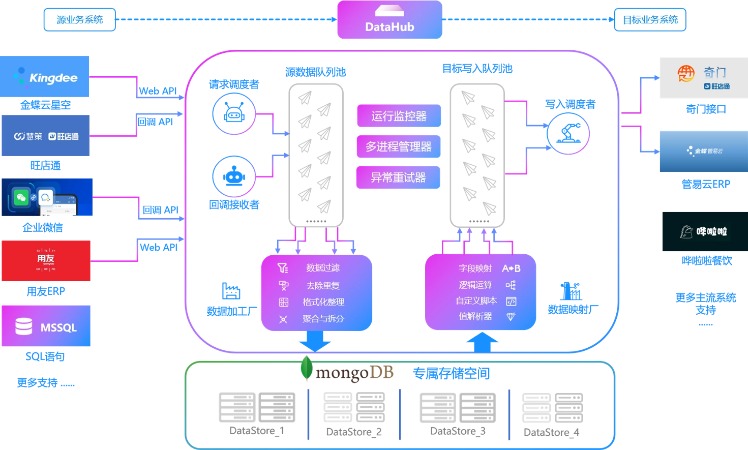
Multi-Source Data Integration Layer
The first step in building a context graph is to break down the data silos that commonly exist within enterprises and capture data from various heterogeneous systems. The main task of this layer is to connect to an enterprise's various data sources and acquire relevant data in real time or near real time. These data sources are very broad and can be roughly divided into three categories:
- Core Business Systems: These include CRM (such as Salesforce), ERP (such as SAP), HRM (Human Resource Management systems), and so on. These systems are the core of enterprise operations and record state changes of key business entities such as customers, orders, and employees.
- Collaboration and Communication Tools: These include enterprise email (such as Outlook), instant messaging tools (such as Slack and Teams), project management tools (such as Jira), and so on. These tools contain a large amount of unstructured and critically important decision context, such as email discussions, meeting minutes, and task assignments.
- Operations and Support Systems: These include monitoring systems (such as PagerDuty), customer service ticketing systems (such as Zendesk), log management platforms, and so on. These systems record the operating status of systems, fault information, and customer feedback, and are key to understanding "why problems occur."
Event Processing and Graph Construction Layer
After acquiring raw data from the multi-source data integration layer, it needs to be processed, analyzed, and correlated, ultimately building a context graph. The main functions of this layer include:
- Event Recognition and Extraction: Identify key "decision events" from raw data streams. For example, identify events such as "create order" and "update customer status" from CRM API calls; identify events such as "customer complaint" and "price negotiation" from email content through natural language processing (NLP) techniques.
- Entity Recognition and Linking: Extract related business entities from events and link them with existing entities in the graph. This process needs to solve problems such as entity disambiguation (for example, whether "Apple" is a fruit or a company) and coreference resolution (for example, who "he" refers to).
- Context Correlation and Causal Reasoning: This is the key to building the "why" chain. The system needs to correlate related decision events and entities based on temporal, spatial, logical, and other relationships. This needs to be implemented by combining rule engines, knowledge graph reasoning, and machine learning models.
Storage and Query Layer
The data model of a context graph is essentially a graph structure, and using traditional relational databases or NoSQL databases for storage and querying will be very inefficient. A graph database is specifically designed for storing and querying graph-structured data and is the ideal storage engine for context graphs. Graph databases use nodes to represent entities and edges to represent relationships between entities, and the model naturally fits the "entity-relationship-event" model of context graphs. Mainstream graph databases include Neo4j, Amazon Neptune, TigerGraph, and so on. Using graph databases enables efficient execution of complex association queries. To support efficient retrieval, vector databases are usually used in combination to store and retrieve semantic embeddings of unstructured data (such as documents and emails).
Application and Service Layer
The context graph stored in the graph database needs to be used by upper-layer AI applications. The application and service layer provides a series of APIs and services that expose the capabilities of the graph to AI agents and other enterprise applications. The services include:
- Context Query API: Supports AI agents in querying the context of a specific decision through a simple API call. For example, a renewal agent can query "the discount approval context for customer ID 123's previous order."
- Decision Recommendation Service: Based on historical precedents in the graph, provides decision recommendations for AI agents. For example, when an AI agent faces a complex customer complaint, the system can recommend "based on historical data, for this type of complaint, the most effective solution is to offer product X as compensation."
- Observability and Debugging Tools: Provides a visual interface that allows developers and business personnel to intuitively view decision trajectories, monitor AI agent behavior, and perform debugging. It is crucial for ensuring the reliability and security of AI systems.
Core Algorithm One: "The Two Clocks Problem"
"The Two Clocks Problem" is a core concept proposed by Animesh Koratana, founder of PlayerZero. It profoundly reveals the fundamental flaw of traditional systems in recording decision context and provides a theoretical foundation for the design of context graphs. The theory holds that in enterprise operations, there are two distinct yet interrelated "times" or "clocks": the state clock and the event clock. A complete and understandable decision record must contain information from both clocks at the same time.
- State Clock: The State Clock reflects a snapshot of the system at a specific moment and records "what it looks like now." Traditional enterprise software systems are almost entirely built around the state clock. Their core function is to maintain and update these states. However, the state clock itself has a fatal flaw: it is memoryless. It only cares about "now" and completely forgets "the past." Once a state is updated, the old state is overwritten, making it impossible for us to trace the reasons for and process of state changes.
- Event Clock: In contrast to the state clock is the Event Clock. The event clock does not care about "what is now"; it cares about "how things happened." It records a series of discrete events, as well as the order and causal relationships of the events. The event clock preserves all information about "why." We can see that every change in inventory quantity is caused by a specific event. This recording of the process is exactly what the context graph needs.
Why do traditional systems focus only on "state" and ignore "events"?
Traditional systems tend to record only state and ignore events for two main reasons.
- Historical Inertia. In early computer systems, storage and computing resources were very expensive, and recording the complete information of every event cost too much. System designers chose the "shortcut" of recording only the final state, which was reasonable under the technical conditions at the time.
- Technical Complexity. Processing and querying event streams is much more complex than handling simple state updates. It requires designing a complex Event Sourcing architecture and solving issues such as the ordering, consistency, and persistence of events. With technological development, storage and computing costs have dropped significantly, and at the same time, distributed event streaming platforms like Apache Kafka have matured, making it technically feasible to build systems based on the event clock.
Core Algorithm Two: Building the Organization's "World Model"
The "dual-clock problem" solved the problem of how to record decision context, while the "World Model" answers the question of how to use this context to improve AI intelligence. Building the organization's "World Model" is the ultimate goal of the context graph, aiming to enable AI systems to understand the operating patterns of the organization as deeply as human experts do, and on that basis to perform prediction, planning, and autonomous decision-making.

Definition of the "World Model"
The "World Model" is a simulator or representation internally constructed by an AI system of how the real world (here, specifically referring to an enterprise organization) operates. A well-developed "World Model" can answer counterfactual questions of the "What if..." type. For example, an IT operations AI agent with a good "World Model," upon receiving a code deployment request, should not simply execute it blindly; it should simulate within its internal "World Model": "If I deploy this new version of the code, given the current system load, dependent services, and historical failure patterns, what is the probability of a system crash?" This simulation-based reasoning capability is the key for AI to move from simple "reactive" intelligence to more advanced "planning-based" intelligence.
How to learn by accumulating AI agents' execution traces?
The organization's "World Model" is constructed and refined through continuous learning and the accumulation of AI agents' execution traces in real environments. The process can be compared to human learning: through constant practice and reflection, an understanding of the world is formed. The process includes the following steps:
- Trace Recording: Every execution process of an AI agent, whether successful or not, is completely recorded, forming an "Execution Trace." The trace includes the agent's initial state, every action taken, the environmental feedback observed, and the final execution result.
- Pattern Mining: The system mines recurring patterns and regularities from massive execution traces. For example, the system discovers that "whenever code is deployed on Friday afternoon and there is a major promotional event that day, the probability of a system crash increases significantly."
- Causal Inference: Going further, the system attempts to perform causal inference. It analyzes the causal relationship between "actions" and "results," for example, "a specific change in the code is the root cause of the memory leak and system crash."
- Model Update: New knowledge obtained through pattern mining and causal inference is used to continuously update and refine the "World Model." This process is dynamic and iterative; as AI agents run in the organization for longer and longer, the "World Model" becomes increasingly precise and comprehensive.
How does the "World Model" enhance AI's autonomous decision-making capability?
A powerful "World Model" can greatly enhance AI's autonomous decision-making capability, enabling it to handle more complex and dynamic tasks. This is specifically reflected in the following aspects:
- Proactive Planning: Based on the predictive capability of the "World Model," AI agents can perform proactive planning. For example, when formulating next quarter's sales strategy, a sales AI agent uses the "World Model" to simulate the possible outcomes of different strategies (such as increasing discounts or increasing investment in marketing activities) and chooses the optimal plan.
- Risk Mitigation: By simulating in a "world model," AI agents can foresee potential risks and take measures to avoid them. For example, before deploying a new version, a DevOps AI agent can simulate its impact on the production environment; if it finds the risk too high, it will automatically pause the deployment and issue an alert.
- Anomaly Handling: When an AI agent encounters a new situation for which it has no direct experience, it can use a "world model" to find similar precedents. For example, when a customer service AI agent encounters a type of customer complaint it has never seen before, by searching in the "world model" for "how were similar customer problems resolved?", it can find an effective solution.
- Continuous Learning: The "world model" itself is a continuously learning system. Each new decision and execution provides new data for the model, enabling it to continuously self-improve and evolve.
Business Application Scenarios of Context Graphs
As a foundational AI-enabling technology, context graphs have a very wide range of application scenarios, covering almost all aspects of enterprise operations.
Scenario One: Intelligent Customer Service and Support
- Understanding the deep intent of customer issues, rather than keyword matching: Traditional chatbots can only perform keyword matching and cannot understand the true context and urgency of customer issues. AI customer service based on context graphs can fully understand customers. When a customer initiates a conversation, the AI can immediately query the graph to obtain a complete profile of that customer: their historical purchase records, past tickets, product usage data, membership level, and even their comments about the company's products on social media. Combining this information, the AI can accurately determine the true intent and urgency of the customer's issue.
- Automating the handling of L2/L3-level complex technical support issues: Many L2/L3-level technical support issues often have solution paths that follow patterns. Context graphs can learn these patterns. By analyzing thousands of historical troubleshooting records, solutions, and expert knowledge, the graph can build a "world model" about "why systems fail." When a new failure occurs, AI agents can use this model for reasoning to quickly locate the root cause of the problem. This can greatly shorten problem resolution time and free senior engineers from repetitive troubleshooting work, allowing them to focus on more challenging tasks.
Scenario Two: Sales and Marketing
- Tracking the customer's full-lifecycle decision chain: Customer purchasing decisions are complex processes involving multiple touchpoints and influencing factors. Context graphs can fully record this "decision chain." From the customer's first click on an ad and visit to the website, to downloading a white paper and attending a webinar, to email communication with a sales representative and a product demo, and finally to signing a contract and becoming a loyal customer, all interactions and events throughout the entire process are recorded in the graph. This deep insight into the customer's full lifecycle provides valuable data support for optimizing marketing strategies and improving sales conversion rates.
- Automating sales processes and personalized marketing outreach: Based on an understanding of the customer decision chain, AI agents can automate many sales tasks. In marketing, context graphs can help enterprises achieve more precise user segmentation and personalized recommendations. By analyzing users' behavioral patterns and interest preferences, AI can push the content and products that different user groups are most interested in, significantly improving the effectiveness of marketing campaigns.
Scenario Three: Finance and Accounting
- Automating complex workflows such as month-end close and cash management: Financial workflows such as month-end close and cash reconciliation involve a large amount of data verification and manual judgment, making them time-consuming, labor-intensive, and error-prone. Context graphs can learn the decision logic in the workflow. AI agents can automatically pull data from multiple sources such as banks, ERP systems, and accounts receivable/accounts payable modules, and perform matching and reconciliation according to complex business rules. When mismatches or anomalies occur, AI agents can make intelligent judgments and handle them based on contextual information (such as customer payment notes, invoice history, contract terms, etc.).
- Audit and compliance, providing a complete decision path for every transaction: For auditing and compliance, the biggest challenge is how to trace the decision-making process behind every transaction. Context graphs solve this problem perfectly. The complete context of every financial decision is recorded, and auditors can clearly see the complete "decision path" of any transaction: under what circumstances it was approved, which policies and rules it was based on, and which people approved it. This end-to-end traceability greatly simplifies the audit process and provides strong support for enterprises to meet regulatory requirements.
Scenario Four: IT Operations and DevOps
- Quickly locating the root cause of system failures: When a system failure occurs, operations engineers need to look for clues in massive logs, monitoring data, and alert information, which is a very time-consuming process that relies on experience. Context graphs link this information together, helping engineers quickly locate the root cause of the problem.
- Predictive maintenance, learning potential risks from system behavior: By learning from historical failures and system behavior data, context graphs can build a "world model" about system stability. The model can identify potential risk patterns that may lead to system failures. For example, AI will discover that "whenever the usage rate of the database connection pool exceeds 80%, and new code is deployed at the same time, the probability of system crash increases significantly." Based on these insights, AI agents can issue warnings before risks occur, recommend that operations engineers take preventive measures, and achieve the shift from "passive response" to "active prevention."
Market opportunities and entrepreneurial directions
With the rapid development of artificial intelligence technology, enterprises are moving from simple task automation to more complex process autonomy. In this evolution, huge market opportunities are emerging, with the core being "Context Graphs," disrupting the existing enterprise software market and giving rise to the next trillion-dollar track.
According to Foundation Capital's analysis, startups can choose three distinctive development paths based on their own strengths, the maturity of the target market, and different entry points. The three paths are not mutually exclusive, but represent different strategic choices and trade-offs.
Path One: Replace Entire Systems
This is the boldest, most disruptive, and also most challenging path. The core strategy is to start from scratch and, around the execution and decision logic of AI agents, redesign and build a complete, AI-native core business system, such as CRM (Customer Relationship Management) or ERP (Enterprise Resource Planning). The system's architecture naturally supports Event Sourcing and policy capture, making the recording of decision trajectories a core function of the system. Startups choosing this path usually target areas where existing system architectures are outdated and difficult to adapt to the needs of the AI era, and where the market is in a period of technological or business model transformation, providing a window of entry for disruptors.
Path Two: Replace Modules Instead of the Entire System (Replace Modules)
Compared with the disruptive innovation of "rebuilding the entire system," the "replace modules" path is a more pragmatic and gradual strategy. The core idea of this path is not to attempt to replace the entire huge and complex existing system (such as ERP) all at once, but to focus on a specific sub-workflow or functional module within it where pain points are obvious. Modules are usually where exception handling and approval processes are highly concentrated in an enterprise, full of complex business logic and human judgment. By providing highly intelligent solutions, startups specialize in handling complex sub-workflows, thereby becoming the authoritative system of record for decisions in that domain. They then synchronize the final execution results or status back to the core existing system (such as the general ledger system).
Path Three: Create New Systems (Create New Systems)
This path differs from the previous two. It focuses on an entirely new, AI-driven domain, creating unprecedented systems. The core strategy of this path is to start from the "orchestration layer" of AI agents, focusing on persistent storage and association of cross-system decision trajectories that have never been recorded in traditional systems. Startups provide an underlying, reusable "context infrastructure" that allows other AI applications to build on top of it. The goal is to become the "source of truth" and "central repository" for all enterprise decision trajectories.
Challenges and Future Outlook
Key Challenges
Technical Challenges
- Complexity of Data Integration: How to extract, clean, and associate in real time and accurately from an enterprise's massive, heterogeneous raw data (from structured databases to unstructured conversations) into semantically coherent context is the primary technical barrier.
- Scale and Performance of Graphs: When a graph expands to billions of nodes and relationships, how to ensure the real-time performance of complex, multi-hop queries is a continuous test for the underlying graph database and computing architecture.
Market and Cognitive Challenges
- Obstacles to Conceptual Change: One of the biggest challenges is educating the market. Enterprises need to shift from the traditional data mindset of "recording results" to the decision-making mindset of "recording processes," which requires time and guidance from successful cases.
- Lack of Standards and Ecosystem: As an emerging paradigm, the industry has not yet established unified model definitions, evaluation standards, and interoperability specifications. The lack of a "common language" will slow down technology adoption and ecosystem formation.
Future Evolution Directions
In the future, enterprises will operate through the collaboration of multiple specialized AI agents (sales, customer service, operations, etc.). The context graph will evolve into their "shared memory hub," recording not only individual decisions but also the collaboration, negotiation, and consensus-building processes among agents, making collective intelligence possible. In the long term, context graphs built by different enterprises can be securely aggregated and anonymized to form a more universally applicable industry-level "world model." This will precipitate industry best practices and deep patterns, empower more powerful general AI, and provide valuable "industry common sense" for new players.