
What is ContentV
ContentV is ByteDance's open-source 8-billion-parametertext-to-videomodel framework. It replaces the 2D-VAE of Stable Diffusion 3.5 Large with a 3D-VAE and introduces 3D positional encoding, enabling the image model to quickly acquire video generation capabilities. For training, it adopts a multi-stage strategy: first using video data to establish temporal representations, then jointly training on images and videos, bucketing by video duration and aspect ratio and using a dynamic batch size mechanism to optimize memory, progressively training by first increasing duration and then resolution, and using the Flow Matching algorithm to improve efficiency. For reinforcement learning, it adopts a cost-effective framework that requires no additional manual annotation and improves generation quality through supervised fine-tuning and reinforcement learning from human feedback. It builds a distributed training framework using NPUs with 64GB of memory, enabling efficient training of 480P, 24FPS, 5-second videos. On VBench, ContentV's long-video total score is 85.14, second only to Wan2.1-14B, and its human preference scores outperformCogVideoXandHunyuanVideo。
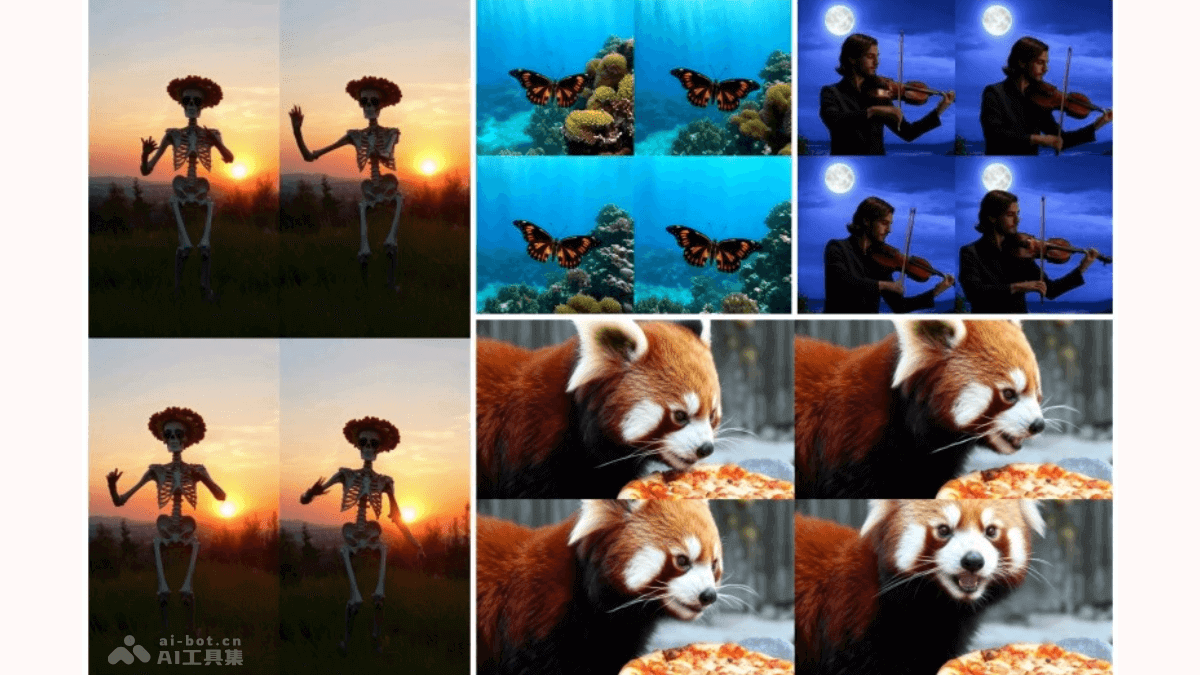
ContentV's main features
- Text-to-video generation: After users input a text description, ContentV can generate various types of videos based on the text content.
-
Custom video parameters: Users can specify parameters such as video resolution, duration, and frame rate to generate videos that meet specific needs. For example, generating high-definition 1080p videos, or creating 15-second short videos suitable for social media, etc.
-
Style transfer: ContentV supports applying a specific style to generated videos. For example, applying oil painting style, anime style, or retro style to video content, giving the generated videos a unique artistic effect.
-
Style fusion: Users can fuse multiple styles together to create unique visual effects. For example, combining science fiction style with cyberpunk style to generate futuristic video content.
-
Video continuation: Users can provide a video as input, and ContentV can continue the subsequent video plot based on the content and style of the input video, enabling expansion of video content.
-
Video modification: Users can modify generated videos, such as changing scenes or character actions in the video, to meet different creative needs.
-
Video-to-text description: ContentV can provide text descriptions for generated videos, helping users better understand video content and enabling bidirectional interaction between video and text.
ContentV's technical principles
-
Minimalist architecture: ContentV adopts a minimalist architecture, maximizing reuse of pre-trained image generation models for video generation. Its core change is replacing the 2D-VAE in Stable Diffusion 3.5 Large (SD3.5L) with a 3D-VAE and introducing 3D positional encoding.
-
Flow Matching: ContentV uses the Flow Matching algorithm for training, achieving efficient sampling through direct probability paths in continuous time. The model is trained to predict velocity, which guides noise samples toward data samples, optimizing model parameters by minimizing the mean squared error between the predicted velocity and the true velocity.
-
Progressive training: ContentV adopts a progressive training strategy, starting training with low-resolution, short-duration videos and gradually increasing duration and resolution. This helps the model better learn temporal dynamics and spatial details.
-
Multi-stage training: The training process is divided into multiple stages, including pretraining, supervised fine-tuning (SFT), and reinforcement learning from human feedback (RLHF). The pretraining stage is conducted on large-scale data to learn basic image and video generation capabilities; the SFT stage is conducted on a high-quality data subset to improve the model's instruction-following ability; the RLHF stage further optimizes generation quality through human feedback.
-
Reinforcement Learning from Human Feedback: ContentV adopts a cost-effective reinforcement learning with human feedback framework to improve generation quality without the need for additional manual annotation. By optimizing the model to maximize the reward model's score and regularizing the KL divergence from the reference model, the model can generate videos that better align with human expectations.
-
Efficient Distributed Training: ContentV uses NPUs with 64GB of memory to build a distributed training framework. By decoupling feature extraction and model training, integrating an asynchronous data pipeline, and using a 3D parallelism strategy, it achieves efficient training for 480P resolution, 24FPS, 5-second videos.
ContentV's project address
- Project Website:https://contentv.github.io/
- Github Repository:https://github.com/bytedance/ContentV
- HuggingFace Model Library:https://huggingface.co/ByteDance/ContentV-8B
- arXiv Technical Paper:http://export.arxiv.org/pdf/2506.05343
ContentV's application scenarios
-
Video Content Creation: Teachers can generate animations or live-action videos related to course content by entering simple text descriptions, enhancing the fun and interactivity of teaching.
-
Game Development: In game development, ContentV can generate animated clips or cutscene videos in games, helping developers quickly create rich game content.
-
Virtual Reality (VR) and Augmented Reality (AR): Videos generated by ContentV can be used in VR and AR applications to provide users with an immersive experience.
-
Special Effects Production: In film and television production, ContentV can generate complex special effects scenes, such as science fiction scenes, fantasy elements, etc., helping special effects teams quickly realize their ideas.