
What is ConsisID
ConsisID is a text-to-video (Text-to-Video, IPT2V) generation model launched by institutions such as Peking University and Pengcheng Laboratory. It maintains the identity consistency of characters in videos based on frequency decomposition technology. The model uses a tuning-free Diffusion Transformer (DiT) architecture, combines low-frequency global features and high-frequency intrinsic features, and uses a hierarchical training strategy to generate high-quality, editable videos with strong identity consistency. ConsisID surpasses existing technologies in multiple evaluation dimensions and advances the development of identity-consistent video generation technology.
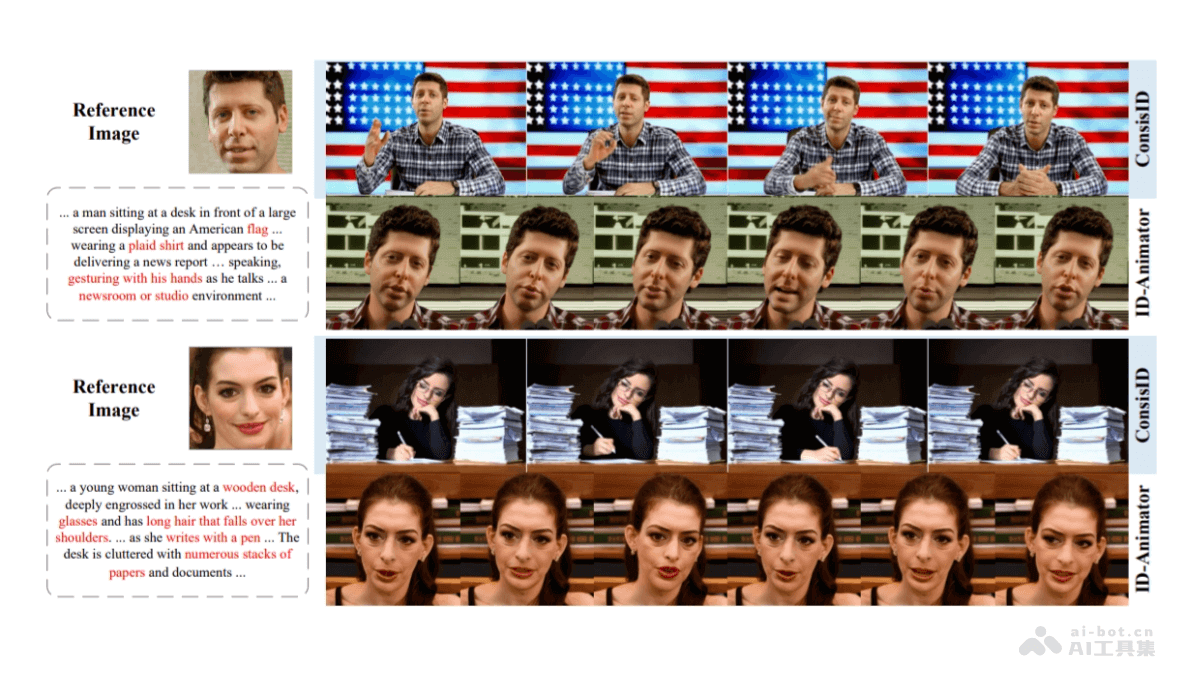
ConsisID's main features
- Identity preservation: Maintains the consistency of a person's identity during video generation, ensuring that the character features in the video match the provided reference image.
- High-quality video generation: Generates visually realistic video content with rich details.
- No fine-tuning required: As a tuning-free model, it does not require fine-tuning for each new case, lowering the barrier to use.
- Editability: Supports users in controlling video content with text prompts, including character actions, expressions, and background, etc.
- Generalization ability: Can handle people outside the training data domain, improving the model's generalization ability.
ConsisID's technical principles
- Frequency decomposition:
- Low-frequency control: Uses a global face feature extractor to encode the reference image and facial key points into low-frequency features, which are integrated into the shallow layers of the network to ease training difficulty.
- High-frequency control: Designs a local face feature extractor to capture high-frequency details and inject them into the Transformer module, enhancing the model's ability to preserve fine-grained features.
- Hierarchical training strategy:
- Coarse-to-fine training: First lets the model learn global information, then refines it to local information, maintaining the consistency of the video in spatial and temporal dimensions.
- Dynamic Mask Loss: Uses a face mask to constrain the calculation of the loss function, focusing the model on the face region.
- Dynamic Cross-Face Loss: Introduces cross-face reference images to improve the model's generalization ability to unseen identities.
- Feature fusion: Uses a face recognition backbone network and CLIP image encoder to extract features, fuses features based on Q-Former, and generates intrinsic identity features containing high-frequency semantic information.
- Cross-attention mechanism: Based on the cross-attention mechanism, the model can interact with visual tokens generated by the pretrained model, effectively enhancing high-frequency information in DiT.
ConsisID's project address
- Project official website:pku-yuangroup.github.io/ConsisID
- GitHub repository:https://github.com/PKU-YuanGroup/ConsisID
- HuggingFace model library:https://huggingface.co/datasets/BestWishYsh/ConsisID
- arXiv technical paper:https://arxiv.org/pdf/2411.17440
- Online experience Demo:https://huggingface.co/spaces/BestWishYsh/ConsisID
ConsisID's application scenarios
- Personalized entertainment: Users create virtual avatars similar to themselves or a specified person, for use on social media platforms or for personal entertainment.
- Virtual anchors: In news broadcasting or online live streaming, virtual anchors generated by ConsisID can work uninterrupted 24 hours a day.
- Film and television production: used in film post-production to generate characters in special effects scenes, or to create entirely new virtual characters.
- Game industry: provide prototypes for game character design, or generate non-player characters (NPCs) in games that resemble the player.
- Education and simulation training: create historical figures or simulate specific scenarios for educational purposes or professional training, such as medical simulation, driving training, etc.