
What is Consensus
Consensus is an AI-driven academic search engine based on large language models (LLMs) and vector search technology, helping users quickly retrieve and understand scientific literature. The platform provides over 200 million peer-reviewed research papers and, through AI tools such as Consensus Meter and Copilot, offers users an intuitive search experience and answers supported by scientific research literature. Consensus aims to simplify the academic research process, enabling researchers, students, and professionals to conduct literature reviews and obtain authoritative scientific answers more efficiently. Consensus's user-friendly interface and advanced features, such as paper reading and interactive querying, and team collaboration tools, support a wide range of research and academic activities, making scientific knowledge easier to access and understand.
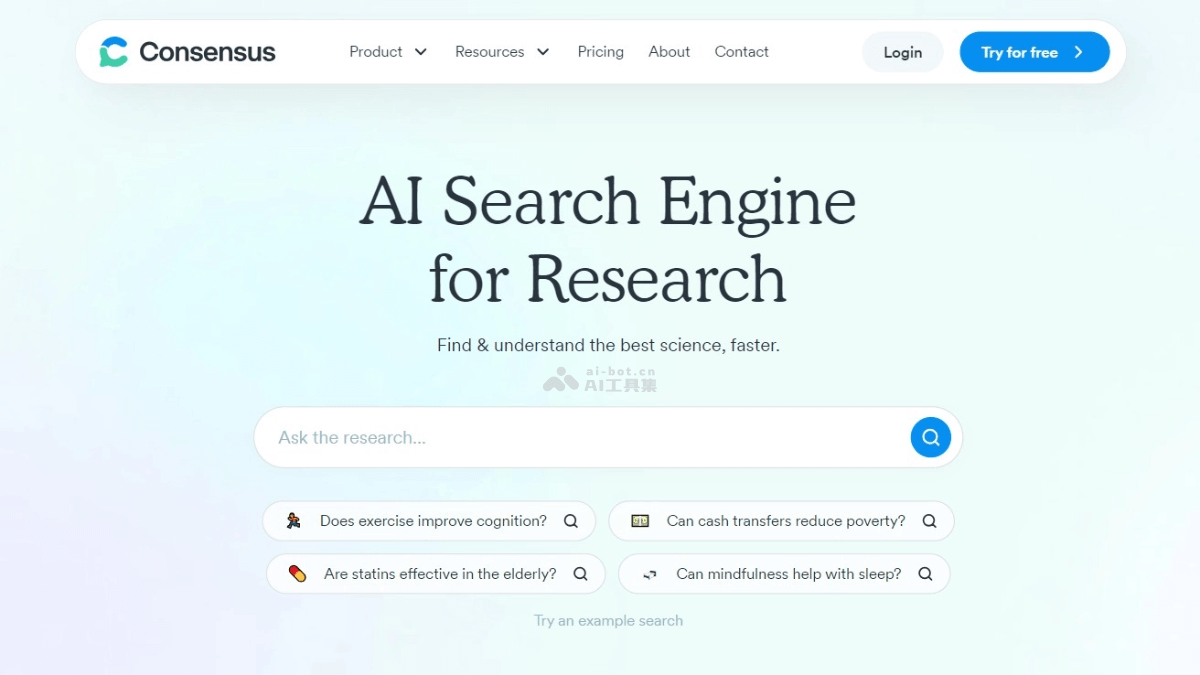
Consensus's main features
- Quick search: Provides quick access to over 200 million peer-reviewed scientific papers.
- AI-generated summaries: Automatically generates summaries of research papers based on AI technology, helping users quickly understand the research content.
- Consensus Meter: Shows the degree of consensus on a question or claim, helping to quickly understand the general views in a research field.
- Evidence-supported answers: Provides answers supported by evidence from scientific research, increasing the credibility of the information.
- Preventing misleading information: Cross-validates information based on AI algorithms, reducing the spread of misinformation.
- ChatGPT 4 summaries: Provides more accurate and relevant research summaries based on advanced language models.
Consensus's official product website
- Official product website:consensus.app
Consensus's application scenarios
- Academic research: Researchers use Consensus to quickly find the latest and most relevant scientific papers related to a research topic.
- Literature review: Students and scholars use Consensus to collect and summarize key literature when writing papers or reports.
- Evidence-based decision-making: Policymakers and professionals rely on evidence-supported information provided by Consensus to make data-based decisions.
- Medical research: Doctors and medical researchers use Consensus to obtain the latest medical research and clinical trial results.
- Education: Teachers and students use Consensus to assist with coursework, research projects, and academic discussions.
- Content creation: Writers, bloggers, and journalists use Consensus to research topics, verify facts, and cite authoritative sources.