
What is ConceptMaster
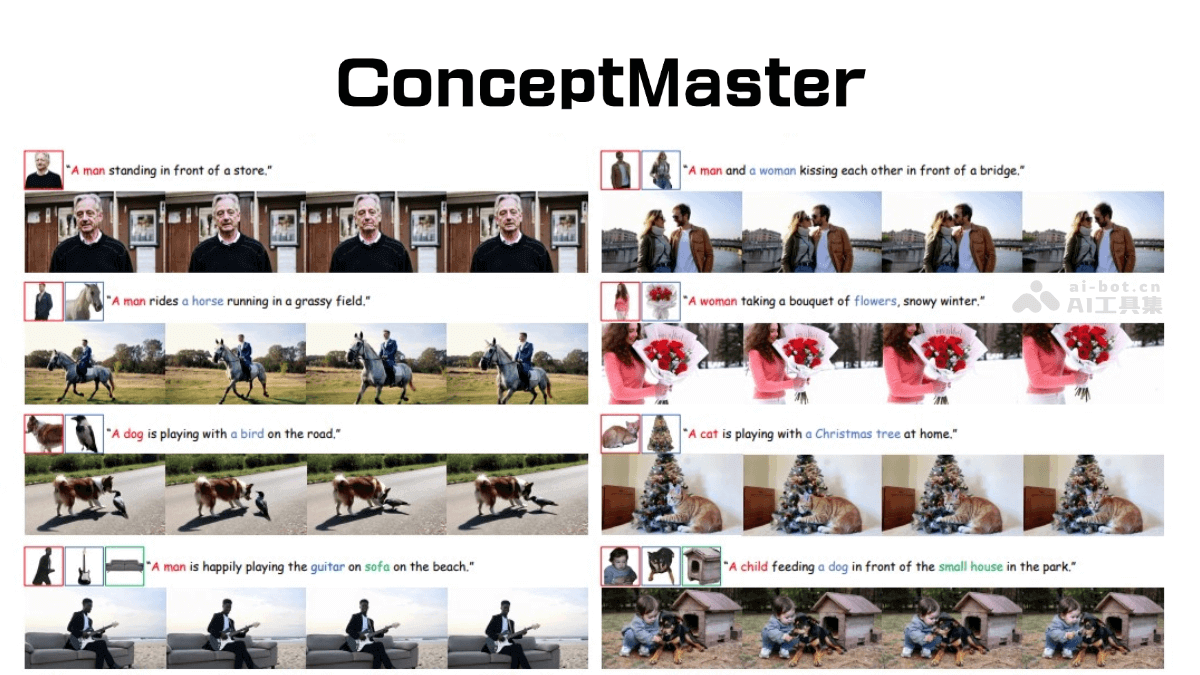
ConceptMaster is an innovative framework for multi-concept video customization that can generate high-quality and concept-consistent customized videos on diffusion Transformer models without test-time tuning. By learning decoupled multi-concept embeddings and independently injecting them into the diffusion model, the framework effectively solves the identity decoupling problem in multi-concept video customization, and can ensure the fidelity of each concept even when faced with highly similar visual concepts.
Main Features of ConceptMaster
- Multi-Concept Video Customization: It can generate high-quality customized videos containing multiple concepts based on multiple given reference images, without the need for additional test-time tuning. For example, based on the reference images of "a man playing guitar by the sea" and "a woman kissing in front of a bridge", it can generate videos of the corresponding concepts.
- Solving the Identity Decoupling Problem: By learning decoupled multi-concept embeddings and injecting them into the diffusion model in an independent manner, it effectively ensures the quality of customized videos with multiple identities, and can accurately distinguish the attributes of different concepts, maintaining their uniqueness even for highly similar visual concepts.
- High-Quality Data Collection: A data construction pipeline was carefully established, which can systematically collect precise multi-concept video entity data across different concepts, providing strong support for training models that can well represent and decouple various concepts. More than 1.3 million video entity pairs covering humans, creatures, and various object categories were collected.
- Comprehensive Benchmark Testing: A comprehensive benchmark was designed to validate the effectiveness of the model from three key dimensions: concept fidelity, identity decoupling capability, and video generation quality. It covers six different concept combination scenarios, providing a comprehensive reference for evaluating the performance of multi-concept video customization models.
Technical Principles of ConceptMaster
- Diffusion Transformer Model Foundation: ConceptMaster is built on a Transformer-based latent diffusion model. The model uses a 3D Variational Autoencoder (3D-VAE) to convert videos from pixel space to latent space, and builds the Transformer model on this basis.
- Multi-Concept Embedding Learning and Injection
- Visual Concept Representation Extraction: A CLIP image encoder is used to extract dense visual tokens from given reference images, and then a learnable Q-Former network uses these tokens as a key-value library for querying, extracting a more comprehensive visual semantic representation.
- Decoupled Internal Pair Embedding: The extracted visual representation is combined with the corresponding text labels to create multimodal concept representations. Unlike methods that directly combine visual representations with caption embeddings, ConceptMaster uses a T5 encoder to encode each concept label separately, and then introduces a Decoupled Attention Module (DAM) to perform internal pairwise attention operations on each pair of visual and text label embeddings, fully mining the text label information and enhancing the specific representation of each concept.
- Multi-Concept Embedding Combination and Injection: The multimodal representation of each concept is combined into a composite embedding, and then a Multi-Concept Injector (MC-Injector) is designed to embed it into the diffusion Transformer model in a cross-attention manner. As an additional dedicated cross-attention layer, MC-Injector is located after the original text cross-attention layer in each Transformer block, and can effectively learn concepts without interference from the original text cross-attention, enhancing the representation of multiple identities.
- Data Construction Pipeline
- Fast filtering of inappropriate videos: Over 6.4 million videos were collected from the internet as source data. PySceneDetect was used to filter out videos containing scene transitions, and videos with low optical flow scores as well as videos with low lighting contrast were removed, ensuring that the basic attributes of the video data are maintained at a high standard.
- Fine-grained identity information extraction: Accurately extract the region and text label of each identity. Using LISA (an MLLM-based segmenter) to input text prompts and images, and relying on strong visual reasoning capabilities to extract entity masks, remove masks that are too large or too small or highly fragmented, derive box regions from these masks, and remove misclassified regions through CLIP classification.
- Joint training with auxiliary datasets: In addition to the constructed MCVC data, ConceptMaster also uses auxiliary datasets to enhance concept representation. BLIPDiffusion's single-concept image dataset (about 300,000) was replicated to enhance highly specific concepts, while the CelebV single-concept video dataset (about 60,000) was incorporated to improve person representation. The data sampling ratio for the constructed data, BLIP-Diffusion, and CelebV is 8:1:1.
ConceptMaster's project address
- Project website:https://yuzhou914.github.io/ConceptMaster
- arXiv technical paper:https://arxiv.org/pdf/2501.04698
ConceptMaster's application scenarios
- Video content creation: Film and TV production teams can use ConceptMaster to quickly generate concept videos containing multiple characters and props based on specific scene descriptions in the script, providing creative references and visual guidance for actual filming.
- Animation production: Animators can use ConceptMaster to generate preliminary versions of animation clips based on character designs and storylines, improving creative efficiency.
- Game development: Game developers can use ConceptMaster to generate video content such as cutscenes and character action demonstrations in games, enriching the game's plot presentation and character development.
- Product display and promotion: Enterprises can use ConceptMaster to create product promotional videos, integrating multiple concepts such as the product's appearance, functions, and usage scenarios into a single video.