
What is Concept Lancet
Concept Lancet (CoLan) is a zero-shot, plug-and-play image editing framework introduced by a research team at the University of Pennsylvania. Concept Lancet is based on sparse decomposition of images in latent space, representing images as linear combinations of visual concepts, and performing precise concept transplantation according to editing tasks (such as replacing, adding, or removing concepts). CoLan uses the CoLan-150K dataset, which contains descriptions of over 150,000 visual concepts, to accurately estimate the degree of presence of each concept, achieving precise and visually consistent image editing.
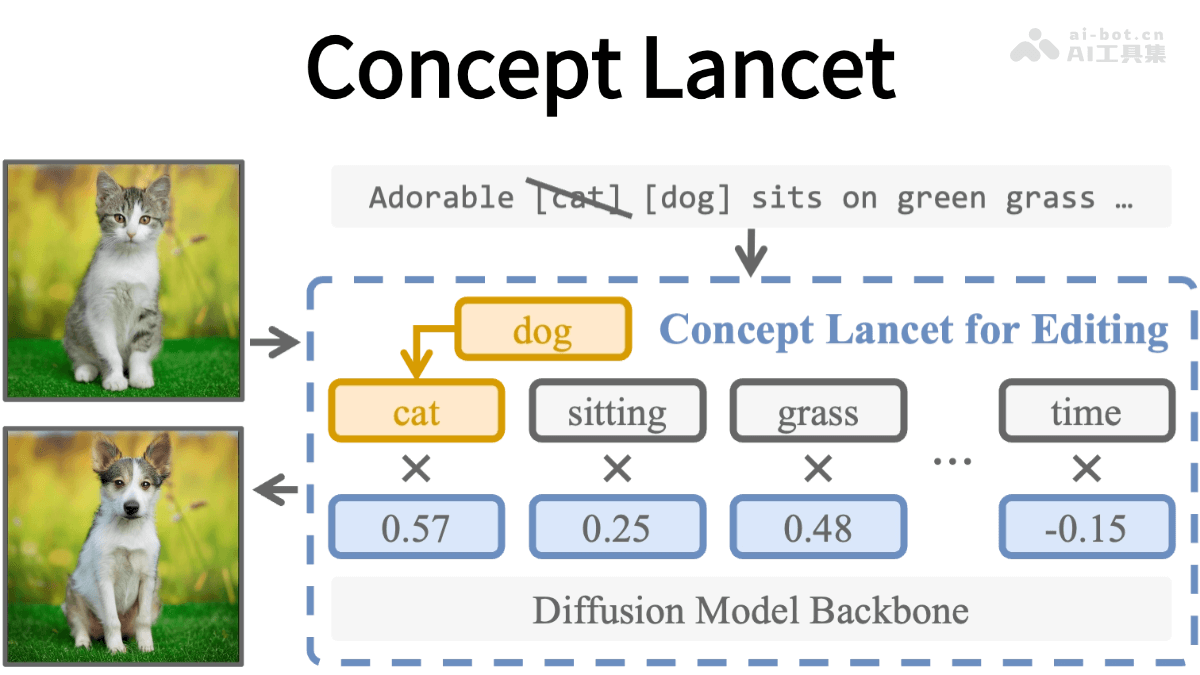
Main Features of Concept Lancet
- Precise Concept Replacement: Supports accurately replacing one concept in an image with another concept (such as replacing "cat" with "dog").
- Concept Addition and Removal: Supports adding new concepts to an image (such as "add watercolor style") or removing existing concepts (such as "remove clouds in the background").
- Visual Consistency Preservation: During the editing process, maintains the overall visual consistency of the image, avoiding visual distortion caused by over-editing or under-editing.
- Zero-Shot Plug-and-Play: Supports direct application to existing diffusion models without retraining or fine-tuning the model, offering strong generality and flexibility.
Technical Principles of Concept Lancet
- Concept Dictionary Construction:
- Visual Concept Extraction: A vision-language model (VLM) parses the input image and prompt, generating a list of visual concepts related to the editing task. Concepts include objects, attributes, scenes, etc.
- Concept Stimulus Generation: A large language model (LLM) generates diverse descriptions and scenarios for each concept (called concept stimuli), capturing the manifestations of the concept in different contexts.
- Concept Vector Extraction: Maps concept stimuli to the latent space of the diffusion model (such as text embedding space or score space), extracts a representative vector for each concept, and forms a concept dictionary.
- Sparse Decomposition: Decomposes the latent representation of the input image (such as text embeddings or scores) into a linear combination in the concept dictionary. Based on solving sparse coefficients, estimates the degree of presence of each concept in the source image. Minimizes reconstruction error and regularization terms (such as L1 regularization) to solve the sparse coefficients, ensuring that the decomposition result is both accurate and concise.
- Concept Transplantation: Adjusts the decomposed coefficients according to the editing task (replacement, addition, removal). For example, replaces the coefficient of the source concept with the coefficient of the target concept to achieve precise concept transplantation. Recombines the adjusted coefficients into a new latent representation, and generates the edited image based on the generation process of the diffusion model.
- Dataset Support: To fully model the concept space, constructs a dataset containing descriptions and scenarios of over 150,000 visual concepts. Concept stimuli provide rich contextual information for each concept, making concept vectors more accurate and robust.
Project Address of Concept Lancet
- Project Website:https://peterljq.github.io/project/colan/
- GitHub Repository:https://github.com/peterljq/Concept-Lancet
- arXiv Technical Paper:https://arxiv.org/pdf/2504.02828
Application Scenarios of Concept Lancet
- Creative Design: Quickly transforms sketches into artwork, adds brand elements, and improves design efficiency.
- Film and Television Production: Quickly generate concept art and scene designs, modify character appearances, and adapt to different storylines.
- Game Development: Generate game scenes and character variants, from day to night, improving development efficiency.
- Education and Training: Generate teaching illustrations, convert historical scenes into modern scenes, and help students understand.
- Social Media: Convert ordinary photos into artistic styles, add eye-catching elements, and increase content appeal.