
What is ComoRAG
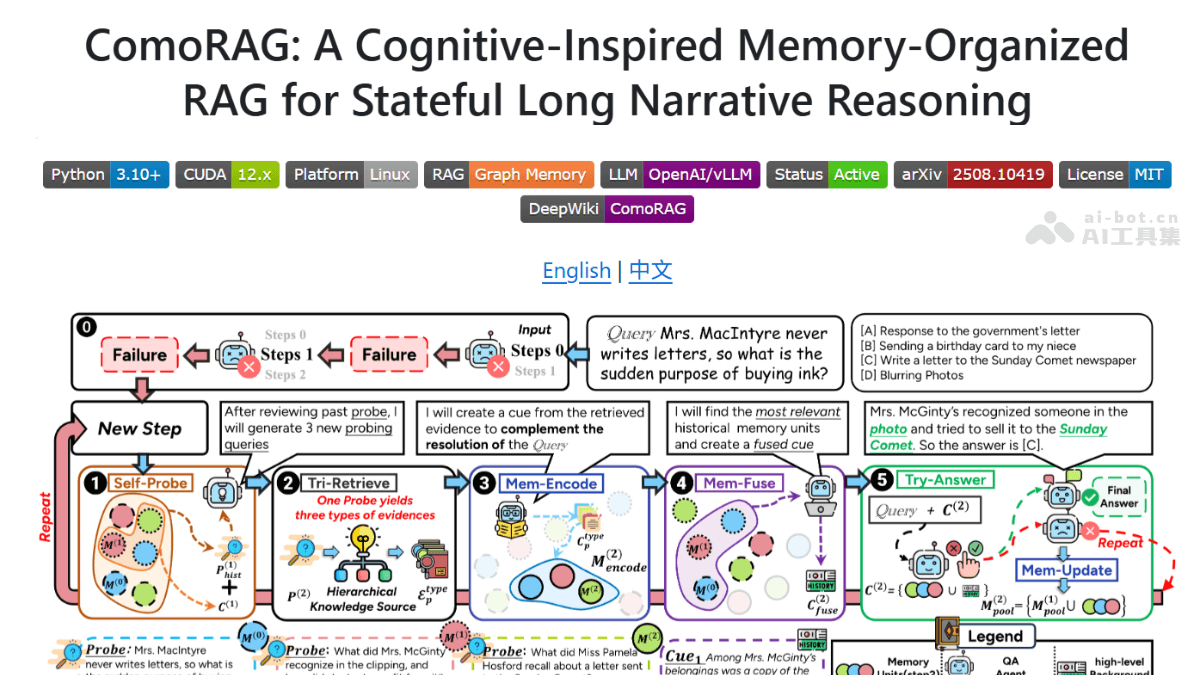
ComoRAG is a cognitively inspiredretrieval-augmented generation(RAG) framework jointly launched by the School of Future Technology at South China University of Technology, the WeChat AI team, and other institutions, specifically for understanding and reasoning over long narrative texts. ComoRAG can simulate the function of the human brain's prefrontal cortex, based on a dynamic memory workspace and iterative reasoning loops, integrating fragmented evidence into coherent context to achieve stateful long-form narrative reasoning. In multiple long-text narrative benchmark tests, ComoRAG significantly outperforms traditional RAG methods and performs excellently on complex queries that require global understanding.
Main Features of ComoRAG
- Long-form narrative understanding: Can handle complex plots and character relationships, solving complex problems that require global understanding.
- Dynamic memory and iterative reasoning: Gradually builds and updates understanding of the narrative, progressively forming coherent context.
- Multi-level knowledge indexing: Builds multi-level knowledge indexes at the factual, semantic, and episodic layers, supporting multi-dimensional reasoning from details to abstractions.
- Efficient retrieval and generation: Assists in generating answers based on retrieved relevant evidence, significantly improving the efficiency and accuracy of processing long texts.
Technical Principles of ComoRAG
- Dynamic memory workspace: The core of ComoRAG is the dynamic memory workspace, used to store and update memory units during the reasoning process. Each memory unit contains a probing question, the retrieved evidence, and clues on how the evidence helps solve the original problem.
- Iterative reasoning loop: When encountering a reasoning bottleneck, ComoRAG automatically initiates an iterative reasoning loop. In each loop, Self-Probe generates new probing questions to explore new information paths. Tri-Retrieve retrieves relevant evidence from the multi-level knowledge index. Mem-Encode encodes the retrieved evidence into new memory units. Mem-Fuse fuses new memory units with past memory units to generate more comprehensive clues. Try-Answer attempts to answer the original question with the new clues and evidence; if it fails, it proceeds to the next loop.
- Multi-level knowledge indexing:
- Veridical Layer: Built from original text fragments to ensure reasoning is based on factual evidence.
- Semantic Layer: Captures the themes and conceptual structure of the text through semantic clustering and summarization.
- Episodic Layer: Reconstructs the flow of the narrative and plot development through sliding window summarization.
- Cognitive regulation mechanism: Simulates the cognitive regulation mechanism of the human brain's prefrontal cortex, continuously evaluating and revising understanding of the narrative based on dynamic memory and iterative reasoning, achieving truly stateful reasoning.
ComoRAG Project Address
- GitHub Repository:https://github.com/EternityJune25/ComoRAG
- arXiv Technical Paper:https://arxiv.org/pdf/2508.10419
Application Scenarios of ComoRAG
- Literary work analysis: Helps researchers and students deeply understand complex plots and character relationships in literary works, answering deep narrative questions, such as analyzing Snape's behavioral motivations in "Harry Potter".
- Film and television script optimization: Assists film and television production teams in organizing script plots, ensuring story coherence and logic, and optimizing script content.
- Educational assistance tools: In the field of education, enhance students' reading comprehension and critical thinking skills, helping users better analyze long reading materials.
- Intelligent Q&A System: Build an intelligent Q&A platform to handle complex narrative questions posed by users and provide accurate and coherent answers.
- Content Creation Assistant: Provide plot organization and optimization suggestions for creators such as novelists and screenwriters to ensure the coherence and appeal of storylines.