
What Is ComfyGen
ComfyGen is a text-to-image generation system introduced by researchers from NVIDIA and Tel Aviv University. It automatically creates workflows that match user text prompts based on large language models (LLMs), improving the quality of image generation. The system addresses the limitations of traditional monolithic models in image generation by combining multiple specialized components such as fine-tuned base models, LoRAs, embeddings, and super-resolution steps to build complex workflows. ComfyGen proposes two LLM-based methods: one is a tuning method based on user preference data, and the other is a training-free method that directly selects existing pipelines. Both methods show higher image quality than traditional models or general-purpose workflows.
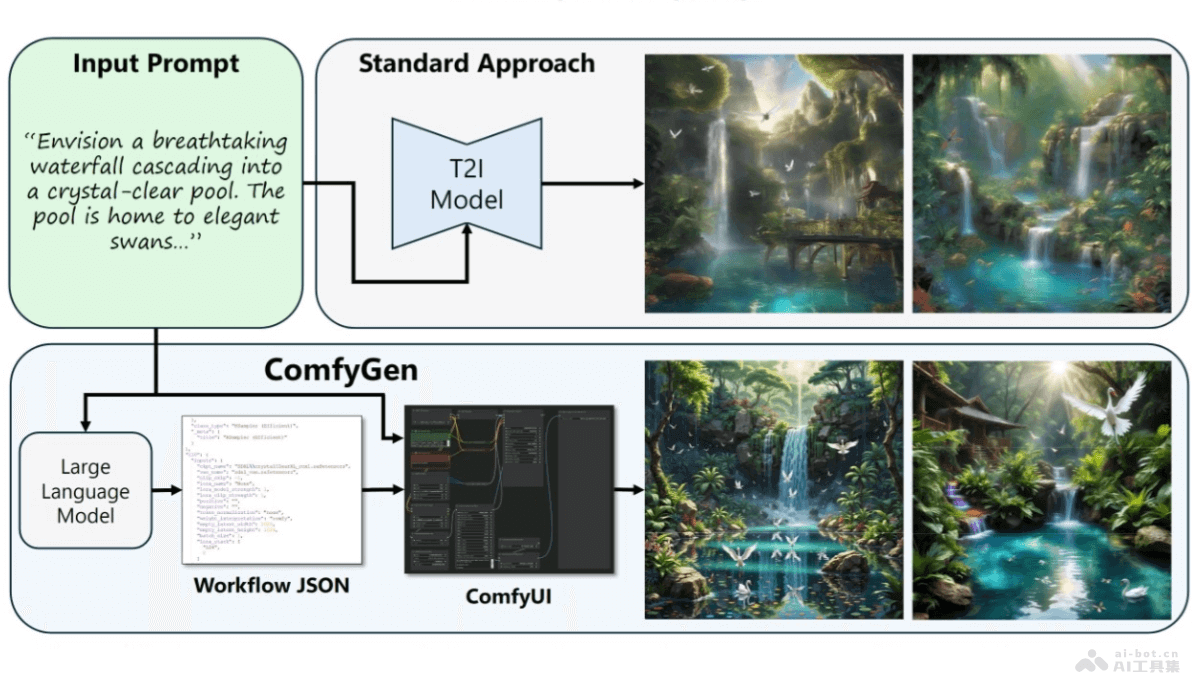
Main Features of ComfyGen
- Adaptive Workflow Generation: Automatically creates the most suitable image generation workflow based on the user's text prompt.
- Multi-Component Collaboration: Combines multiple specialized components such as fine-tuned base models, LoRAs, embeddings, and super-resolution steps to build complex workflows.
- Quality Improvement: Improves the quality of generated images based on optimized workflows, making them better match the user's text prompt.
- Automated Process Design: Reduces the professional knowledge required to design effective workflows, and the automated process design adapts to different text prompts.
- LLM Prediction Integration: Predicts and selects the image generation process that best matches the text prompt based on a large language model (LLM).
Technical Principles of ComfyGen
- Data Collection and Training Set Construction: The researchers collected a set of human-created ComfyUI workflows and augmented the dataset by randomly swapping workflow parameters (such as base models, LoRAs, samplers, etc.). Images were generated using a set of text prompts, and the images were scored based on aesthetics and human preference predictors, forming a triplet dataset containing prompts, workflows, and scores.
- LLM Prediction: ComfyGen predicts the optimal workflow for a given text prompt based on an LLM. Two methods are involved:
- In-Context Method (ComfyGen-IC): Provides the LLM with a table containing workflows and their scores in different categories, and asks it to select the most suitable workflow for a new text prompt.
- Fine-Tuning Method (ComfyGen-FT): Fine-tunes an LLM to predict, given a text prompt and a target score, a workflow that can achieve the target score.
- Workflow Generation: During inference, ComfyGen takes a text prompt and a high score as input, and the LLM predicts a workflow that matches the conditions.
- Image Generation and Evaluation: Uses the predicted workflow to generate images, and evaluates the generated images using human preference and image quality evaluation metrics.
ComfyGen Project Address
- Project Website:comfygen-paper.github.io
- arXiv Technical Paper:https://arxiv.org/pdf/2410.01731v1
Application Scenarios of ComfyGen
- Artistic Creation: Artists and designers use ComfyGen to generate images with specific styles and themes, accelerating the creative process and exploring new visual concepts.
- Game Development: Game developers use ComfyGen to quickly generate backgrounds, character concept art, or other game elements in game environments, improving development efficiency.
- Advertising and Marketing: Marketing teams use ComfyGen to design advertising images and marketing materials, ensuring they match the ad copy and brand messaging.
- Film and entertainment industry: Filmmakers and visual effects teams use ComfyGen to create concept art or special effects images for scenes in films, assisting with pre-production and visual effects design.
- Education and research: Educators and researchers use ComfyGen to generate illustrations for teaching materials and create precise images when performing scientific visualization.