
What is Collaborative Gym
Collaborative Gym (Co-Gym) is a framework focused on Human-Agent Collaboration, supporting real-time interaction and collaboration between humans and AI agents. Through both simulated and real experimental conditions, it supports developers in iterative development within a controlled environment while also enabling deployment and evaluation of collaboration effectiveness in real-world scenarios. Co-Gym supports asynchronous interaction and can handle three-way interactions among agents, humans, and the task environment.
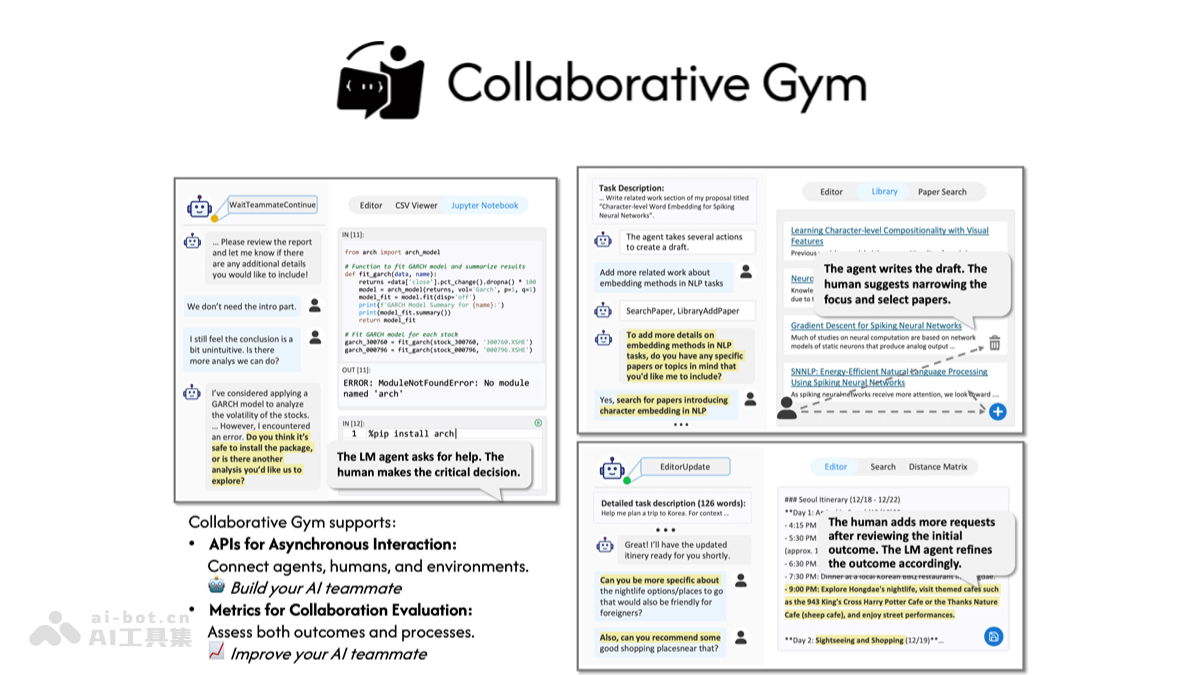
Main features of Collaborative Gym
- Supports asynchronous interaction: Co-Gym breaks through the limitation of synchronous actions in traditional multi-agent frameworks, supporting humans and AI agents to flexibly initiate actions during collaboration without requiring strictly sequential interaction. This is closer to real human collaboration patterns.
- Task environment design: Co-Gym defines each task as a partially observable Markov decision process (POMDP), supporting public and private observation spaces. The public part is visible to all participants, while the private part is visible only to its owner, similar to the distinction between a shared whiteboard and personal notes in a human team.
- Evaluation framework: Co-Gym focuses on the outcome of task completion and values the collaboration process itself. It provides a comprehensive evaluation framework that evaluates agents from two dimensions: collaboration quality and collaboration process.
- Simulated and real conditions: Co-Gym supports both simulated and real experimental conditions. The simulated condition uses pre-collected task instances and simulated human behavior, facilitating rapid iterative development; the real condition supports collaboration with real humans in actual task environments, supporting a variety of tasks such as travel planning, literature review, and table analysis.
Technical principles of Collaborative Gym
- Collaboration-driven environment design: Co-Gym draws on the design ideas of OpenAI Gym and optimizes them for human-agent collaboration. It supports defining public and private parts in the observation space: the public part is visible to all participants, while the private part is visible only to its owner. It simulates the distinction between shared information and personal notes in real collaboration scenarios.
- Asynchronous interaction: Co-Gym supports asynchronous interaction, allowing humans and agents to act independently when necessary without waiting for the other party's response. To this end, Co-Gym introduces two collaborative behaviors: sending a message (SendTeammateMessage) and waiting for the other party to continue (WaitTeammateContinue), using a notification protocol to notify participants of environmental changes in real time.
- Notification protocol: Co-Gym implements the notification protocol through a Redis server, supporting four event types: shared observation updates, private observation changes, new message notifications, and environment inactivity timeout notifications. This enables agents to monitor environmental changes in real time and collaborate better with humans.
- Task environment interface (CoEnv): Co-Gym provides a flexible task environment interface, allowing developers to easily add new task environments. Developers only need to define the task description, action space, and observation space. Co-Gym supports a variety of task environments, such as travel planning, literature review, and tabular data analysis.
Project address of Collaborative Gym
- Github repository:https://github.com/SALT-NLP/collaborative-gym
- arXiv technical paper:https://arxiv.org/pdf/2412.15701
Application scenarios of Collaborative Gym
- Travel Planning: In the travel planning task, Co-Gym supports humans and AI agents in collaborating to create a detailed travel itinerary. Agents can contribute based on search and planning capabilities, while humans can provide preferences and expertise, jointly completing the travel plan.
- Tabular Analysis: Co-Gym provides agents and humans with a shared workspace and real-time communication capabilities, supporting efficient collaborative analysis.
- Literature Review (Related Work): In literature review tasks, Co-Gym supports humans and AI agents collaborating to organize and analyze academic literature. Agents can quickly retrieve and screen relevant literature, while humans can provide domain expertise, jointly completing a high-quality literature review.