
What is CoinVE-200K
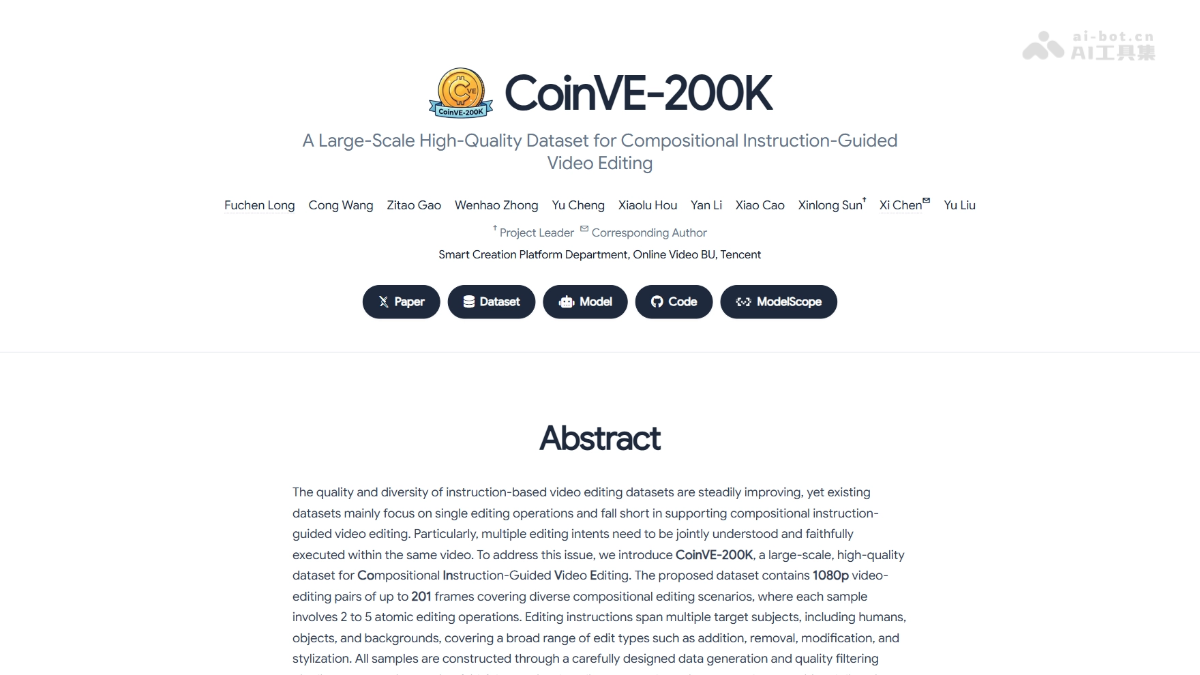
CoinVE-200K is a large-scale compositional instruction video editing dataset open-sourced by the Tencent Video Zhichuang team. It contains 200,000 pairs of 1080p video editing samples, each containing 2-5 atomic editing instructions, including addition, removal, modification, stylization, etc., covering multiple target categories such as people, objects, and backgrounds, with a maximum length of 201 frames. CoinVE-200K also open-sources the 22B-parameter model CoinVE-Edit and the evaluation set CoinVE-Bench, filling the triple gaps in data, models, and evaluation standards for compositional instruction video editing.
Main Features of CoinVE-200K
-
Massive compositional editing data: Provides 200,000 pairs of 1080p compositional instruction video editing samples, supporting multi-intent joint training for models.
-
Diverse atomic operation coverage: Covers 6 atomic editing operations, including addition, removal, replacement, stylization, etc., which can be flexibly combined for complex editing tasks.
-
Full-scenario target support: Editing targets span multiple subject categories such as people, objects, and backgrounds, with rich scene and semantic diversity.
-
Out-of-the-box editing model: Comes with the open-source 22B-parameter CoinVE-Edit model, enabling accurate execution of multiple editing instructions in one pass.
-
Systematic evaluation benchmark: Builds the CoinVE-Bench evaluation set, using 11 fine-grained metrics to systematically evaluate compositional editing performance.
Technical Principles of CoinVE-200K
- Data generation and filtering: Based on a predefined editing taxonomy, Qwen3.6-27B is used to analyze source video content and identify editable subjects, and composite instructions are generated by combining multiple atomic operations; then SAM3/SAM2 is used to generate editing region masks, HunyuanImage-3.0 and Nano Banana are used to synthesize editing keyframes, which are then diffused into complete videos via Wan2.1-Animate or VACE, followed by secondary quality filtering with Gemini to screen qualified samples from dimensions such as instruction-following ability, visual quality, and temporal consistency.
- Multimodal semantic understanding: CoinVE-Edit uses Qwen3-VL-8B-Instruct as the multimodal understanding module, simultaneously receiving source video frame sequences and multiple text editing instructions, jointly parsing video content and composite editing intents, and extracting high-level semantic representations oriented toward compositional editing, enabling the model to globally understand the correlations and constraints among multiple instructions.
- Editing-aware feature transformation: Through the Feature Connector, the hidden states output by the MLLM are mapped into two types of editing-aware tokens: one type is learnable tokens bound to each instruction, and the other is visual tokens that preserve original video information; among them, instruction-related tokens are injected as conditioning signals into the DiT backbone network, guiding the generation process to accurately respond to different types of editing needs.
- Region-decoupled attention mechanism: The Mask Predictor predicts spatiotemporal editing region masks for each instruction, and GateNet generates dynamic gating coefficients; in the cross-attention layers of the DiT, the Q-Blending mechanism differentially regulates the contribution of each instruction token and visual token to the Query based on masks and gating weights, achieving precise binding of different editing intents to corresponding regions while suppressing interference from irrelevant regions and maintaining temporal consistency.
- Dual-track complementary evaluation system: CoinVE-Bench adopts an evaluation framework that combines an MLLM-based Checklist with dedicated evaluators: the former uses Gemini 3.6 Flash to assess instruction-following correctness across three dimensions—editing accuracy, physical naturalness, and semantic preservation; the latter leverages Aesthetic Predictor, DOVER++, VisualQuality-R1, and optical flow fields to measure aesthetic quality, technical quality, overall quality, and temporal stability, respectively, covering 4 core dimensions and 11 metrics in total.

Follow WeChat and reply “open source” to join theAI Open Source Project Community
How to use CoinVE-200K
-
Download the dataset: After installing the ModelScope CLI, run the
modelscope downloadcommand to pull the full dataset as needed or download only themetadata_coinve200k.jsonlmetadata for a trial run first. -
Extract the shard files: Extract the downloaded tar shards into the corresponding directories for
src_videos、tgt_videos、combined_masksandinstruction_masks. -
Parse the metadata: Use Python to read
metadata_coinve200k.jsonlto obtain each sample's source video path, edited video path, and 2–5 composite editing instructions. -
Access the mask information: Extract
instruction_mask_video_pathsandcombined_mask_video_pathfrom the metadata to obtain the spatiotemporal editing region mask corresponding to each instruction. -
Carry out model training: Feed the parsed video pairs, composite instructions, and masks into the DiT framework to supervise the training and fine-tuning of the composite-instruction video editing model.
-
Reproduce baseline results: Directly load the officially open-sourced CoinVE-Edit model weights and validate composite editing performance on the CoinVE-Bench evaluation set.
Core advantages of CoinVE-200K
-
Leading in both scale and quality: It has 200,000 pairs of 1080p high-definition video editing pairs, with up to 201 frames, making it the largest composite-instruction video editing dataset to date.
-
Complex composite editing: Each sample contains 2–5 atomic editing instructions, supporting flexible and complex combinations of operations such as addition, removal, modification, and stylization.
-
Strict quality filtering: Through MLLM semantic understanding and a secondary quality filtering pipeline, it ensures instruction-following degree, visual quality, temporal consistency, and integrity of unedited regions.
-
Full-chain open-source ecosystem: It simultaneously provides the 22B-parameter CoinVE-Edit model and the CoinVE-Bench evaluation set, forming a complete closed loop of data–model–evaluation.
-
Accuracy surpasses closed-source models: It comprehensively surpasses mainstream closed-source solutions such as Seedance 2.0 and Kling O3 in composite-instruction editing accuracy (SA/SPA/EP).
-
Region-decoupled editing mechanism: Through Mask-based Conditioning and Q-Blending cross-attention, it achieves precise binding of multiple instructions to corresponding spatiotemporal regions while preserving irrelevant content.
Project address of CoinVE-200K
- Project website:https://coinve200k.github.io/
- GitHub repository:https://github.com/coinve200k/CoinVE-200K
- HuggingFace model library:https://huggingface.co/datasets/FireCRT/CoinVE-200K
- arXiv technical paper:https://arxiv.org/pdf/2608.17566
Comparison of CoinVE-200K with similar competitors
| Dimension | CoinVE-200K | OpenVE-3M | ReCo-Data |
|---|---|---|---|
| Data scale | 200,000 pairs | 3 million pairs | 500,000 pairs |
| Video resolution | 1080p | 720p (1280×720) | 480×832 |
| Maximum Frames | 201 frames | 65–129 frames | 81 frames |
| Compositional Editing | ✅ Supported(2–5 atomic instructions) | ❌ Mostly single instructions | ❌ Mostly single instructions |
| Average Number of Instructions | 2.55 | About 1 | About 1 |
| Edit Types | Add, remove, replace, stylize, etc. | 8 categories (including style/background/local/subtitle, etc.) | Add, remove, replace, stylize |
| Companion Models | CoinVE-Edit(22B) | None | ReCo(1.3B) |
| Dedicated Evaluation Set | CoinVE-Bench | OpenVE-Bench | None |
| Quality Filtering | Gemini secondary filtering + MLLM checklist | Yes | Gemini-2.5-Flash-Thinking filtering |
Application Scenarios of CoinVE-200K
-
Film and Television Post-Production: Directors can complete multi-element replacement, background modification, and visual style transfer in one go through natural language compositional instructions, greatly improving post-production efficiency.
-
Advertising Content Iteration: Brands can quickly perform batch compositional editing such as character outfit changes, product replacement, and background adjustment on the same video material, reducing reshoot costs.
-
Short Video Creation: Creators input multiple editing intents and achieve complex effects such as character removal, object addition, and visual stylization with one click, lowering the professional threshold.
-
AI Model Training: As high-quality supervision data, it is used to train large video editing models with compositional instructions, improving the model's ability to jointly understand multiple intents and execute them accurately.
-
Evaluation Benchmark Research: It provides academia with the standardized CoinVE-Bench to systematically evaluate the performance of video editing models in compositional instruction following, physical naturalness, and visual quality.