
What is CodeDPO
CodeDPO is a code generation optimization framework jointly launched by Peking University and ByteDance, capable of improving the performance of code models in terms of correctness and efficiency. The framework is based on a self-generation and verification mechanism, simultaneously constructing and evaluating code and its test cases, using the PageRank algorithm to iteratively update the ranking of code snippets, ultimately forming a dataset optimized for correctness and efficiency. CodeDPO does not rely on external resources and can flexibly and scalably generate diverse preference optimization data, providing a solid foundation for code model optimization in complex real-world scenarios.
Main Features of CodeDPO
- Improve code accuracy: Ensure that the generated code can accurately solve problems based on a self-verification mechanism.
- Optimize code efficiency: The framework considers the execution efficiency of code, ensuring that the code is not only correct but also runs fast.
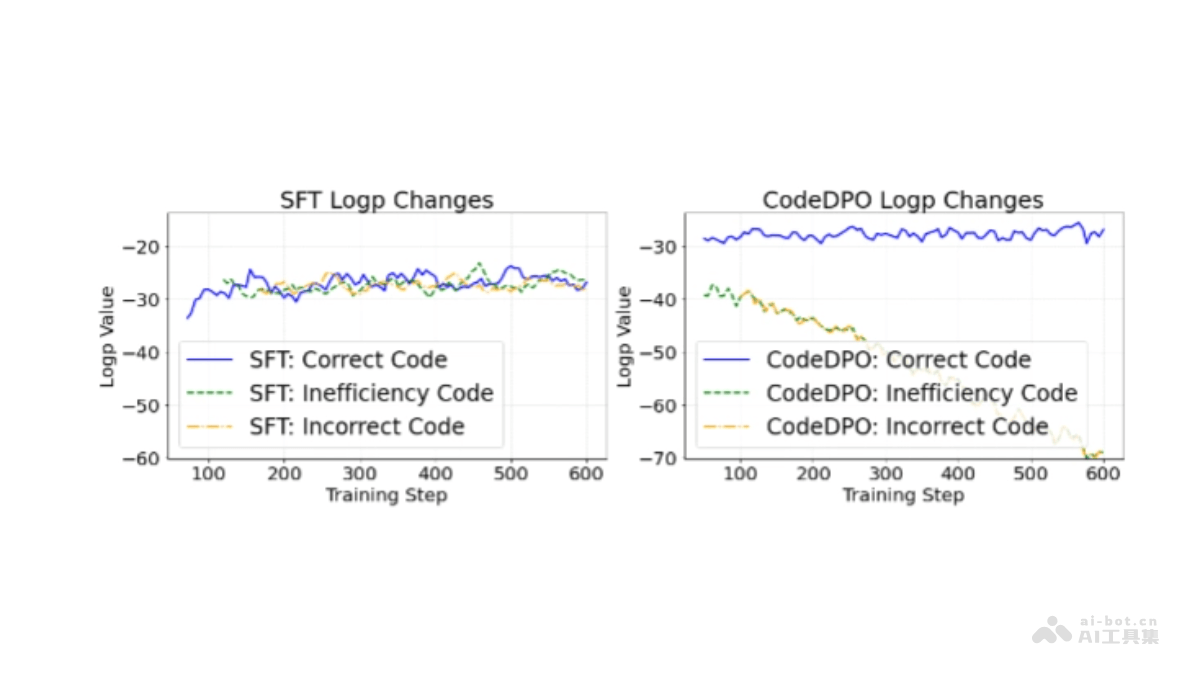
- Preference learning integration: Integrate preference learning into code model training, enabling the model to make better choices between correct and incorrect solutions.
- Self-generation and verification: Simultaneously generate code and test cases, and use the test cases to verify the correctness of the code.
- Dataset construction: Create a code preference optimization dataset based on correctness and efficiency for training and optimizing code models.
- Reduce external dependencies: Do not rely on external resources, independently generate and verify code and test cases, and reduce the need for high-quality test data.
Technical Principles of CodeDPO
- Self-generation and verification mechanism: Based on generating code and corresponding test cases, execute the test cases to verify the correctness of the code and construct the dataset.
- PageRank-inspired algorithm: Use a PageRank-like algorithm to iteratively update the ranking scores of code snippets. The scores are based on whether the code passes tests and evaluate the correctness of the code.
- Correctness optimization: Based on the self-verification process, identify code snippets that are more likely to be correct because they pass more test cases.
- Efficiency optimization: The test cases passed by the code snippets that perform best in the correctness optimization stage are selected as a "trusted test set" to evaluate the execution efficiency of the code.
- Model training: Use methods such as Direct Preference Optimization (DPO), combined with datasets optimized for correctness and efficiency, to train code models and improve the model's performance in these two aspects.
CodeDPO Project Address
- arXiv technical paper:https://arxiv.org/pdf/2410.05605
Application Scenarios of CodeDPO
- Automated software development: The generated code can be directly used in automated software development processes, reducing the workload of manual coding.
- Code-assisted writing tools: In an integrated development environment (IDE), act as a plugin to help developers quickly generate code snippets and improve development efficiency.
- Education and learning: In programming education, assist students in learning programming languages and algorithms, and deepen understanding based on generated example code.
- Code quality assurance: In continuous integration/continuous deployment (CI/CD) processes, it is used to generate test cases, help detect code defects, and improve code quality.
- Code optimization and refactoring: Help identify inefficient or redundant code, and propose optimization solutions to achieve code refactoring and performance improvement.