
What is CoA
CoA (Chain-of-Agents) is a multi-agent collaboration framework launched by Google, designed to address the context limitations faced by large language models (LLMs) when handling long-text tasks. The CoA framework splits long texts into multiple shorter segments, which are processed sequentially by multiple worker agents, passing useful information to the next agent through chain-based communication. A manager agent integrates all the information and generates the final output. It requires no additional training, is task-agnostic, and is highly interpretable.
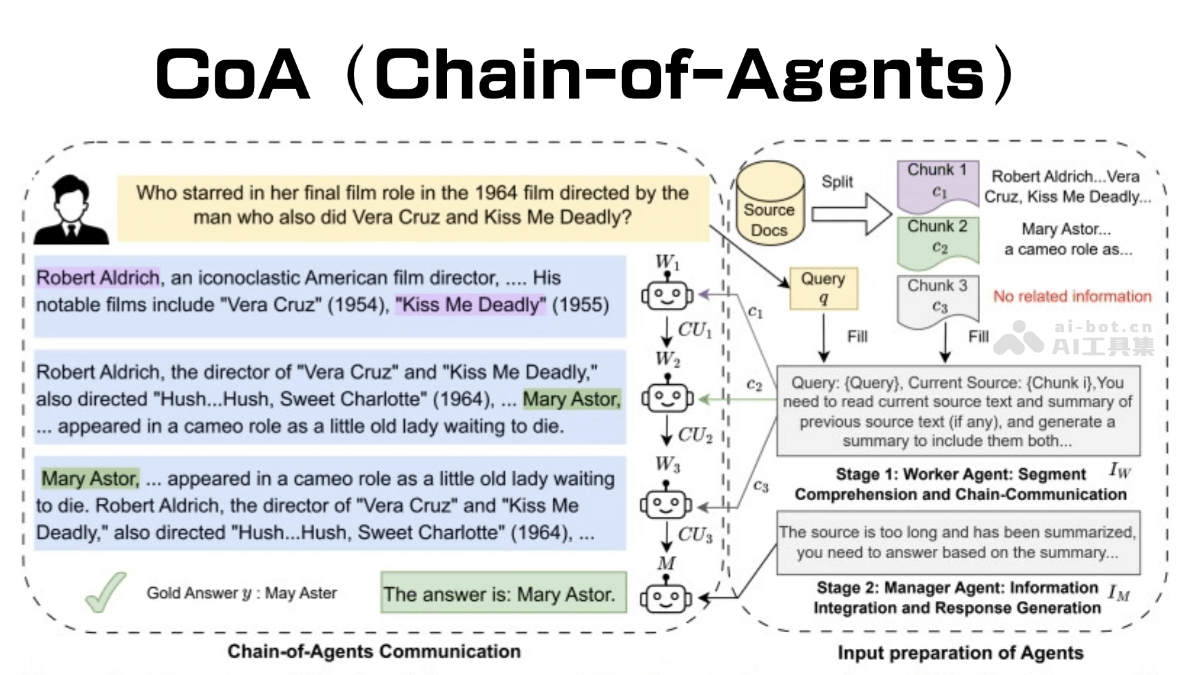
Main Features of CoA
- Segmented Processing and Chain-Based Communication: CoA splits long texts into multiple shorter segments, which are processed sequentially by multiple worker agents, passing useful information to the next agent through chain-based communication.
- Information Aggregation and Contextual Reasoning: When worker agents process their respective segments, they pass key information to the next agent, and finally the manager agent integrates all the information to generate a consistent output.
- Task-Agnostic and Training-Free: The CoA framework requires no additional training and is applicable to various task types, such as question answering, summarization, and code completion.
- Improved Performance and Efficiency: CoA significantly improves the performance of long-text tasks through multi-agent collaboration, by up to 10%, reducing the time complexity from quadratic complexity to linear complexity.
- Scalability: CoA can adapt to inputs of different lengths by adjusting the number of worker agents, and has good scalability.
CoA's Design Principles
- Multi-Agent Collaboration and Information Aggregation: In the first stage, worker agents sequentially read and process text segments, passing key information to the next agent. Each agent receives information from the previous agent and updates its own processing results. Finally, the manager agent receives the outputs of all worker agents and integrates the information to generate the final answer.
- Contextual Reasoning and Task-Agnosticism: CoA enables collaboration among multiple agents through natural language communication, with each agent focusing on a shorter context, alleviating the attention concentration problem in long contexts.
- Time Complexity Optimization: CoA reduces the time complexity from the traditional quadratic complexity (O(n²)) to linear complexity (O(nk)), where n is the number of input tokens and k is the LLM's context limit. This significantly lowers computational costs and makes processing long-text tasks more efficient.
CoA's Project Address
- arXiv Technical Paper:https://arxiv.org/pdf/2406.02818
CoA's Application Scenarios
- Long-Text Question Answering: CoA can handle complex multi-hop reasoning problems. For example, when handling family relationship reasoning, the long text is split into multiple segments, worker agents sequentially process these segments and pass key information, and finally the manager agent generates the answer.
- Long-Text Summarization: In long-text summarization tasks, CoA can effectively extract key information and generate accurate summaries through chunked processing and multi-agent collaboration.
- Code Completion: CoA can be applied to code completion tasks. Through multi-agent collaboration, CoA can process long code segments, extract key information, and generate code completion suggestions.
- Multi-Domain Tasks: The CoA framework is highly flexible and task-agnostic, and can work in conjunction with a variety of large language models (LLMs).