
What Is CloudDM
CloudDM is a database R&D and governance platform open-sourced by the ClouGence team. CloudDM integrates core database capabilities such as data querying, SQL review, and permission control into a unified platform. It supports 30 types of data sources, covering MySQL, PostgreSQL, ClickHouse, Redis, StarRocks, and cloud databases such as Alibaba Cloud, AWS, and Azure, providing DBAs, developers, and operations personnel with a one-stop database collaboration and governance solution.
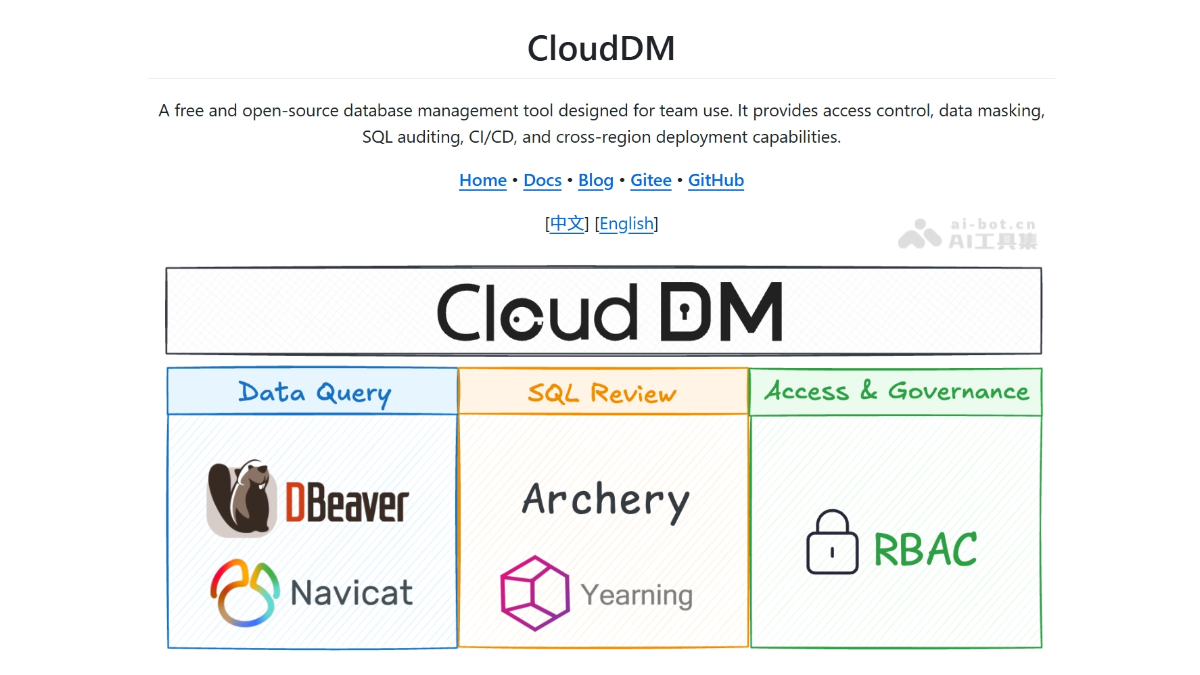
Main Features of CloudDM
-
Unified Data Querying: The Web console supports 30 types of data sources, providing syntax highlighting, intelligent suggestions, execution plans, result export, table structure retrieval, and transaction and isolation level control.
-
SQL Change Control: Built-in SQL review rule engine with 54 rules, supporting custom extensions via Rule Script, with rule scope precise down to instances, databases, tables, and columns; the approval process integrates with Feishu, DingTalk, and WeCom.
-
Fine-Grained Permission Management: Adopts an RBAC model that separates functional permissions from resource permissions, with authorization granularity covering instances, databases, schemas, and tables, and supports separate authorization for DDL and DML.
-
Data Masking Protection: Provides column-level masking capabilities, with 5 built-in masking rules and support for custom rules, enabling masking of individual values or entire rows, with protection scope precise to columns.
-
Unified Identity Authentication: Supports OpenLDAP, Windows AD, OIDC, as well as DingTalk, Feishu, and WeCom SSO, making it easy for teams to have a unified account system.
-
Database Object Management: A visual editor supports the creation, deletion, modification, and viewing of properties for objects such as databases, schemas, tables, columns, indexes, views, functions, stored procedures, and triggers.
-
Auditing and Compliance: Provides operation auditing and SQL execution auditing, supporting three modes: manual execution, immediate execution, and scheduled execution.
-
CI/CD Integration: Supports three ways to trigger the change release process: Git Push, WebHook, and HttpCall, with check, approval, and execution nodes that can be freely enabled or disabled.
-
DDL Conversion: Supports 192 conversions from 18 types of data sources to 12 target databases including MySQL, ClickHouse, DAMENG, Oracle, and PostgreSQL.
Technical Principles of CloudDM
-
Web Console Architecture: Adopts a front-end and back-end separated design, enabling unified access to and management of multiple data sources through a browser, with no need to install a local client.
-
SQL Rule Engine: The built-in rule engine performs static analysis and security detection on change statements, enables extensible rule definitions based on Rule Script, and supports four scope matching modes: exact, prefix, suffix, and contains.
-
RBAC Dual-Layer Permission Model: Decouples functional permissions (menus and operations) from resource permissions (data source objects), implementing fine-grained access control at the instance, database, schema, table, and column levels through role definitions.
-
Multi-Protocol Data Source Adaptation: Connects to underlying databases through standard JDBC/ODBC protocols, uniformly abstracting the query and management interfaces of 30 heterogeneous data sources.
-
Elastic Deployment Architecture: Supports standalone mode and cluster mode, provides two containerized deployment methods, Docker and Kubernetes, and enables cross-datacenter management without exposing public network ports.
-
Data masking and audit mechanisms: Inserts a column-level masking layer into the data return path, while persistently storing audit records of operational behavior and SQL execution records.
How to use CloudDM
-
One-click deployment: Execute the Docker command
docker run -d --name cgdm-alone -p 8222:8222 bladepipe/cgdm-alone:3.0.7, startup is completed within 10 seconds (in China, the Alibaba Cloud image acceleration address can be used). -
Access the console: Open in the browser
http://localhost:8222, and complete the initial configuration. -
Connect data sources: In data source management, add connections for 30 supported databases such as MySQL and PostgreSQL.
-
Configure permissions: Create roles and assign functional permissions and resource permissions, with precise control down to the database, table, or column level.
-
Set review rules: In security rules, enable or customize SQL review rules, and configure warning or blocking policies.
-
Execute queries or changes: Write SQL through the query console, or submit changes through the ticket system, and execute after approval.
-
Integrate enterprise IM: Configure DingTalk, Feishu, or enterprise Webhook to implement ticket notifications and SSO login.
CloudDM's core advantages
-
Fully open source with zero restrictions: All features are fully open, with no crippled enterprise edition, and advanced capabilities such as permission control and auditing can all be used for free.
-
The widest industry coverage of data sources: Supports 30 data sources, covering mainstream domestic and international relational databases, OLAP, caches, and cloud databases.
-
Extremely fine-grained permission control: Supports multi-level authorization for instances, databases, schemas, tables, and columns, with DDL and DML separately controllable, meeting enterprise compliance requirements.
-
Highly flexible rule engine: 54 built-in rules combined with Rule Script customization, with scope precise down to the column level, adapting to the SQL standards of different teams.
-
Low deployment and operations barriers: One-click startup with Docker, supports standalone and cluster modes, cross-datacenter deployment requires no public network ports, reducing the cost of private deployment.
CloudDM's project address
- Project official website:https://www.cdmgr.com/
- GitHub repository:https://github.com/ClouGence/open-cdm
Comparison of CloudDM with similar competitors
| Dimension | CloudDM | Archery | Yearning | Bytebase |
|---|---|---|---|---|
| Open source license | Apache 2.0 (full functionality) | Apache 2.0 | GPL | Partially open source/commercial edition |
| Data source support | 30 types (including cloud databases) | Fewer | Fewer | More |
| Data query | ✅ Web console | ❌ | ❌ | ✅ |
| SQL review rules | 54 built-in + custom | Yes | Yes | Yes |
| Permission granularity | Instance/Database/Schema/Table/Column | Coarser | Coarser | Database/table level |
| Data masking | ✅ Column-level | ❌ | ❌ | Partially supported |
| SSO integration | LDAP/AD/OIDC/DingTalk/Feishu/WeCom | Limited | Limited | OIDC/LDAP |
| CI/CD Integration | Git Push/WebHook/HttpCall | Limited | Limited | GitOps |
| Deployment Method | Docker/K8s/Installer Package | Relatively Complex | Moderate | Docker/K8s |
CloudDM Application Scenarios
-
Unified Enterprise Database Management and Control: Provides DBAs and development teams with a unified data query entry point and change process, avoiding switching between multiple tools.
-
SQL Review and Compliance Governance: Intercepts dangerous SQL through an automated rules engine, meeting the compliance audit requirements of industries such as finance and the internet.
-
Sensitive Data Security Protection: Automatically masks sensitive columns of core tables in the production environment to prevent data leakage.
-
DevOps Database Change Pipeline: Incorporates database changes into the CI/CD process, enabling Git-driven automated release and rollback.
-
Multi-Tenant Permission Isolation: Allocates independent data access boundaries to different teams and projects through fine-grained RBAC.