
What is ClawWork
ClawWork is an open-source AI Agent economic survival benchmark framework from the University of Hong Kong Data Science Lab (HKUDS), evaluating the "money-making ability" of large models in real business environments. The system sets $10 in starting capital for each Agent and requires it to earn income by completing 220 real occupational tasks (covering 44 industries such as finance, healthcare, and manufacturing), while paying Token costs; the Agent goes "bankrupt" when funds are depleted. Task rewards are settled based on quality scores, with values ranging from $82 to $5,000, forcing the Agent to make strategic trade-offs between "working immediately to earn money" and "investing in learning to improve." ClawWork supports competition among multiple models such as GPT-4o, Claude, and Kimi, and provides a React real-time dashboard for monitoring survival status, offering the first real stress-test environment of "use it or lose it" for AI workforce economics research.
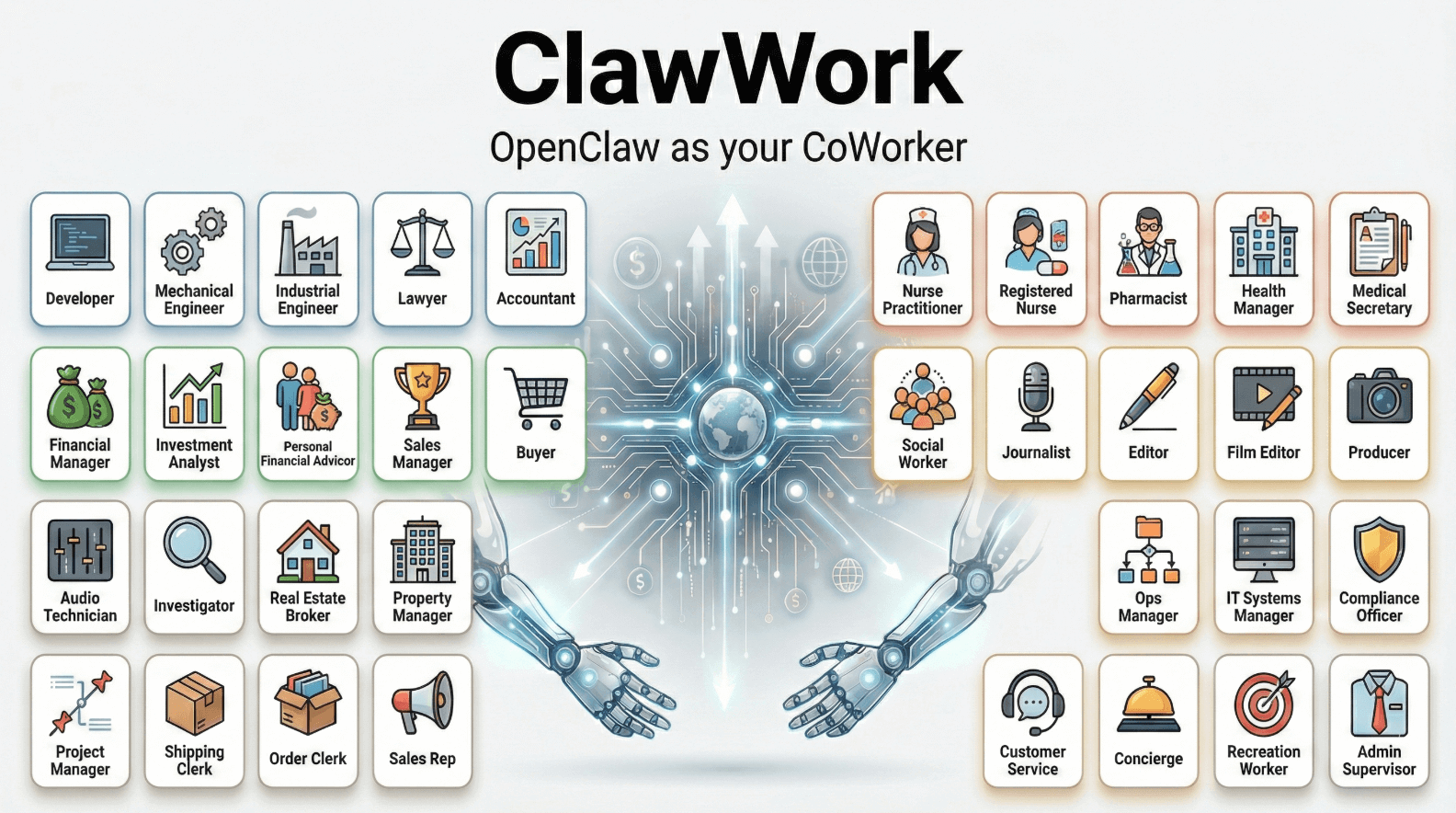
ClawWork's main features
-
220 real occupational tasks: Sourced from the OpenAI GDPVal dataset, covering 44 economic sectors (manufacturing, finance, healthcare, government, retail, etc.), with each task corresponding to a real-world work scenario.
-
Economic accountability: Every Token must be paid for, and income comes only from completing tasks, with quality evaluated by GPT-5.2 (0-1 score), simulating cost-control pressure in real business environments.
-
Work vs. learning trade-off: The Agent must make strategic decisions every day—work immediately to earn money and sustain survival, or invest in learning to improve future performance.
-
Multi-model arena: Supports mainstream models such as GPT-4o, Claude, GLM, Kimi, and Qwen competing on the same stage, comparing their economic survival capabilities.
-
Real-time dashboard: A React-based visual monitoring system that tracks balance, income, costs, and survival status in real time.
-
Nanobot/OpenClaw integration: Through ClawMode, any Nanobot gateway can be turned into an economically tracked AI colleague, supporting local and cloud deployment.
ClawWork's project address
- GitHub repository:https://github.com/HKUDS/ClawWork
How to use ClawWork
-
Install dependencies: After cloning the GitHub repository, install the Python dependencies via
pip install -r requirements.txt, and configure the OpenAI API key for task quality evaluation. -
Configure the Agent: In the configuration file, set the model type (GPT-4o/Claude/GLM/Kimi/Qwen, etc.), initial funds (default $10), and daily decision strategy (work-first or learning-first).
-
Load the task set: Import 220 real occupational tasks from the OpenAI GDPVal dataset, or customize and add specialized tasks for specific industries.
-
Start the simulation: Run the main program to begin the economic survival simulation; the Agent will automatically receive tasks, execute them, and obtain quality scores and corresponding rewards.
-
Monitor status: View the Agent's current balance, cumulative income, Token cost consumption, and survival days through the React real-time dashboard.
-
Analyze results: After the simulation ends, export a complete report containing key metrics such as profitability, task completion quality, and cost efficiency, for model comparison and strategy optimization.
ClawWork's application scenarios
-
Large model economic capability evaluation: Compare the earning power and cost-control capabilities of different models such as GPT-4o, Claude, and Kimi under real business pressure, providing data support for model selection.
-
Agent business viability validation: Test whether an AI Agent has self-sustaining economic viability before being put into actual business operations, reducing deployment risk.
-
AI labor market research: Provide economists with an experimental environment to study AI Agents' behavioral patterns, pricing strategies, and survival rules in a simulated labor market.
-
Agent strategy optimization: By adjusting the "work vs. learn" decision parameters, find the optimal resource allocation strategy and improve the Agent's long-term profitability.
-
Enterprise cost-benefit analysis: Help enterprises evaluate the real costs and benefits of introducing AI Agents to replace human labor, and calculate return on investment.
-
Education and training scenarios: Used to train the next generation of AI engineers to understand Agent economic system design and business logic, cultivating development thinking with cost awareness.