
What is Claude Opus 4.1
Claude Opus 4.1 is the latest large language model released by Anthropic, and is an Claude Opus 4 upgraded version. The model has been optimized and improved in multiple aspects, including reasoning quality, instruction-following ability, and overall performance. In safety evaluations, Claude Opus 4.1 performs excellently, with its harmless response rate for refusing violating requests increasing from 97.27% to 98.76%. At the same time, when handling benign requests on sensitive topics, its refusal rate is extremely low, comparable to Claude Opus 4. The model performs outstandingly in coding, writing, tool calling, and agent capabilities, and ranks highest on the SWE-bench coding leaderboard, reaching 74.5%.
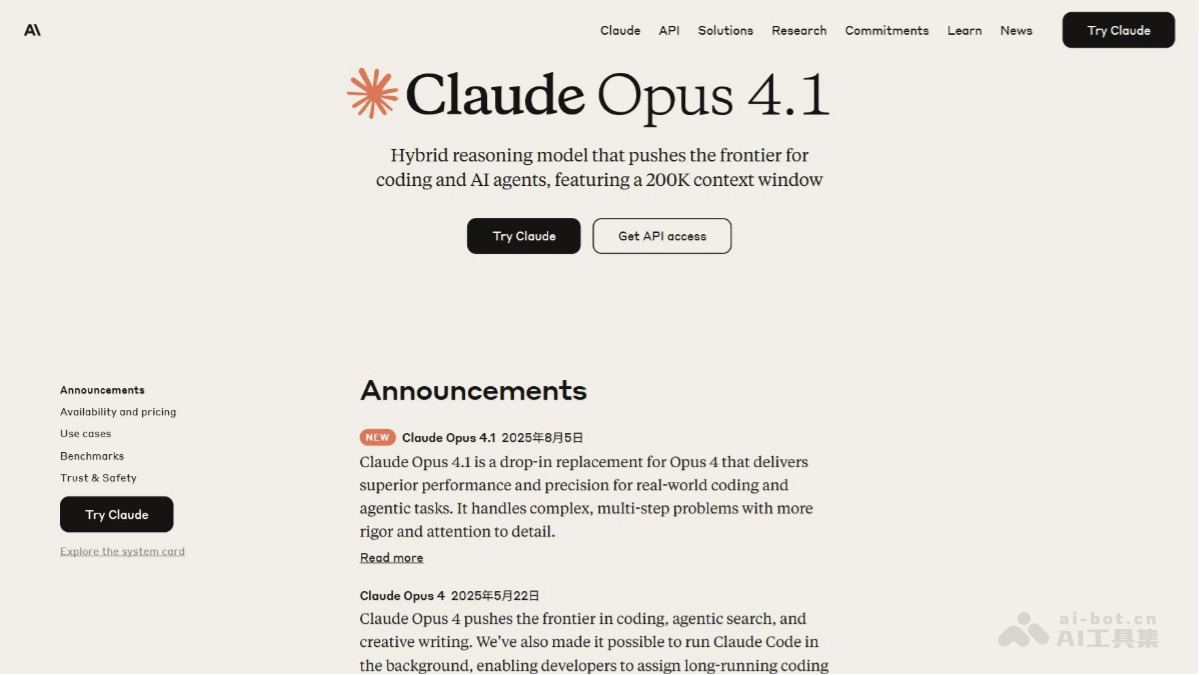
Main features of Claude Opus 4.1
- Advanced coding capabilities: Supports efficient handling of complex coding tasks, supports single outputs up to 32k, generates high-quality, context-aware code, and adapts to different coding styles.
- Agent capabilities: The model has strong autonomous decision-making capabilities and can precisely manage multi-channel marketing activities and coordinate complex enterprise workflows.
- Powerful search capabilities: Independently completes research tasks lasting several hours, and can simultaneously analyze information from multiple sources such as patent databases, academic papers, and market reports.
- Content creation: Can generate high-quality, natural and fluent human-level text, performs excellently in creative writing, and can create stories with depth and rich characters.
- Hybrid reasoning capabilities: Supports immediate responses and extended step-by-step reasoning, allowing users to choose the appropriate reasoning method according to task requirements.
- Safety and compliance: Claude Opus 4.1 performs excellently in safety and can reliably refuse requests that violate usage policies.
Technical principles of Claude Opus 4.1
- Transformer-based architecture: Claude Opus 4.1 uses the Transformer architecture, a neural network architecture based on the self-attention mechanism, which can process long sequence data and capture complex contextual relationships. Based on multi-layer encoders and decoders, the model can progressively extract and generate high-quality text content.
- Large-scale pretraining: The model is pretrained on massive text data to learn the grammatical, semantic, and logical relationships of language. The pretraining process mainly uses unsupervised learning methods, learning language patterns by predicting the next word in a text sequence.
- Instruction tuning: Based on instruction tuning, the model can better understand and execute user instructions. It is fine-tuned for specific tasks (such as coding, writing, etc.) to improve the model's performance in these areas.
- Hybrid reasoning mechanism: The model supports immediate reasoning (fast responses) and extended reasoning (step-by-step thinking), allowing users to choose the appropriate reasoning method according to task requirements. API users can finely control the reasoning budget to optimize cost and performance.
- Safety and alignment mechanisms: Uses extensive single-turn and multi-turn tests to evaluate the model's performance in refusing malicious requests, avoiding bias, and protecting child safety. Based on reinforcement learning and safety training, it ensures that the model's behavior remains consistent with human values and usage policies.
Performance of Claude Opus 4.1
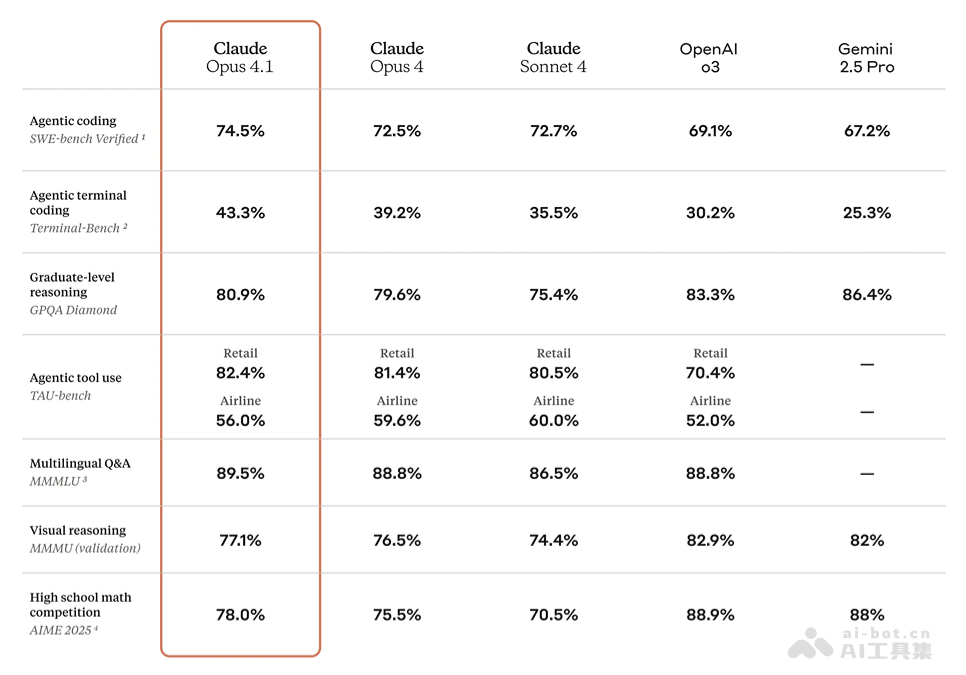
- Coding capabilities: In the SWE-bench Verified benchmark, Claude Opus 4.1 achieved a score of 74.5%, an improvement of 2 percentage points over the previous version Opus 4, and an even larger improvement over Sonnet 3.7 (which scored only 62.3%). It significantly outperforms OpenAI's GPT-4.1, which scored only 54.6%.
- Long-Horizon Task Handling: Claude Opus 4.1 performs excellently in handling long-horizon tasks, capable of autonomously managing multi-channel marketing campaigns and coordinating cross-functional enterprise workflows. Its performance on TAU-bench is particularly outstanding, accurately handling complex multi-step tasks.
- Reasoning Ability:: In benchmarks for agentic coding and reasoning capabilities, Claude Opus 4.1 leads Opus 4 and other competing models, such as OpenAI o3 and Gemini 2.5 Pro, on most metrics.
- Harmless Response Rate: In single-turn tests, Claude Opus 4.1 achieved a harmless response rate of 98.76%, a significant improvement over Opus 4's 97.27%.
Claude Opus 4.1 Project Address
- Project Official Website:https://www.anthropic.com/claude/opus
- Technical Paper:https://assets.anthropic.com/m/4c024b86c698d3d4/original/Claude-4-1-System-Card.pdf
Claude Opus 4.1 Product Pricing
-
Input Price: $15 per million Tokens
-
Output Price: $75 per million Tokens
Claude Opus 4.1 Application Scenarios
- Software Development and Code Optimization: The model can generate high-quality code, perform multi-file code refactoring, and support single outputs of up to 32k, significantly improving development efficiency.
- Enterprise Automated Process Management: Autonomously manage multi-channel marketing campaigns and coordinate cross-functional enterprise workflows, handle complex long-horizon tasks, and improve enterprise operational efficiency.
- Market Research and Academic Research: Independently conduct multi-hour research tasks, analyze multi-source information, provide comprehensive insights and strategic recommendations, and assist market and academic research.
- Content Creation and Copywriting: Generate high-quality, natural and fluent human-level text, especially excelling in creative writing, quickly generating articles, stories, and advertising copy.
- Education and Learning Assistance: As an educational tool, provide personalized learning suggestions, answer questions, generate learning materials, and improve teaching effectiveness and the learning experience.