
What is Claude 3.7 Sonnet
Claude 3.7 Sonnet is the world's first hybrid reasoning model launched by Anthropic, featuring two modes of operation: "standard mode" and "extended thinking mode." In standard mode, Claude 3.7 Sonnet can quickly generate responses; extended thinking mode solves complex problems based on step-by-step reasoning. The model performs excellently on complex tasks such as mathematics, physics, and programming, and leads across the board in coding capabilities. Claude 3.7 Sonnet has optimized safety and reduced unnecessary refusals. Claude 3.7 Sonnet supports access via the Anthropic API, Amazon Bedrock, and Google Cloud's Vertex AI.
Claude 3.7 Sonnet's main features
- Hybrid reasoning modes:
- Standard mode: Quickly generates responses, suitable for everyday conversations and simple tasks.
- Extended thinking mode: Performs deep self-reflection and step-by-step reasoning, suitable for complex tasks such as mathematics, physics, logical reasoning, and programming.
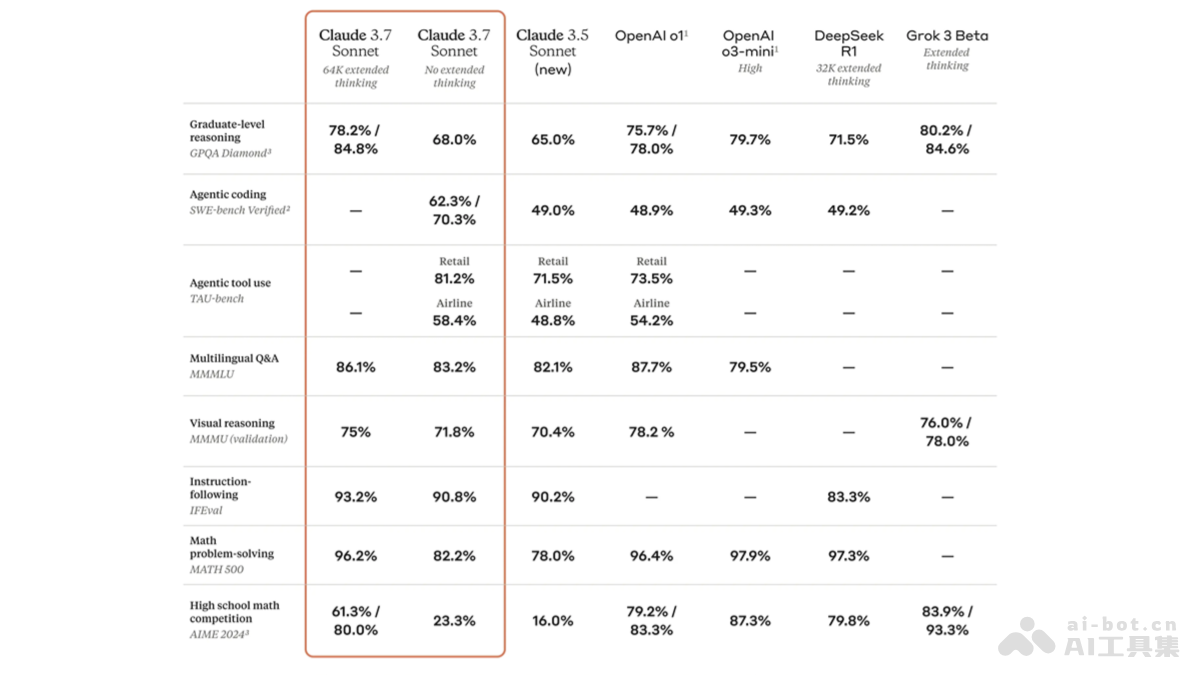
- Complex task handling capability: Performs excellently in fields requiring strong logical reasoning, such as mathematics, physics, and programming. Performs well in benchmark tests such as SWE-bench Verified and TAU-bench.
- Code collaboration capability: Supports development workflows such as code editing and test execution. Supports integration with GitHub, helping developers fix bugs, develop new features, and handle full-stack updates.
- Improved safety: More accurately distinguishes malicious requests from normal requests, reducing unnecessary refusals compared with the previous generation (by 45%).
- Multi-platform support: Applies to Free, Pro, Team, and Enterprise subscription plans, accessed via the Anthropic API, Amazon Bedrock, and Google Cloud's Vertex AI.
- Flexible usage: In API usage, users can specify the number of thinking tokens, with output limited to 128K tokens.
Claude 3.7 Sonnet's performance
- Reasoning capability task performance:
- In tasks such as mathematics, physics, instruction following, and programming, Claude 3.7 Sonnet performs excellently in extended thinking mode, improving by more than 10% compared with the previous generation model.
- SWE-bench: Claude 3.7 Sonnet set a high score of 70.3%, setting a new SOTA (State of the Art) record.
- Coding capability:
- SWE-bench Verified test: Claude 3.7 Sonnet's coding capability has improved significantly, efficiently solving real-world software problems.
- Multimodal and agent capabilities:
- OSWorld test: Claude 3.7 Sonnet can complete tasks based on virtual mouse clicks and keyboard presses.
- Pokémon game test: Based on extended thinking capability and agent training, Claude 3.7 Sonnet obtained the corresponding badges, performing far better than earlier versions.
- Test-time compute scaling:
- Serial test-time compute: Before generating the final output, multiple consecutive reasoning steps are performed, continuously increasing the investment of computational resources. For example, in mathematical problem solving, its accuracy grows logarithmically as the number of thinking tokens increases.
- Parallel test-time compute: By sampling multiple independent reasoning processes and selecting the best result (such as majority voting or a scoring model), model performance is significantly improved. In the GPQA test, Claude 3.7 Sonnet achieved an overall score of 84.8% based on parallel computation (with the physics section reaching as high as 96.5%).
Claude 3.7 Sonnet's project address
- Project official website::https://www.anthropic.com/news/claude-3-7-sonnet
Claude 3.7 Sonnet's model pricing
- Input Tokens: $3 per million input tokens.
- Output Tokens: $15 per million output tokens.
Claude 3.7 Sonnet's application scenarios
- Software development and coding: Helps developers handle complex codebases, write high-quality code, perform full-stack updates, and fix errors, supporting everything from simple code generation to complex system architecture design.
- Front-end development: Optimizes front-end development workflows, generates HTML, CSS, and JavaScript code, and supports responsive design and interactive interface development.
- Mathematical and scientific problem solving: Based on extended thinking mode, solves complex mathematics and physics problems, and supports logical reasoning and step-by-step solutions.
- Enterprise-level task automation: In enterprise environments, used to automate complex business processes, generate reports, optimize workflows, and execute directive tasks.
- Multimodal interaction and collaboration: Supports multimodal input and output, and is suitable for complex tasks that require combining text, images, or other data types, such as intelligent customer service, educational assistance, and creative design.