
What is Claude 3.5 Haiku
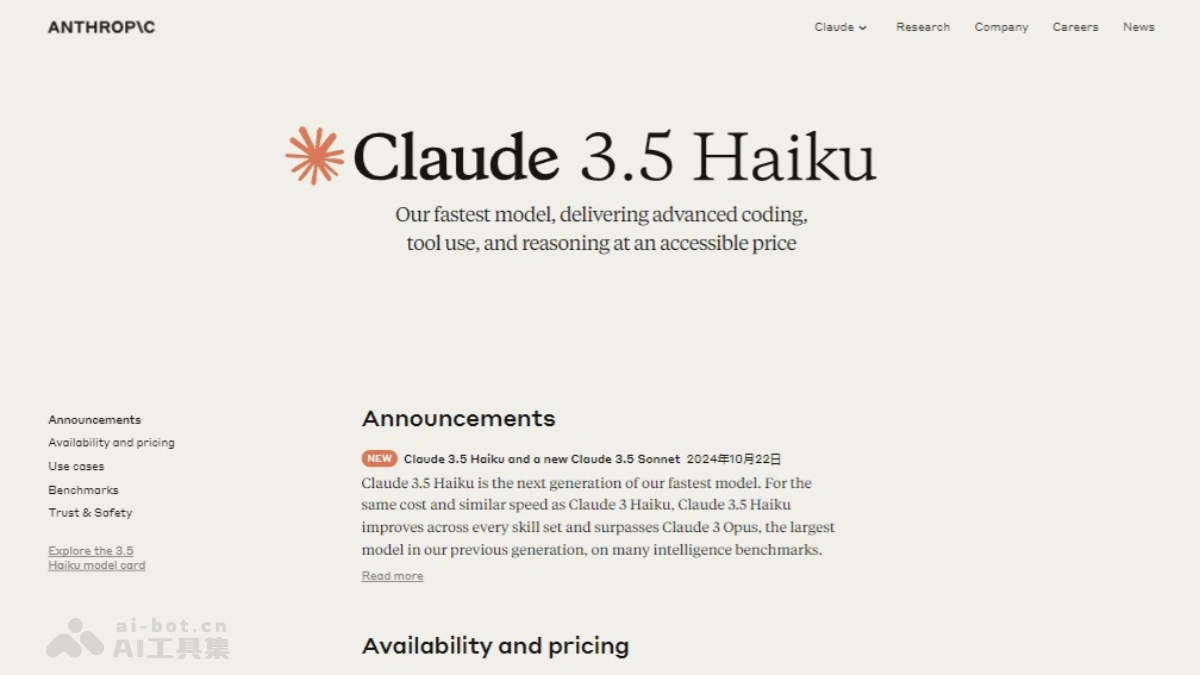
Claude 3.5 Haiku is a new artificial intelligence model released by Anthropic. While maintaining speed and cost similar to the previous generation Claude 3 Haiku, it achieves improvements in various capabilities and surpasses Claude 3 Opus in multiple benchmark tests. Claude 3.5 Haiku focuses on providing fast responses and improved reasoning capabilities, making it suitable for tasks that require both speed and intelligence, such as fast and accurate code suggestions, customer service chatbots that need quick response times, e-commerce solutions, and educational platforms. Claude 3.5 Haiku supports efficiently processing and classifying information from large amounts of data, such as purchase history, pricing, or inventory data, to generate personalized experiences.
Main features of Claude 3.5 Haiku
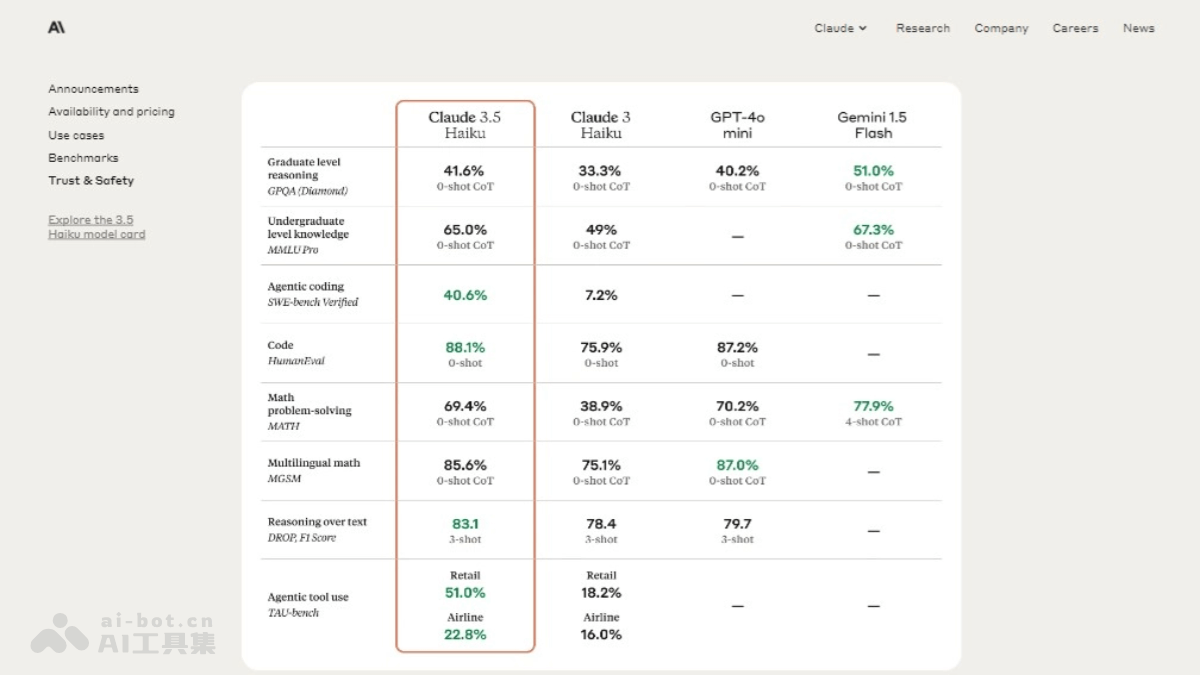
- Coding capabilities: It scored 40.6% on the SWE-bench Verified test, demonstrating its strong capabilities in programming tasks.
- Low latency and excellent instruction understanding: Suitable for developing user products and handling sub-agent tasks.
- Precise tool use capabilities: It can generate personalized experiences from large amounts of data, such as purchase records, price, or inventory information.
- Cost-effectiveness: It maintains the same cost as Claude 3 Haiku while achieving significant improvements in various capabilities.
Technical principles of Claude 3.5 Haiku
- Unstructured data processing capability: Claude 3.5 Haiku uses an algorithm called "Unstructured Generalization," making AI more effective when processing unstructured data.
- Stable and understanding reasoning methods: Claude 3.5 Haiku is committed to expanding the model's capabilities in complex reasoning and problem-solving, making the model's understanding more stable and reliable.
- Constitutional AI: Anthropic provides a clear set of behavioral principles for its AI models, called "Constitutional AI." These principles include the Universal Declaration of Human Rights, part of Apple's terms of service, trust and safety "best practices," and Anthropic's AI research laboratory principles.
- Computer use functionality: Claude 3.5 Sonnet and Haiku introduce "computer use" functionality, enabling AI to simulate how humans interact with computers, such as moving the cursor, clicking buttons, and entering text. This capability requires the ability to view and interpret images (i.e., the computer screen), reasoning ability, and understanding when to perform specific operations.
Claude 3.5 Haiku project address
- Project official website:anthropic.com/claude/haiku
Application scenarios of Claude 3.5 Haiku
- Automating desktop tasks: Through the new "computer use" API, Claude 3.5 Haiku can simulate human-computer interaction, performing operations such as keystrokes, clicks, and mouse gestures to automate daily desktop tasks.
- Virtual assistants: Anthropic builds virtual assistants that can independently conduct research, answer emails, and handle background work. Claude 3.5 Haiku can understand and interact with any desktop application, supporting developers in trying computer use through Anthropic's API, Amazon Bedrock, and Google Cloud's Vertex AI platform.
- Security and compliance: In the security field, AI technologies such as Claude 3.5 Haiku can be used to enhance complex data analysis capabilities and adaptive protection capabilities, and help lower the requirements for specialized skills. They can help organizations more effectively monitor, warn about, and handle security risks and threats, and improve the level of intelligent security protection in cyberspace.
- Medical decision support: In the medical field, AI models such as Claude 3.5 Haiku can be used to assist clinical decision-making by analyzing patient data to provide treatment recommendations. For example, supersparse linear integer models (SLIM) have been used in medical applications requiring rapid and accurate clinical decisions; due to their sparse and interpretable characteristics, SLIM provides the best interpretability for human-centered decision support.
- Education and training: AI models can be used for personalized education and training, providing customized learning resources and teaching plans by analyzing students' learning habits and progress.
- Customer service: In the customer service field, AI models can provide chatbots and automated reply systems, improving response speed and service quality.