
What is CHRONOS
CHRONOS is a new framework for news timeline summary generation jointly launched by the Department of Computer Science and Engineering at Shanghai Jiao Tong University, the Alibaba Group Tongyi Lab, and other institutions. Based on an iterative self-questioning and self-answering approach, it uses large language models (LLMs) to construct timelines in open and closed domains. The framework is based on generating 5W1H questions related to news topics, retrieving relevant information, and continuously posing new sub-questions to expand the news database. Based on a question rewriting mechanism to improve search precision, it adopts a divide-and-conquer strategy to generate and merge timelines, ultimately forming coherent event summaries. CHRONOS performs excellently in experiments and can effectively handle information overload and data noise problems, making it suitable for timeline generation tasks on large-scale news data.
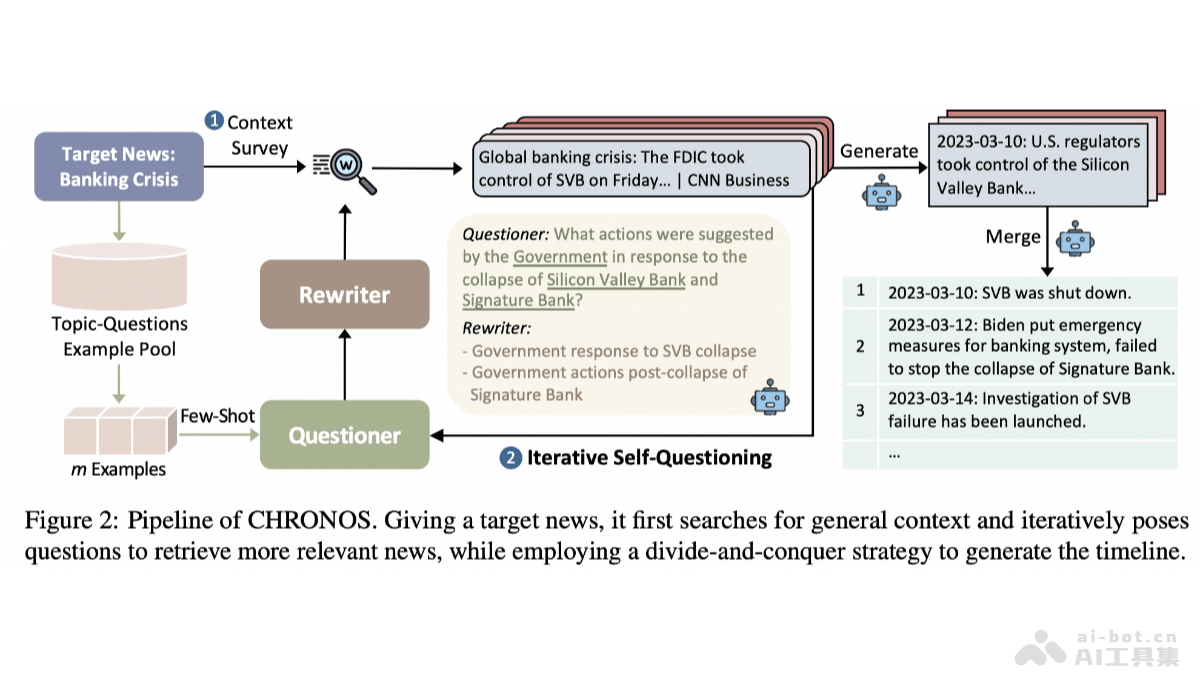
CHRONOS's main features
- News timeline generation: Extract key events from large numbers of news documents and generate coherent timeline summaries in chronological order.
- Open-domain and closed-domain support: It can directly retrieve news from the internet in the open domain to generate timelines, and can also use a predefined news set for timeline construction in the closed domain.
- Iterative self-questioning and self-answering: Based on continuously posing questions related to news topics, it gradually expands and enriches the content of the timeline, ensuring the comprehensiveness and accuracy of the information.
- Question rewriting and optimization: Decompose complex questions into more specific queries, improve the precision and efficiency of searches, and obtain more relevant information.
- Dataset support: Introduce the Open-TLS dataset, providing abundant news timeline samples for training and evaluating model performance.
CHRONOS's technical principles
- Retrieval-based generation: Enhance the generation capability of language models based on retrieving external knowledge sources (such as the internet or predefined news sets), solving information overload and data noise problems.
- Iterative self-questioning and self-answering mechanism: Simulate the human information retrieval process, using generated 5W1H questions (What, Who, Why, Where, When, How) to gradually dig deeper into event information related to news topics and construct a causal relationship graph between events.
- Question rewriting technology: Use LLMs to decompose and rewrite complex questions, generating more specific and more easily retrievable queries, improving the relevance and accuracy of retrieval results.
- Divide-and-conquer strategy: Decompose the timeline generation task into multiple subtasks, generate a separate timeline from each round of retrieval, and based on steps such as merging and conflict resolution, generate the final coherent timeline summary.
- Large language models (LLMs): As the core tool, used for understanding text, generating high-quality summaries and questions, and performing effective information retrieval and integration.
CHRONOS's project address
- GitHub repository:https://github.com/Alibaba-NLP/CHRONOS
- arXiv technical paper:https://arxiv.org/pdf/2501.00888
CHRONOS's application scenarios
- News report organization: Help news editors and reporters quickly organize the development process of a news event, generate clear timelines, and provide reference for writing in-depth reports or retrospective articles.
- Financial industry: Track major events in financial markets, such as company earnings releases and policy changes, generate timelines, and help investors and analysts better understand market dynamics and trend changes.
- Government departments: In the policy-making process, organize the timeline of relevant policy events, analyze the implementation effects and impacts of policies, and provide a basis for policy evaluation and adjustment.
- Education: Provide students and researchers with timelines of historical events, help users better understand and remember the sequence of events and key milestones, and promote the learning and study of historical knowledge.
- Enterprises and Marketing: Enterprises generate timelines of brand development history, display important milestones and achievements of the brand, and use them in brand promotion and marketing activities.