
What is Chronicles-OCR
Chronicles-OCR is the industry's first cross-temporal visual perception benchmark covering the complete evolutionary trajectory of the "Seven Scripts" of Chinese characters, jointly launched by Tencent Hunyuan together with the Institute of Information Engineering of the Chinese Academy of Sciences, Anyang Normal University, Nankai University, and the Palace Museum. The benchmark contains 2,800 high-quality images and systematically covers seven major scripts: oracle bone script, bronze script, seal script, clerical script, regular script, running script, and cursive script. Through a stage-adaptive annotation paradigm and four major evaluation tasks, it evaluates the perceptual robustness of visual large language models when faced with the continuous evolution of Chinese character forms over thousands of years.
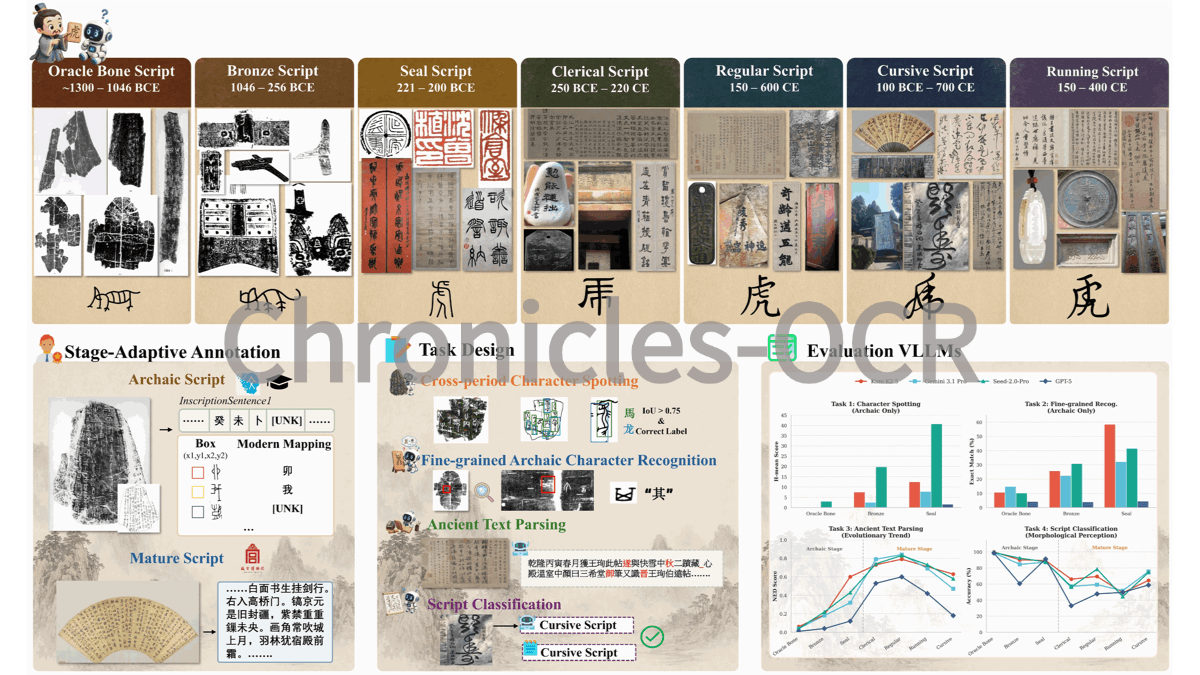
Main features of Chronicles-OCR
-
Full coverage evaluation of seven scripts: Complete coverage of the seven major Chinese scripts—oracle bone script, bronze script, seal script, clerical script, regular script, running script, and cursive script—building a cross-temporal evaluation system from the Shang dynasty to modern times.
-
Stage-adaptive annotation: For ancient scripts (oracle bone/bronze/seal script), provides character-level bounding boxes + modern Chinese character mapping annotations; for mature scripts (clerical/regular/running/cursive), provides sequence-level layout understanding annotations, adapting to morphological differences across different historical stages.
-
Four core evaluation tasks: Supports cross-period character localization, fine-grained ancient script recognition, ancient text parsing, and font classification, comprehensively evaluating model capabilities.
-
Visual referring mechanism: Uses colored boxes to mark target characters in images, allowing the model to perform recognition, enabling decoupled evaluation of character deciphering ability and spatial localization ability.
-
High-quality expert annotation: Multi-level cross-annotation by doctoral students, graduate students, and domain experts in ancient script studies, ensuring high fidelity in font classification, bounding box localization, and character transcription.
-
Integration of authoritative data sources: Oracle bone script comes from the Key Laboratory of Oracle Bone Script Information Processing at Anyang Normal University; bronze script/seal script were organized by an ancient script studies team; clerical/regular/running/cursive come from the Palace Museum cultural relic handwritten character recognition test dataset.
-
Model robustness diagnosis: Systematically evaluates the perceptual capability boundaries of visual large language models during the evolution of Chinese character forms over thousands of years, revealing key bottlenecks in generalizing modern document parsing to historical writing systems.
How to use Chronicles-OCR
-
Visit the open-source repository: Go to the GitHub repository https://github.com/VirtualLUOUCAS/Chronicles-OCR to obtain the dataset, paper, and evaluation code.
-
Download the dataset: Obtain the complete dataset containing 2,800 images, with 400 each for oracle bone script, bronze script, seal script, clerical script, regular script, running script, and cursive script, accompanied by annotation files in JSON or XML format.
-
Understand the data format: Read the stage-adaptive annotation specification—the ancient script stage (oracle bone/bronze/seal script) uses character-level bounding box coordinates + modern Chinese character mapping; the mature script stage (clerical/regular/running/cursive) uses sequence-level text layout and reading order annotation.
-
Choose an evaluation task: According to research goals, select from four major tasks: cross-period character localization, fine-grained ancient script recognition, ancient text parsing, and font classification
-
Prepare the model under test: Deploy the visual large language model (VLLM) to be evaluated, ensuring that the model supports image input and text output capabilities.
-
Execute model inference: Input the dataset images into the model and output the corresponding results as required by the task (such as bounding box coordinates, modern Chinese character transcription, font category, etc.).
-
Run the evaluation script: Use the official evaluation code provided by the repository to compare the model outputs with the standard annotations, and automatically calculate the metrics for each task (such as localization accuracy, NED edit distance, classification accuracy, etc.).
-
Analyze the evaluation results: Compare against the model performance data in the benchmark report to diagnose the capability boundaries and deficiencies of the evaluated model in ancient script perception, historical layout understanding, and font evolution cognition.
-
Citation and feedback: Cite arXiv:2605.11960v1 in related research papers, and provide feedback on usage issues or improvement suggestions to the author team via GitHub Issues.
Chronicles-OCR's core advantages
-
Industry-first cross-time evaluation system: The first visual perception evaluation benchmark to systematically cover the complete evolutionary trajectory of the "Seven Script Transformations" of Chinese characters (oracle bone script, bronze script, seal script, clerical script, regular script, running script, cursive script), filling the gap in evaluation spanning from the Shang dynasty to modern times
-
Joint endorsement by top academic institutions: Jointly launched by Tencent Hunyuan together with the Institute of Information Engineering of the Chinese Academy of Sciences, the Key Laboratory of Oracle Bone Information Processing of Anyang Normal University, Nankai University, and the Palace Museum, with data sources and annotation quality strictly academically vetted
-
First stage-adaptive annotation paradigm: In response to the drastic morphological changes of scripts across different historical stages, it differentially implements character-level localization + mapping for the ancient script stage and sequence-level layout understanding for the mature script stage, making the evaluation dimensions more precise
-
Deeply reveals the boundaries of model capabilities: It not only provides evaluation data, but also systematically reveals the catastrophic failures of current mainstream VLLMs in fine-grained spatial localization and semantic decipherment of ancient scripts, providing a clear direction for model optimization
-
Authoritative data sources and expert-level annotation: Oracle bone script comes from a professional laboratory at Anyang Normal University, bronze script/seal script were organized by a team of PhDs in paleography, and clerical/regular/running/cursive scripts are taken from the Palace Museum cultural relic dataset, with multi-level cross-annotation ensuring high fidelity
-
Visual referring decoupled evaluation mechanism: Through colored-box visual referring, character-level decipherment capability is decoupled from spatial localization capability for evaluation, precisely diagnosing the specific weaknesses of models
-
Fully open source and reproducible: Both the paper and the dataset are open source, facilitating academic reproduction and verification, comparative evaluation, and further extended research
Comparison of Chronicles-OCR with similar competitors
| Comparison dimension | Chronicles-OCR | AncientDoc | ACCID |
|---|---|---|---|
| Publishing institution | Tencent Hunyuan, Institute of Information Engineering of the Chinese Academy of Sciences, Anyang Normal University, Nankai University, Palace Museum | ByteDance, Beijing Jiaotong University, etc. | Academic research institution (the paper does not specify a single institution) |
| Dataset scale | 2,800 strictly balanced images, 400 for each of the seven scripts | About 3,000 pages of ancient book images, from 100+ ancient books | 2,892 character category images, including radical-level annotations |
| Coverage | Seven major scripts: oracle bone script, bronze script, seal script, clerical script, regular script, running script, cursive script | 14 categories of ancient book documents (classics, histories, philosophical works, belles-lettres, medicine, astronomy and calendrical calculations, Chu ci, etc.) | Ancient Chinese character images (emphasizing radical structure) |
| Time Span | Approximately three thousand years (Shang dynasty to modern times) | Warring States, Qin and Han dynasties to Ming and Qing dynasties | Ancient Chinese characters (periodization not specified) |
| Evaluation Tasks | Cross-period character localization, fine-grained ancient script recognition, ancient text parsing, font classification | Page-level OCR, vernacular translation, reasoning QA, knowledge QA, language variant QA | Zero-shot character recognition, radical recognition |
| Annotation Granularity | Stage-adaptive: character-level bounding boxes for ancient scripts + modern Chinese character mapping; sequence-level layout for mature fonts | Page-level text, question-answer pairs, translation pairs | Character-level + radical-level (including coordinates and structure) |
| Target Models | Vision Large Language Models (VLLMs) | Vision Language Models (VLMs) | Zero-shot OCR / deep learning models |
| Core Innovations | First cross-temporal Chinese character evolution evaluation, stage-adaptive annotation paradigm, visual reference decoupling assessment | First multi-task benchmark for ancient books, extending from OCR to knowledge reasoning | First radical-level fine-grained annotation, supporting zero-shot learning |
Application Scenarios of Chronicles-OCR
-
Intelligent Recognition of Ancient Scripts: Assisting automated recognition and expert verification of incompletely deciphered ancient scripts such as oracle bone script and bronze inscriptions, lowering the threshold for paleographic research.
-
Ancient Book Digitization Projects: High-precision OCR and structured parsing of calligraphy, rubbings, and documents from successive dynasties, promoting digital archiving of cultural heritage.
-
Font Evolution Research: Using AI models to analyze the morphological evolution of Chinese characters from oracle bone script to regular script, supporting interdisciplinary research in philology and history.
-
VLLM Capability Evaluation: Serving as a standardized benchmark to evaluate and compare the cross-temporal perception capabilities and robustness of different vision large language models.
-
Artifact Information Extraction: Extracting textual information from images of artifacts such as bronze inscriptions, bamboo slips, and silk manuscripts, assisting archaeological research and artifact authentication.
-
Educational and Popular Science Applications: Used for ancient script recognition demonstrations and font evolution visualization in Chinese character culture education, enhancing public understanding of the history of Chinese characters.