
What is ChatMusician
ChatMusician was launched by researchers from the Multimodal Art Projection Research Community, Skywork AI, and The Hong Kong University of Science and Technology. It is an open-source large language model for understanding andgenerating music. The model was developed through continued pretraining and fine-tuning based on the LLaMA2 model, using ABC notation (a text-compatible music representation) to process music, treating music as a language. What makes ChatMusician unique is its ability to understand and create music using only a plain text tokenizer, without relying on external multimodal neural architectures or tokenizers.
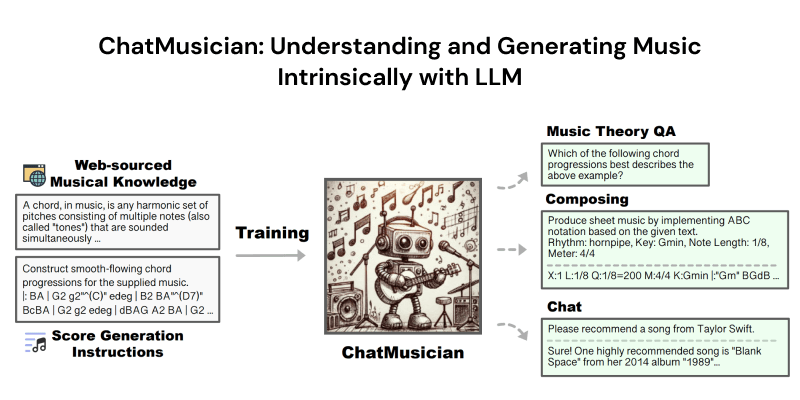
- Official project homepage:https://shanghaicannon.github.io/ChatMusician/
- arXiv research paper:https://arxiv.org/abs/2402.16153
Main Features of ChatMusician
- Music understanding and analysis:
- Music theory question answering: ChatMusician can answer complex questions about music theory, which may involve chords, melody, rhythm, musical form, etc.
- Musical form analysis: The model can identify and analyze the structure of musical works, such as binary form, ternary form, etc.
- Musical motif extraction: ChatMusician can extract the main musical motifs from musical works and understand their role in the work.
- Music generation and composition:
- Chord composition: Based on a given chord sequence, ChatMusician can create smooth chord progressions.
- Melody composition: The model can create melodies based on a given chord or musical form.
- Musical form composition: ChatMusician can create musical works with specific musical forms (such as sonata form, rondo form, etc.).
- Music style imitation: The model can imitate the style of a specific musician, such as the Bach style, to create new musical works.
- Interaction between music and text:
- Music knowledge question answering: ChatMusician can understand and answer questions about music knowledge, such as music terminology, history, instrument characteristics, etc.
- Music composition guidance: The model can provide guidance during the music composition process, such as suggesting chord progressions, melodic development, etc.
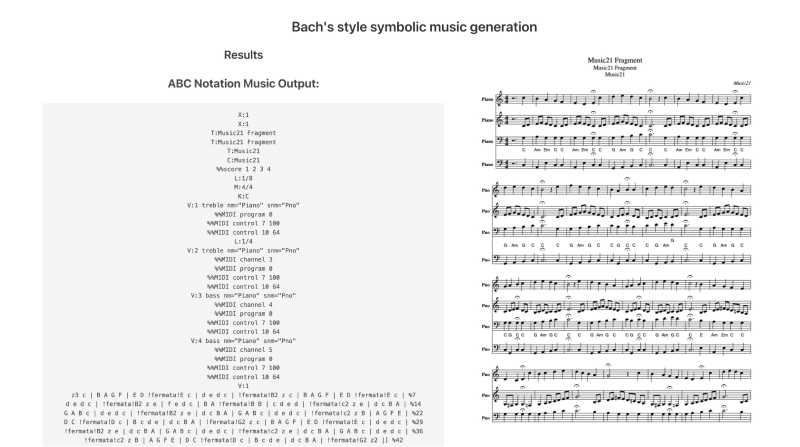
Technical Principles of ChatMusician
- Large Language Model (LLM):ChatMusician is based on large pretrained models such as LLaMA2. These models learn the structure, grammar, and semantics of language through pretraining on large amounts of text data.
- Music notation (ABC Notation):To enable the model to process music data, ChatMusician uses ABC notation, which is a notation system that converts musical symbols into a text format.The textual representation of ABC notation allows music data to be input into the model in a form similar to natural language text, enabling the model to use its capabilities in text processing to understand and generate music.
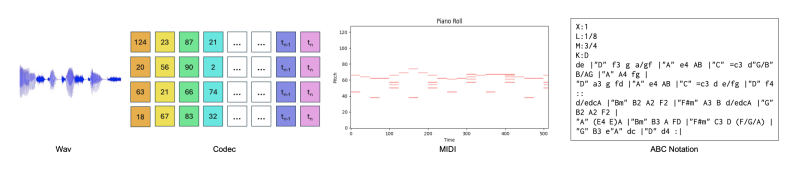
Common music representation methods
- Continued pretraining and fine-tuning:During the pretraining stage, the model learns general representations of language on diverse text datasets.During the fine-tuning stage, the model is trained on specific music tasks to adapt to the needs of music understanding and generation, including handling music theory knowledge, chord progressions, melody composition, etc.
- Multi-task Learning:ChatMusician uses multi-task learning (MTL) to simultaneously handle music understanding and music generation tasks, allowing the model to share knowledge across different tasks and improve overall performance.
- Music Theory Benchmark:To evaluate the model's ability in music understanding, researchers developed MusicTheoryBench, a benchmark specifically targeting music theory questions.Through this benchmark, ChatMusician's music understanding ability was verified, especially in music knowledge, music reasoning, and music form analysis.
- Dataset Construction:To train and evaluate ChatMusician, researchers constructed the dedicated music-language corpus MusicPile, as well as the MusicTheoryBench music understanding benchmark.These datasets contain music knowledge question-answer pairs, music notation, music summaries, etc., providing the model with rich music and language information.