
What is CAVIA
CAVIA is a multi-view video generation framework jointly launched by Apple, the University of Texas at Austin, and Google. It can convert a single input image into multiple spatiotemporally consistent video sequences. The framework is based on the introduction of a view ensemble attention module, enhancing the view consistency and temporal coherence of videos, supporting users in precisely controlling camera motion while preserving object motion. The design flexibility of CAVIA enables it to be jointly trained with multiple data sources, significantly improving the geometric consistency and perceptual quality of videos, and it has application potential in fields such as virtual reality, augmented reality, and film production.
Main Features of CAVIA
- Multi-view video generation: Generate video sequences from multiple viewpoints from a single input image, providing users with precise control over camera motion while preserving object motion.
- View and temporal consistency: Based on a view ensemble attention module, enhance the consistency of videos across different viewpoints and temporal frames.
- Camera control: Users precisely specify camera motion to generate video frames consistent with viewpoint instructions.
- Joint training strategy: Train with a mixed data source of static videos, dynamic videos, and real-world monocular dynamic videos to improve the quality and realism of video generation.
- Multi-view extension: At inference time, extend to four viewpoints, providing improved view consistency.
- 3D reconstruction: Frames generated by CAVIA are used to reconstruct 3D scenes, demonstrating three-dimensional effects with high perceptual quality.
Technical Principles of CAVIA
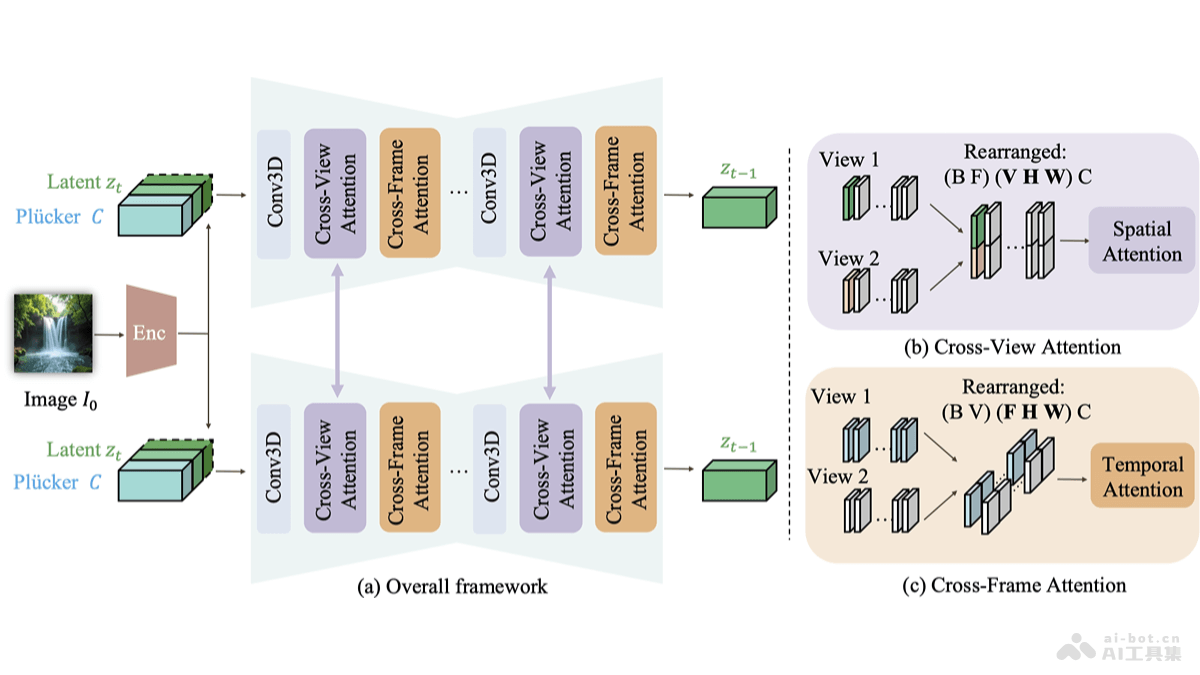
- SVD-based model: Built on a pretrained Stable Video Diffusion (SVD) model; the model extends Stable Diffusion 2.1 by adding temporal convolutions and attention layers.
- Plücker coordinates: Introduce Plücker coordinates to achieve camera control, using the camera's position and orientation information as embeddings together with the original latent input, ensuring that the generated video frames follow precise viewpoint instructions.
- Cross-frame Attention: Improve the original 1D temporal attention module with a 3D cross-frame temporal attention module, supporting joint modeling of spatial-temporal features and adapting to large pixel displacements caused by viewpoint changes.
- Cross-view Attention: To improve the consistency of multi-view videos, introduce a 3D cross-view attention module, encouraging the exchange of information between different views during the generation process.
- Joint training strategy with data mixing: Based on a joint training strategy, combine static scene videos, dynamic object videos, and real-world monocular videos, enabling the model to learn rich object motion and complex background information.
- 3D reconstruction capability: Video frames generated by CAVIA are converted into three-dimensional scenes based on 3D reconstruction technology, demonstrating the potential for generating three-dimensional content with high perceptual quality.
CAVIA Project Address
- Project website:ir1d.github.io/Cavia
- arXiv technical paper:https://arxiv.org/pdf/2410.10774
Application Scenarios of CAVIA
- Virtual reality (VR) and augmented reality (AR): Generate VR and AR content, providing more realistic and immersive experiences, especially in fields such as gaming, simulation training, and virtual tourism.
- Film and video production: In film production, preview and simulate complex camera movements and scene layouts, or create special effects to enhance visual effects.
- 3D Content Creation: Assist in 3D modeling and animation production, generate multi-view videos to help designers better understand and present 3D models during the creative process.
- Video Conferencing and Remote Collaboration: In video conferencing, simulate different camera angles to provide a more natural and flexible remote communication experience.
- Education and Training: In the field of education, create simulated experiments and training scenarios, provide multi-angle learning materials, and enhance the learning experience.