
What is CAT4D
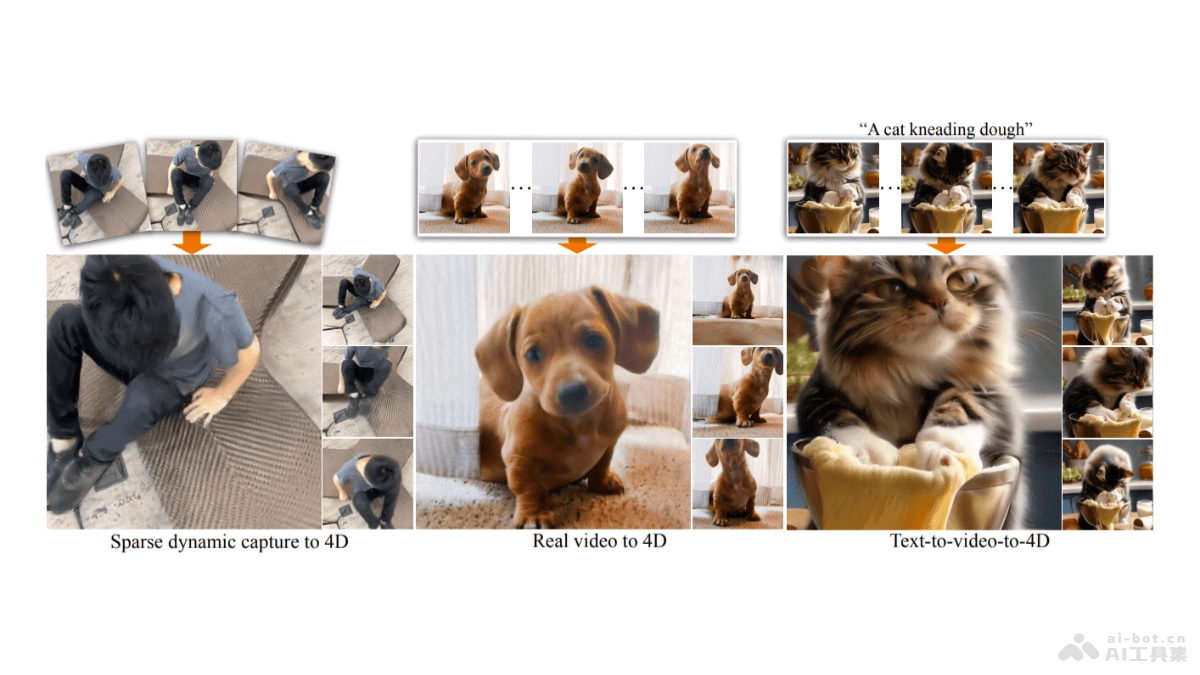
CAT4D was jointly developed by Google DeepMind, Columbia University, and UC San Diego, and can create 4D scene (dynamic 3D) representations from monocular video. CAT4D is based on a multi-view video diffusion model, can synthesize new views at any specified camera pose and time point, and converts monocular video into multi-view video to achieve robust 4D reconstruction. CAT4D can generate 4D scenes from real videos and create 4D content from generated videos, bringing possibilities for innovative applications in fields such as film production, game development, and virtual reality.
Main features of CAT4D
- 4D scene creation: Create 4D (dynamic 3D) scenes from monocular video (whether real footage or computer-generated).
- Multi-view video generation: Given a monocular video input, generate multi-view videos at new viewpoints.
- Dynamic 3D scene reconstruction: Use the generated multi-view videos to reconstruct dynamically changing 3D scenes, which can be represented as 3D Gaussian models that deform over time.
- Separated camera and time control: At the core of CAT4D is a multi-view video diffusion model that can separate camera viewpoint control and scene dynamics control, allowing users to independently manipulate camera perspectives and temporal changes in the scene.
- Real-time rendering: Based on an interactive viewer, it supports users in rendering 4D scenes in real time in the browser, providing an intuitive way to experience them.
Technical principles of CAT4D
- Multi-view video diffusion model: Based on a multi-view video diffusion model, the model accepts a set of input views (including images, camera parameters, and time information) and generates target frames at specified viewpoints and times.
- Dataset training: Because multi-view training data for dynamic scenes is scarce, CAT4D's training involves a mixture of real and synthetic data sources, including multi-view images of static scenes, fixed-viewpoint videos, and synthetic 4D data.
- Novel view synthesis: Based on the input monocular video, the model synthesizes the appearance of the scene at new time points and viewpoints, achieving the conversion from monocular input to multi-view output.
- Optimizing deformable 3D Gaussian representations: The generated multi-view videos are used to reconstruct a dynamic 3D model by optimizing a deformable 3D Gaussian representation, and this representation method can capture the dynamic changes of the scene.
- Separated control: CAT4D can independently control camera motion and scene dynamics, making it possible to generate output sequences at different times and viewpoints from a given input image.
- Alternating sampling strategy: To generate sufficiently consistent multi-view videos for accurate 4D reconstruction, CAT4D is based on an alternating sampling strategy that alternates between multi-view sampling and temporal sampling, ensuring consistency of the video in time and viewpoint.
CAT4D project address
- Project official website:cat-4d.github.io
- arXiv technical paper:https://arxiv.org/pdf/2411.18613
Application scenarios of CAT4D
- Film and video production: In film and video production, based on creating 3D scenes from existing 2D videos, add visual effects, or generate new perspectives and scene dynamics.
- Game development: In game development, generate more realistic and dynamic game environments, providing a richer player experience.
- Virtual reality (VR) and augmented reality (AR): Create realistic 3D environments and objects for use in virtual reality and augmented reality applications, enhancing users' sense of immersion.
- 3D modeling and design: Designers extract and reconstruct 3D models from existing video materials, accelerating product design and prototyping.
- Education and training: In the field of education, create dynamic 3D recreations of historical events or scientific phenomena, providing a more intuitive learning experience.