
What Is Casevo
Casevo (Cognitive Agents and Social Evolution Simulator) is an open-source social communication simulation system jointly launched by the School of Data Science and Intelligent Media at Communication University of China and the State Key Laboratory of Media Convergence and Communication at Communication University of China. By combining large language models and multi-agent technology, it understands and predicts social communication phenomena based on simulating human cognition, decision-making, and social interaction. Casevo uses a modular architecture, supports a complete simulation framework from scenario setup to complex social network modeling, and advances the simulation process with a round-based update mechanism. The Casevo system has broad application potential and is suitable for fields such as journalism and communication, social computing, and public policy, helping researchers conduct theory building, hypothesis validation, and strategy optimization, and promoting the development of the "AI For Social Science" research paradigm.
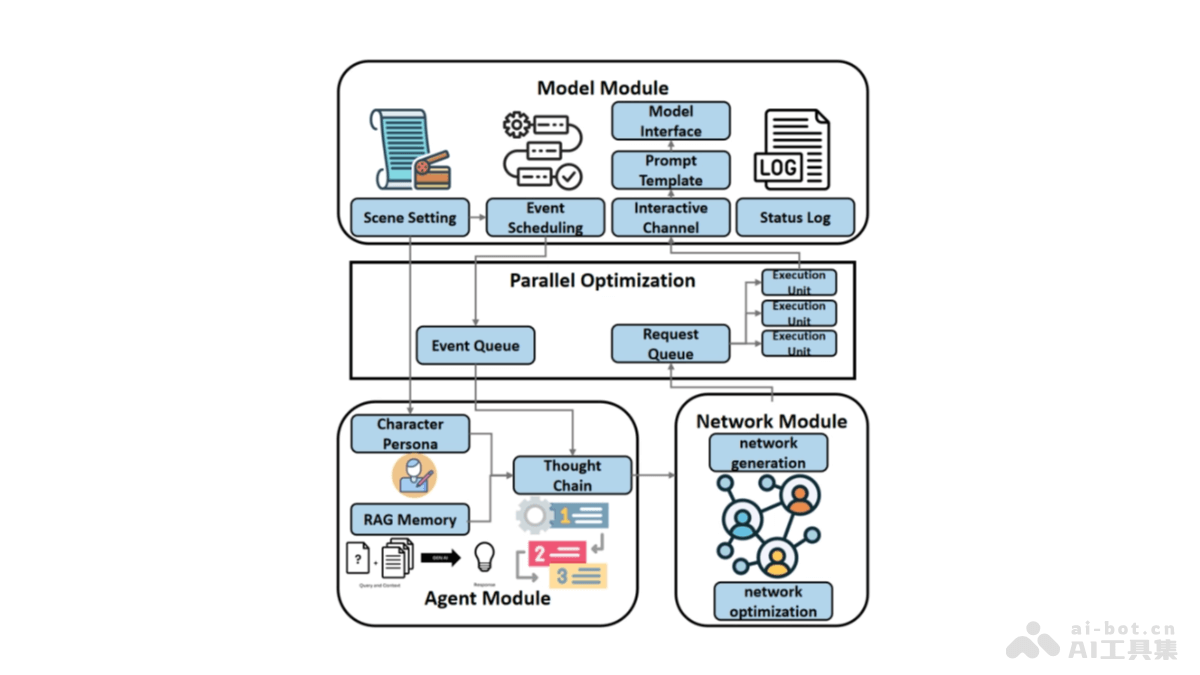
Casevo's Main Features
- Social Interaction Simulation: Simulates complex social interaction processes, such as election debates and public opinion dissemination, reproducing interactions and information exchange among individuals.
- Dynamic Social Network Modeling: Supports the construction and dynamic adjustment of social network structures, reflecting the evolution of individual relationships, and is suitable for research scenarios such as information dissemination and social influence.
- Individual Behavior and Decision-Making Simulation: Based on mechanisms such as Chain of Thought (CoT) and Retrieval-Augmented Generation (RAG), agents can perform multi-step reasoning and make decisions based on historical memory, simulating individuals' behavioral choices in complex situations.
- Large-Scale Parallel Processing: Equipped with parallel optimization modules, it efficiently handles the parallel behavior and decision-making of large-scale agents, improving simulation efficiency and performance.
- Flexible Scenario Customization: Users can customize simulation scenarios according to their needs, including agent personality settings, network topology, and external event intervention, adapting to diverse research needs.
Casevo's Technical Principles
- Discrete Event Simulation: Based on a discrete event simulation mechanism, it uses a polling update method to manage agent behavior and event scheduling, ensuring synchronization of system behavior and orderly arrangement of events, and is suitable for social dynamic simulation scenarios that advance step by step.
- Large Language Model (LLMs) Integration: Integration with LLMs allows agents to generate natural language text and engage in human-like decision-making and communication, enhancing the realism and complexity of simulations.
- Chain of Thought (CoT): The CoT mechanism supports agents in multi-step reasoning, considering multiple factors before making decisions, and simulating strategic behaviors such as planning, negotiation, and coalition building.
- Retrieval-Augmented Generation (RAG): The RAG memory system enables agents to recall past interactions and decisions, generating more detailed and context-relevant behavior based on historical data, and simulating human long-term strategic thinking and memory-dependent decision-making.
- Modular Architecture: Casevo adopts a modular design, dividing functions such as model setup, agent behavior definition, parallel optimization, and network management into independent modules, achieving a high degree of system flexibility and scalability, and facilitating customization and extension according to specific needs.
Casevo's Project Address
- GitHub Repository:https://github.com/rgCASS/casevo
- arXiv Technical Paper:https://arxiv.org/pdf/2412.19498
Casevo's Application Scenarios
- Social Science Research: Simulates election processes, analyzes changes in voter preferences, predicts election results, and provides data support for election research.
- Behavior Prediction: Simulate consumer purchasing decisions, analyze influencing factors, help enterprises formulate marketing strategies, and improve market competitiveness.
- Education: Build a virtual chemistry laboratory, simulate chemical reactions and experimental operations, assist chemistry teaching, and improve learning outcomes and safety.
- Entertainment and Game Development: Design complex interactive NPCs so that NPCs can respond in diverse ways based on player behavior, enhancing game playability and immersion.
- Emergency Management: Simulate emergency responses to disasters such as earthquakes, analyze the effects of emergency strategies, improve emergency efficiency, and reduce disaster losses.