
In the field of artificial intelligence, discussion is increasingly intense about whether Vision-Language Models (VLMs) can replace traditional Optical Character Recognition (OCR). After in-depth analysis of technical principles, performance, and application scenarios, a clear conclusion emerges:VL models are not the "terminator" of OCR, but its powerful "evolutionary partner" . The relationship between the two is not a simple replacement, but a complex symbiosis and complementarity. OCR technology, especially modern OCR optimized by deep learning, still maintains its core advantages in speed, accuracy, and cost-effectiveness for specific, standardized tasks. VL models, by contrast, leverage their outstanding contextual understanding and multimodal fusion characteristics to show potential beyond OCR's reach when handling complex, unstructured visual information. The future development trend is not choosing one over the other, but moving toward deep integration, building hybrid systems that can intelligently schedule and collaborate according to task requirements, achieving a "1+1>2" effect.
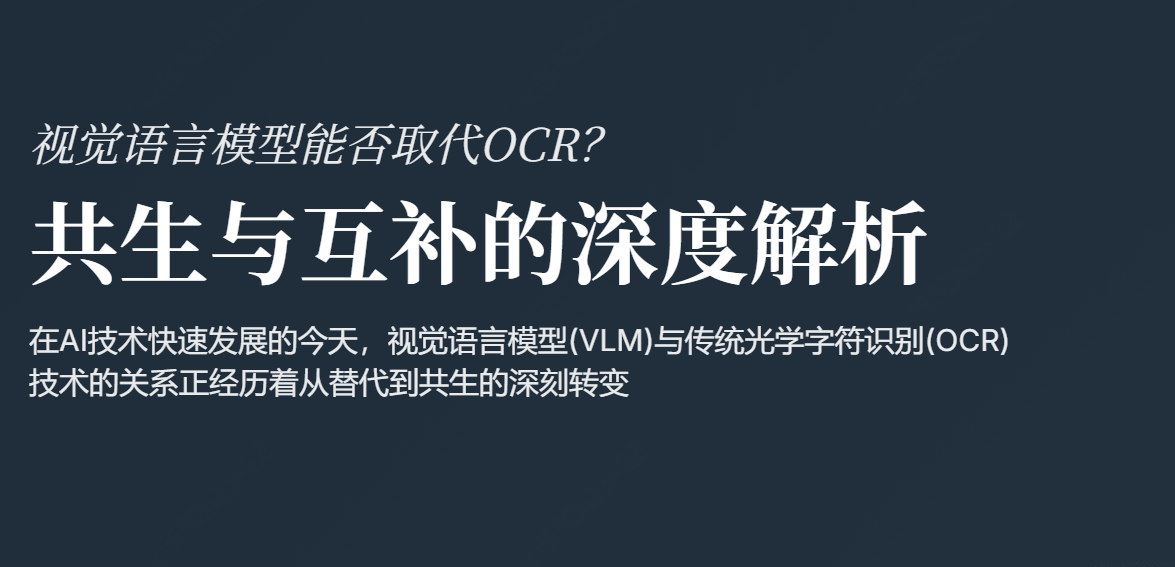
Evolution from replacement to symbiosis
Evolution of the technical relationship
Essential differences in capabilities
OCR:A "specialist" focused on character recognition – a highly skilled letter engraver
VLM:A "generalist" with visual-language common sense – a deeply learned interpreter
"The leap from 'reading characters' to 'understanding' is the essential difference in capability dimensions between VLM and OCR"
- OCR's core task is "recognition", a highly specialized process whose goal is to accurately map the shapes of characters in an image to computer-readable text encoding. Whether it is traditional OCR based on template matching and feature extraction, or modern end-to-end OCR based on deep learning, the essence is solving a complex classification problem: determining whether a region in an image is "A" or "B", "1" or "l". Its work stops at the character level, with almost no cognition of the text's semantics, contextual logic, or layout meaning in the document (such as headings, body text, tables).
- VL models' core capability lies in "understanding". By mapping visual information and language information into the same semantic space, they achieve an overall grasp of image content. When a VL model "sees" an invoice, it can not only "read" the text on it, but also "understand" that it is an invoice, know where the "amount" field is usually located, distinguish "product name" from "unit price", and infer from context what unclear handwriting most likely is.
Fusion systems become mainstream
- Fusion at the architecture level, for example research projects such as DocVLM, by inputting text and layout information extracted by OCR as an independent modality into the VL model, significantly improving the model's performance on document understanding tasks while reducing dependence on high-resolution images and effectively lowering computational overhead.
- Fusion at the workflow level, that is, building an intelligent routing system. Based on factors such as the complexity, quality, and format of the input image, the system dynamically decides whether to call a lightweight OCR model for rapid processing or activate a powerful VL model for deep understanding.
With the emergence of powerful VLMs such as GPT-4V and Qwen-VL, the industry initially held the expectation of "one trick that works everywhere." However, as practice deepened, this view of "complete replacement" was gradually replaced by the more pragmatic concept of "symbiotic complementarity." OCR maintains its core advantages of speed, accuracy, and cost-effectiveness in specific scenarios, while VLMs excel when handling blurry, skewed, handwritten, multilingual-mixed, and complex-layout documents.
In-Depth Analysis of Technical Principles
OCR: A "Specialist" Focused on Character Recognition
The development of OCR technology can be broadly divided into three stages: the traditional algorithm stage, the deep learning stage, and the lightweight model stage. Each stage represents different trade-offs and optimization directions in recognition accuracy, processing speed, and model efficiency.
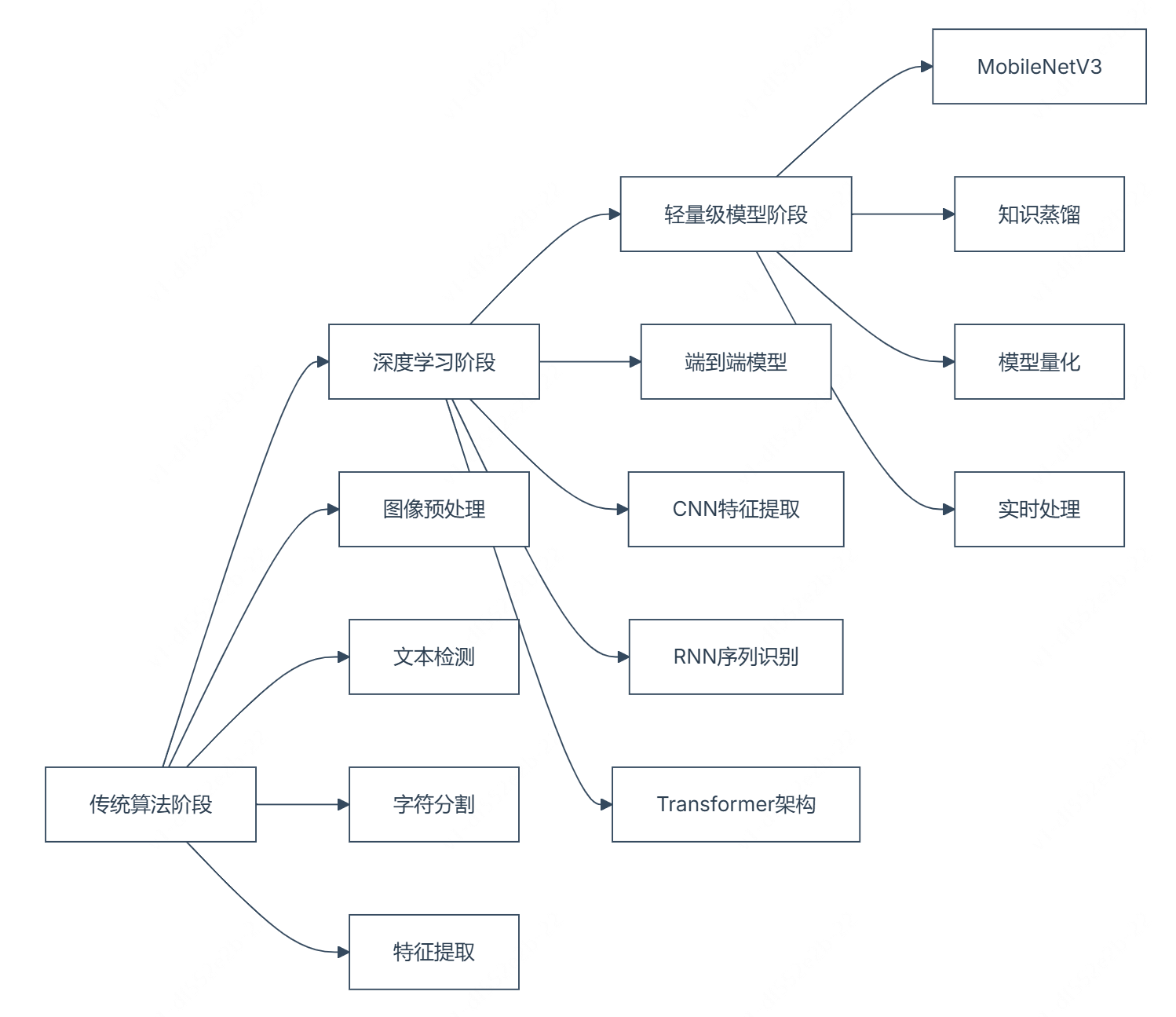
Traditional OCR Pipeline
Image preprocessing → text detection and segmentation → character recognition. Based on connected component analysis and feature extraction, classifiers such as SVM are used for character recognition.
Deep Learning OCR
End-to-end neural network architecture that integrates detection and recognition. CNNs extract visual features, RNNs/Transformers handle sequence dependencies, and it supports recognition of complex backgrounds and artistic fonts.
Lightweight OCR
Taking PP-OCRv5 as an example, it adopts the MobileNetV3 backbone network and, through knowledge distillation and model quantization techniques, achieves real-time processing on CPU.
VL Models: A "Generalist" with "Vision-Language" General-Purpose Capabilities
Unlike OCR, which focuses on character recognition, the goal of VL models is to build a general-purpose artificial intelligence system capable of understanding both images and text simultaneously. Its core idea is to map visual information and linguistic information into a unified representation space, thereby performing cross-modal reasoning and generation within this space.
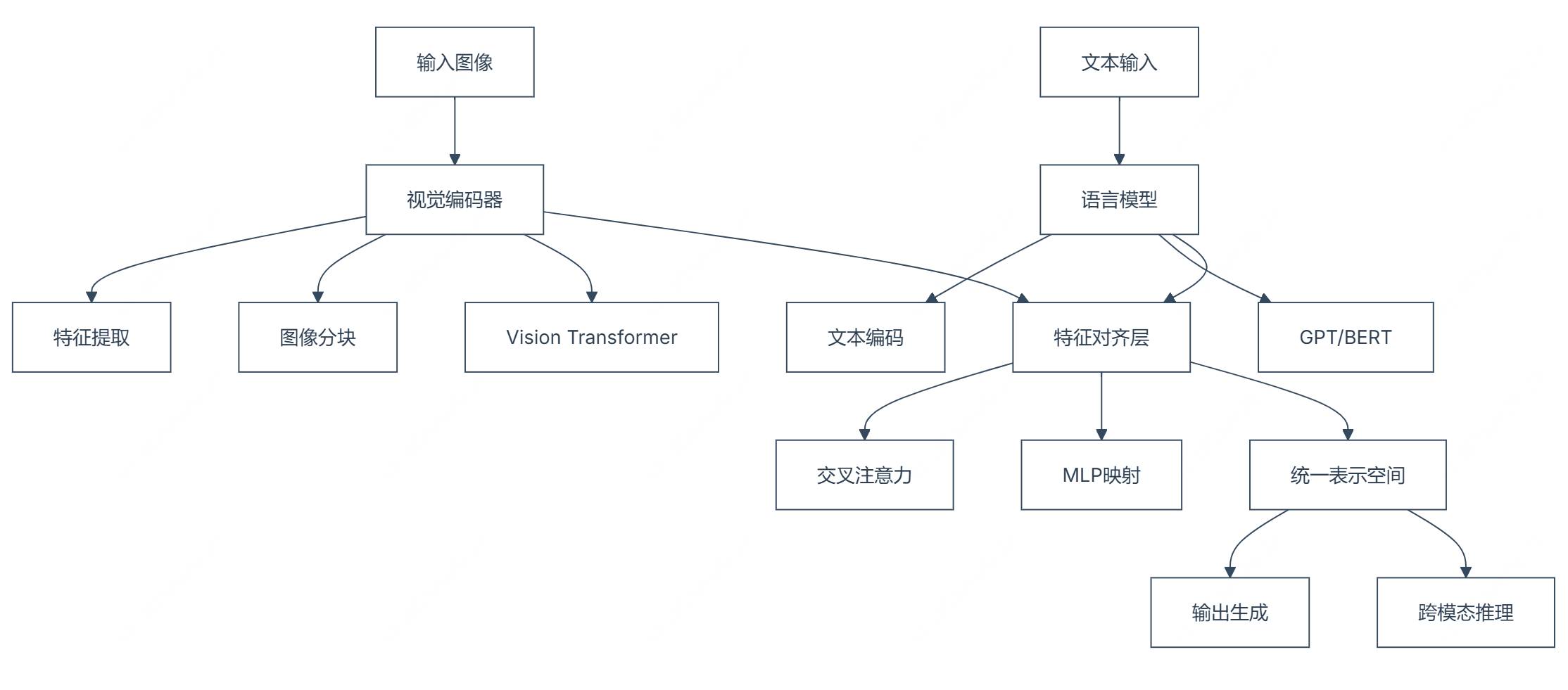
Core Architecture Components
Vision encoder (ViT) + language model (LLM) + feature alignment layer. Maps visual and linguistic information into a unified semantic space.
Working Mechanism
"Top-down" holistic understanding that captures global semantic information and relationships among visual elements, and uses context for reasoning.
High-Resolution Processing
Dynamic tiling strategies and visual token compression techniques, such as image tiling in Qwen2-VL and DocCompressor in mPLUG-DocOwl2.
Performance Comparison
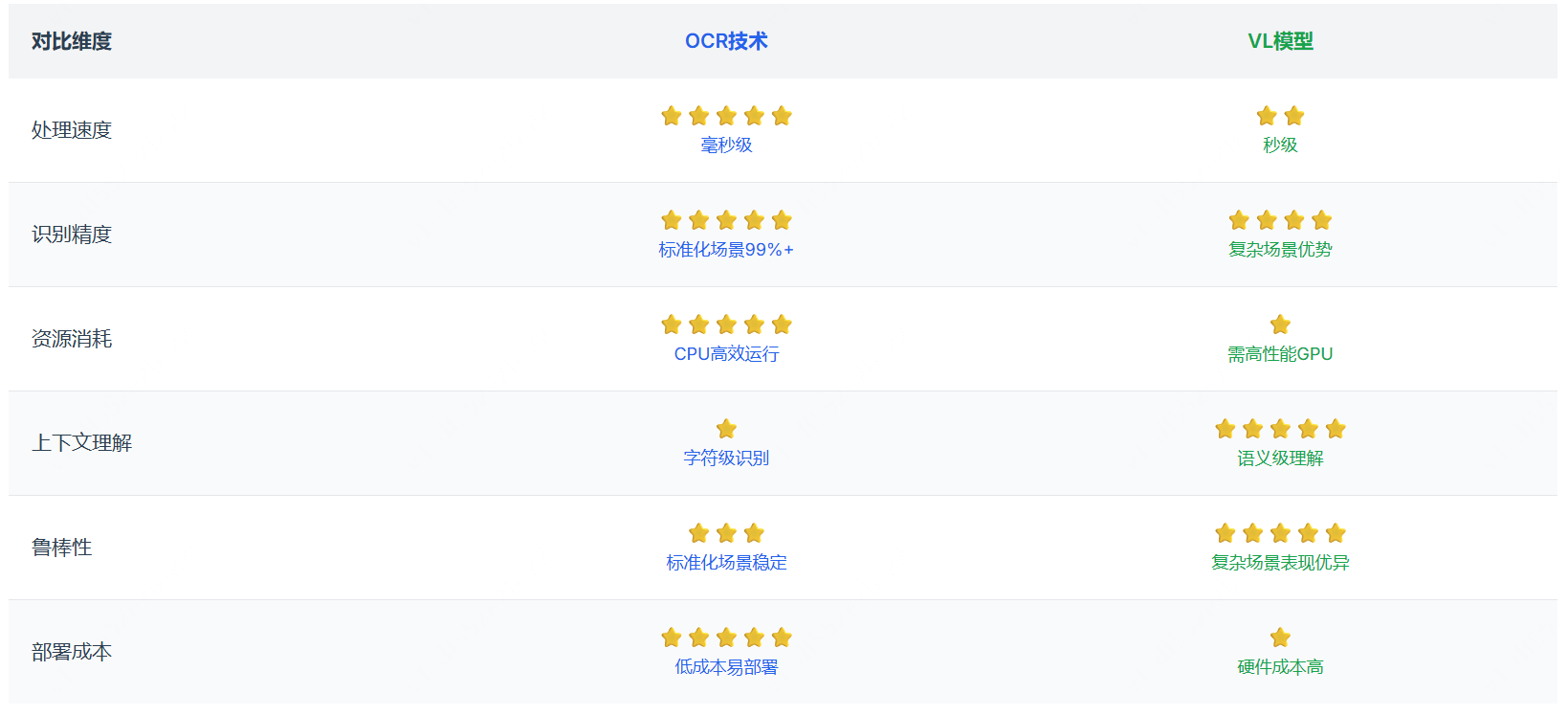
When evaluating the performance of VL models and OCR, one cannot simply use a single metric to measure them. The two have their own strengths and weaknesses across different dimensions, presenting a typical trade-off between "accuracy" and "speed." OCR holds an advantage in standardized scenarios with its extreme speed and cost-effectiveness, while VL models shine in complex tasks thanks to their exceptional accuracy and robustness.
Accuracy Comparison
Accuracy is the most core metric for measuring text recognition technology. Under ideal conditions—that is, clear documents, standard formats, and uniform fonts—modern OCR technology can already achieve very high recognition accuracy, even surpassing humans.
VLMs Have Clear Advantages in Complex Scenarios
Comparative Analysis Based on the FUNSD Dataset
To objectively compare the performance of VL models and traditional OCR, researchers conducted a series of benchmark tests using FUNSD (Form Understanding in Noisy Scanned Documents), a dataset containing 199 noisy scanned forms. The tests evaluated traditional OCR services including Tesseract and Google Vision API, as well as VL models such as Qwen and Mistral. The evaluation metrics covered text similarity, word error rate (WER), character error rate (CER), and processing time.
| Model/Service | Text Similarity (↑) | Word Error Rate (WER) (↓) | Character Error Rate (CER) (↓) | Average Processing Time (seconds/page) (↓) |
|---|---|---|---|---|
| Traditional OCR (Average) | Lower | Higher | Higher | ~0.1 |
| Tesseract | Lower | Higher | Higher | Fast |
| Google Vision API | Medium | Medium | Medium | Fast |
| VL Models (Average) | High | Low | Low | ~1.0 – 2.0 |
| Qwen-VL | High | Low | Low | Slow |
| Mistral-VL | High | Low | Low | Slow |
Scenarios Where VLMs Excel
- Complex layouts and unstructured documents
- Low-quality images and blurred text
- Mixed-language and handwritten text recognition
- Contextual reasoning and semantic understanding
Scenarios Where OCR Excels
- Standardized documents and fixed formats
- Small fonts and fine-detail recognition
- High-precision character-level recognition
- Structured text extraction
Speed and Efficiency Comparison
If accuracy is the "spear" of VL models, then speed and efficiency are the "shield" of OCR. In applications that need to process massive volumes of documents or have strict real-time requirements, OCR's advantage is overwhelming.
OCR's Absolute Advantages
VLMs are 5-10 times slower than OCR
VLM Resource Consumption Challenges
- Requires support from expensive GPU clusters
- High memory requirements for billions of parameters
- Requires high-performance GPUs during inference
- High deployment and maintenance costs
OCR Efficiency Advantages
- Millisecond-level inference speed meets real-time requirements
- Lightweight models can run efficiently on CPUs
- Supports mobile and embedded devices
- Low deployment cost and simple maintenance
Robustness and Adaptability Comparison
Adaptability Across Different Scenarios
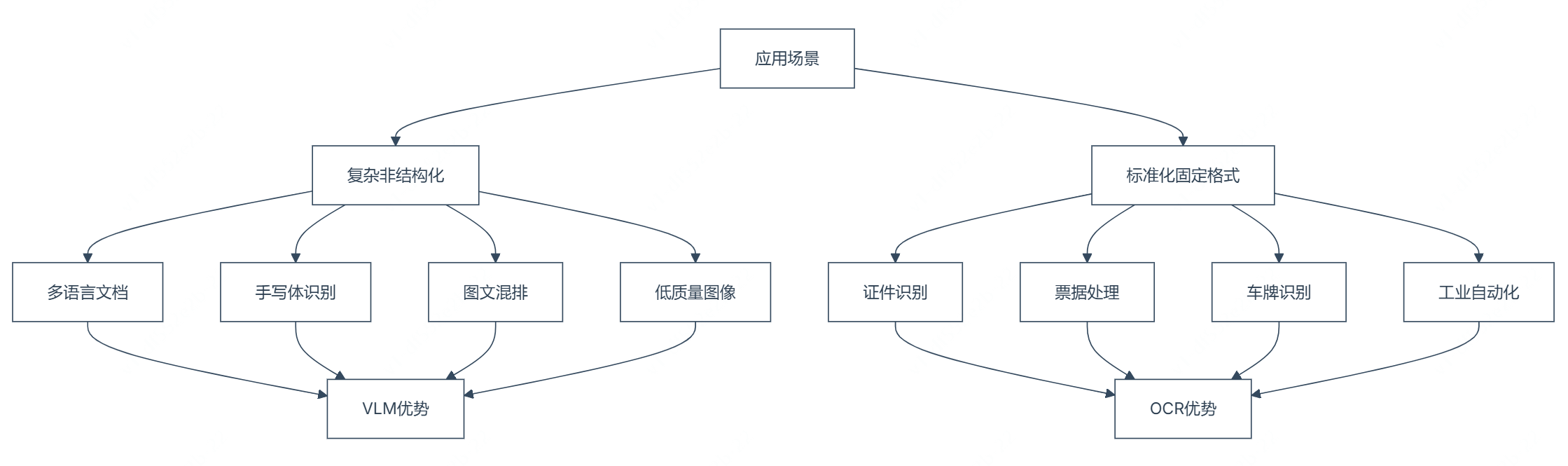
VLM Generalization Capability: Demonstrates strong generalization in multilingual and handwritten text recognition, with native support for multiple languages and seamless switching between them.
- Zero-shot learning capability
- Cross-lingual understanding capability
- Capture of handwriting stroke features
OCR Stability Performance: Delivers extremely high stability and accuracy in processing fixed-format documents, with dedicated templates approaching 100% accuracy.
- Dedicated template optimization
- Rule-based information extraction
- High reliability assurance
"When processing fixed-format documents, the efficiency and reliability of dedicated OCR templates remain the best choice"
Practical Application Scenarios
OCR's "Home Turf"
- License plate recognition and ID document extraction: Highway ETC, parking lot billing, self-service check-in devices; millisecond-level recognition with accuracy exceeding 99%
- Receipt and form processing: Financial invoices, logistics waybills, bank statements; standardized information extraction with strong batch processing capability
- Industrial automation: Production line serial number recognition, dashboard reading monitoring; real-time data collection synchronized with production节奏
VLMs' "Stage"
- Complex document understanding: Research reports, financial statements, academic papers, mixed text-image layout structures, chart and table comprehension
- Multimodal question answering: Image-based visual question answering, object recognition, scene understanding, commonsense reasoning
- Unstructured data extraction: Medical reports, product packaging, legal documents, diverse information extraction and structured output
"Golden Partner" model
- Guidance OCR: OCR guides VLM for precise information extraction, combining OCR speed and VLM comprehension capability
- DocVLM architecture: Integrate OCR as an independent modality encoder into the VLM architecture to improve document understanding performance
- Industrial-grade document AI: "OCR rough processing + VLM precise finishing" hybrid architecture, improving recall and reducing costs
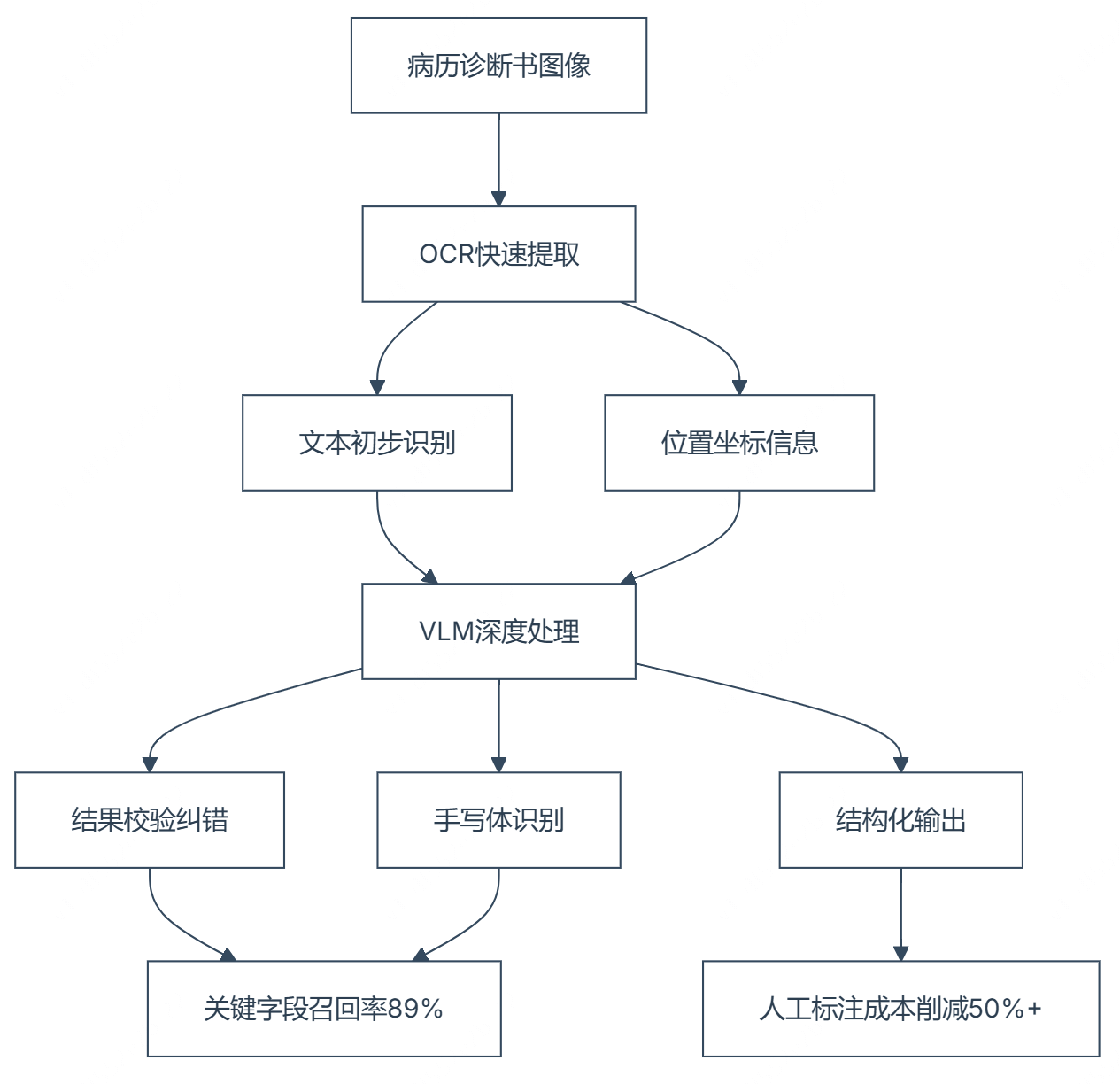
Industrial-grade case study: Parsing of medical record diagnosis certificates from top-tier hospitals
"Through the hybrid architecture of 'OCR rough processing + VLM precise finishing,' the optimal balance between efficiency and accuracy is achieved"
- Hybrid architecture solution
- Project results
- Key field recall increased to 89%
- Manual annotation costs reduced by more than 50%
- Recognition accuracy for handwritten portions significantly improved
- Structured output facilitates subsequent data utilization
Advantages and limitations
OCR technology
Advantages
The core advantages of OCR can be summarized in three points:speed, accuracy, and cost. In terms of speed, whether OCR is based on traditional algorithms or lightweight deep learning models, inference speed is very fast, usually at the millisecond level, meeting the needs of real-time processing. In terms of accuracy, for clear, standard printed text, OCR recognition accuracy can reach over 99%, performing very stably. In terms of resource consumption, OCR models are usually relatively lightweight, can run efficiently on CPUs, have low hardware requirements, and have relatively low deployment costs.
Limitations
- Lack of contextual understanding: It only cares about "what this character is," not "what this sentence means"
- Poor adaptability: Relies on preset rules and templates; performance drops sharply when formats change
- Powerless in complex scenarios: Recognition rates drop significantly when facing blurry, skewed, handwritten, or multilingual mixed images
VL models
Advantages
- Powerful contextual understanding capability:This is the core advantage of VL models. Like humans, they can understand an image as a whole, capture the logical relationships between visual elements, and reason by combining language knowledge. They perform excellently in tasks such as processing complex documents and conducting visual question answering.
- Multimodal fusion:VL models can seamlessly fuse visual and linguistic information to achieve cross-modal understanding and generation, opening up imaginative possibilities for applications in fields such as creative content generation and intelligent interaction.
- Zero-shot learning capability:Due to their massive knowledge base, VL models have good zero-shot or few-shot learning capabilities and can quickly adapt to new tasks or domains without requiring large amounts of annotated data and retraining.
Limitations
The limitations of VL models are equally obvious.Slow speed and high resource consumption. The inference speed of VL models is far slower than OCR, and the hardware resource requirements are extremely high;The "hallucination" problem exists. Because VL models are generative models, they sometimes "spout nonsense with a straight face," generating text that does not match the image content or is inconsistent with the facts.Inaccurate recognition of small fonts and details. When processing high-resolution images, VL models may lose some detail information, leading to errors when recognizing extremely small fonts or dense text.
Comprehensive Comparison of VLM vs OCR
Future Development Trends: Integration and Evolution
Technological Integration: Deep Integration of VLM and OCR
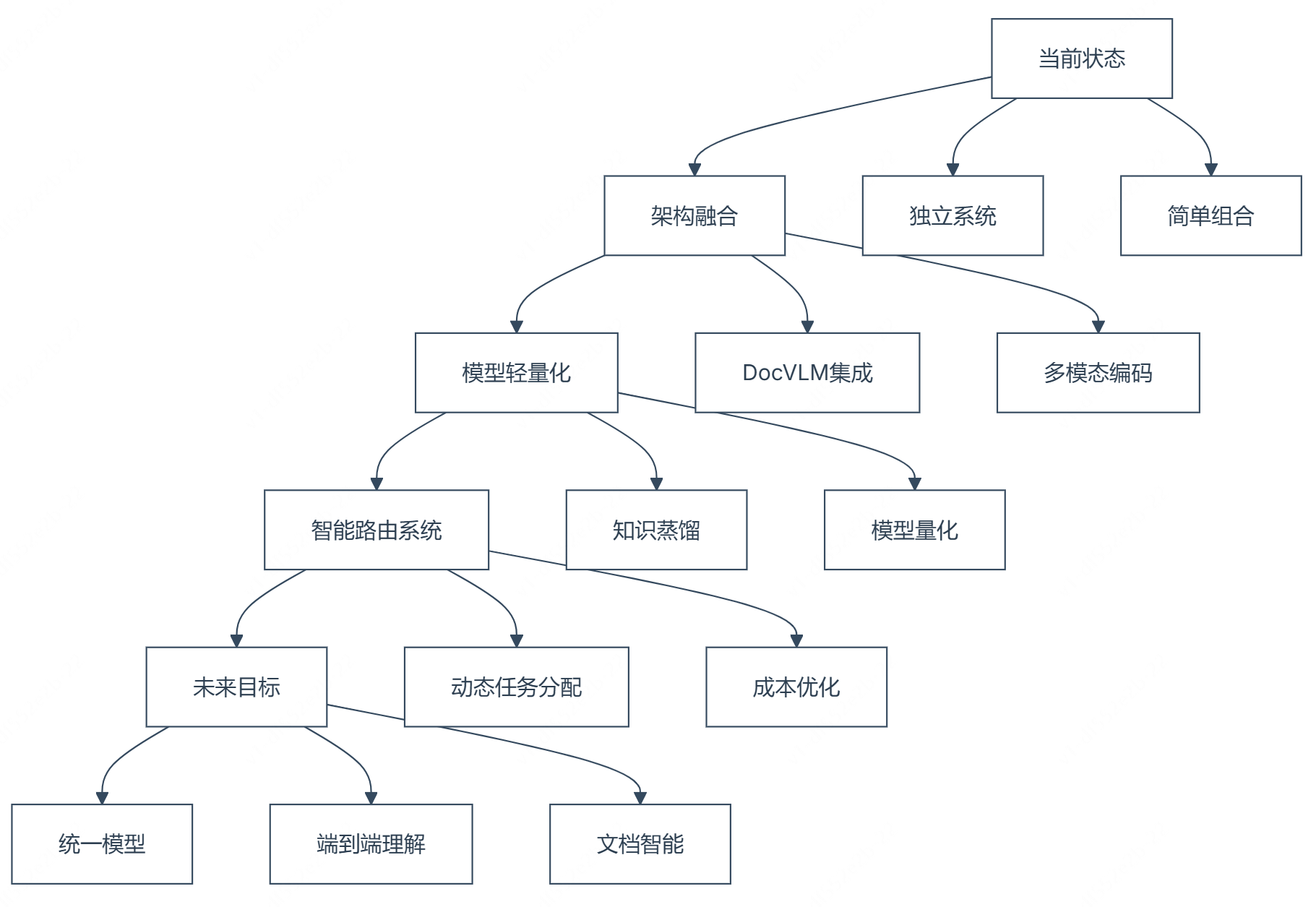
The future technological trend will be to break down the barriers between VLM and OCR and build a unified, end-to-end document intelligence model.
- Evolution of Model Architecture: Seamlessly integrate OCR's precise recognition capabilities with VLM's general understanding capabilities, design new attention mechanisms, and strengthen the text recognition module.
- Lightweight VLM: Through model compression techniques such as knowledge distillation, quantization, and pruning, significantly reduce model size and computational complexity while maintaining performance.
- Intelligent Routing System: Dynamically select OCR or VLM processing based on factors such as document complexity, quality, and format to optimize overall performance and cost-effectiveness.
Evolution of Integrated Architecture
Application Expansion: From Text Recognition to Document Intelligence
The goal of document AI is not merely to extract text but to comprehensively understand the content, structure, and intent of documents. Future systems will be able to automatically classify documents, extract key information, generate summaries, conduct compliance reviews, and even answer complex questions about document content.
- Rise of Document AI: Document understanding and analysis beyond OCR, automatic classification, information extraction, summary generation, and compliance review.
- Enhanced Multimodal Capabilities: Integrate more data types such as audio, video, and 3D point clouds; for example, the Qwen-VL series has already demonstrated long video understanding capabilities.
- Deepening of Industry Applications: Deep application in fields such as finance, law, and healthcare to solve industry pain points and create business value.
Future document intelligence systems will achieve a comprehensive leap from 'optical character recognition' to 'document intelligence,' driving the digital transformation of various industries to new heights