
What is buffett-skills
buffett-skills is an open-source Claude Code Skill collection built on Buffett's complete investment framework. buffett-skills distills 49 core concepts from the corpus of Buffett's shareholder letters into 8 reference files. Through progressive loading and three execution paths (quick screening, in-depth analysis, and topic-based Q&A), it enables AI to analyze any company using Buffett's decision-making process, outputting a structured report containing 10 fixed sections including moat, management, valuation, and margin of safety.
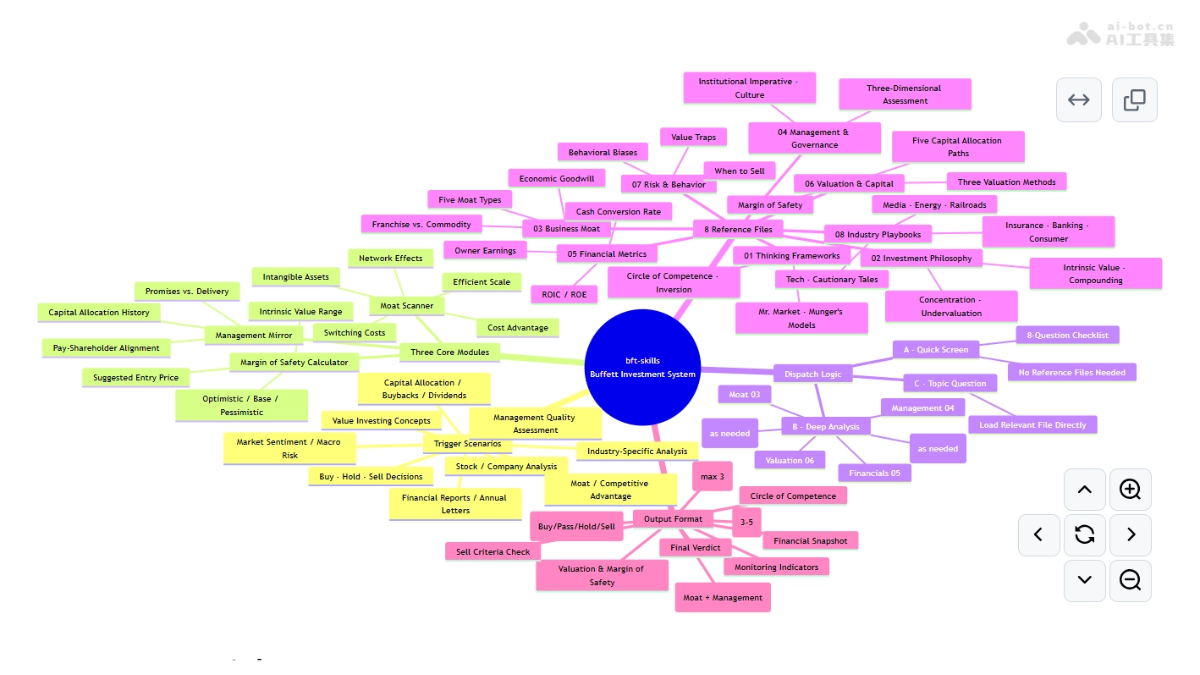
Main features of buffett-skills
-
Automatic investment analysis triggering: Automatically activates when users analyze stocks, read financial reports, discuss buy or sell decisions, or evaluate moats, invoking the complete investment framework without explicitly mentioning "Buffett."
-
Progressive reference file loading: Uses a design of a SKILL.md main file paired with 8 topic-specific reference files, loading content such as moat, management, financial, or industry manuals only as needed, effectively controlling context costs.
-
Intelligent routing across three execution paths: The quick screening path uses an 8-question checklist to determine within 2 minutes whether a company is worth researching; the in-depth analysis path reads the moat, management, financial, and valuation files in sequence to complete a full assessment; the topic-based Q&A path directly locates a single concept file to answer precisely.
-
Moat scanning and trend assessment: Identifies five types of moats—cost advantage, switching costs, network effects, intangible assets, and scale efficiency—and determines whether they are widening or narrowing.
-
Three-dimensional management evaluation: Evaluates management quality and integrity across three dimensions—degree of promise fulfillment, capital allocation history, and alignment with shareholder interests—with a one-vote veto applied to dishonest management.
-
Core financial metric analysis: Focuses on Buffett-style financial metrics such as owner earnings, ROIC/ROE, and cash conversion rate, distinguishing accounting profit from real cash flow.
-
Valuation and margin of safety calculation: Uses three valuation methods to output the intrinsic value range, margin of safety percentage, and suggested entry price under optimistic, base, and pessimistic scenarios.
-
Mandatory structured output: Each in-depth analysis must output 10 fixed sections: conclusion, circle of competence, key assumptions, business quality, financial snapshot, valuation, sell criteria, major risks, monitoring indicators, and overall judgment.
-
Industry-specific manual support: Includes differentiated analysis manuals for industries such as insurance, banking, consumer, media, energy, railroads, and technology, invoking the corresponding evaluation logic for different industries.
-
Sell discipline check: For hold or sell decisions, mandatorily verifies against the four sell criteria one by one, ensuring that exit decisions also follow a systematic process.
How to use buffett-skills
- Environment preparation: Ensure Claude Code is installed locally and that there is a project directory for storing the skill.
- Download the project: Run
git clone https://github.com/agi-now/buffett-skills /tmp/buffett-skillsto clone the repository to a local temporary directory. - Deploy the Skill: Run
cp -r /tmp/buffett-skills/skills/buffett your-project/.claude/skills/buffett, copying the buffett folder to the target project's.claude/skills/path. - Verify the directory: Confirm that the directory structure strictly matches
your-project/.claude/skills/buffett/SKILL.mdand 8 reference files; Claude Code will automatically discover the skill under that path. - Getting started: Enter any company name, stock ticker, or investment analysis question in the Claude Code conversation, and the skill will be triggered automatically.
- Select analysis mode: The system will automatically route to one of three paths based on the type of question: quick screening (2-minute 8-question checklist), in-depth analysis (complete 10-chapter report), or topical Q&A (precise answer to a single concept).
Key information and usage requirements for buffett-skills
-
Project nature: Open-source Claude Code Skill, not a standalone application
-
Reference sources: 49 concept pages from Buffett's shareholder letters and public writings from 1965 to the present
-
Installation requirements: Claude Code must already be installed, and the skill placement path must strictly conform to
.claude/skills/<name>/SKILL.md -
Trigger method: Automatic recognition; automatically activated when analyzing keywords such as stocks, financial reports, buy/sell decisions, moats, and management, without explicitly mentioning "Buffett"
-
Output format: Strict 10-chapter structured template (conclusion, circle of competence, key assumptions, business quality, financial snapshot, valuation, sell criteria, main risks, monitoring indicators, comprehensive judgment)
-
Performance cost: In-depth analysis consumes on average about 30,829 additional tokens and 59.2 seconds, with tool calls increasing from 2 to more than 11
Core advantages of buffett-skills
-
Process rather than conclusion: It does not provide follow-the-crowd advice on "what Buffett buys"; it reproduces his decision-making process so users understand why to buy or not buy.
-
Disciplined output: It mandates complete output of 10 chapters to avoid analysis omissions; when the business model is highly uncertain, it clearly gives the disciplined conclusion "cannot judge, observe, do not act."
-
Engineering-oriented design: Progressive loading solves the long-context cost problem, and three paths match different analysis depth requirements.
-
Significant measured results: In three test cases—Apple stock analysis, banking framework, and Moutai hold/sell—the pass rate with the Skill reached 100% (15/15), versus only 66.7% (10/15) without the Skill, an improvement of 33%.
Comparison of buffett-skills with similar competitors
| Dimension | buffett-skills | buffett-oracle-analyzer | ai-sub-invest (ConsensusAI) |
|---|---|---|---|
| Core positioning | Reproduction of Buffett's decision-making process | Buffett philosophy + modern multidimensional analysis framework | Multi-master consensus investment decision system |
| Analytical perspective | Single depth (pure Buffett framework) | Single depth (Buffett as the main focus, integrating technical analysis) | Multiple breadth (aggregation of 21 analyst roles) |
| Data dependency | None, purely framework- and corpus-driven | Requires real-time financial/market/conference call data | Requires financial data API key and Python environment |
| Valuation methods | Three classic valuation methods + margin of safety | 8 models (DCF/PEG/DDM/NAV/sum-of-the-parts, etc.) | Varies by analyst role |
| Technical analysis | None | Yes (candlestick charts/moving averages/RSI/MACD/chip analysis) | Yes (supported by independent technical skill) |
| Output format | 10-chapter fixed structured template | Buffett scorecard + target price + position sizing recommendation | JSON signal aggregation + consensus rating |
| Installation method | Copy the folder to .claude/skills |
Copy the folder to .claude/skills |
Requires uv sync Install dependencies and configure API |
| Best scenarios | Learn Buffett's thought process and discipline | Generate institutional-grade in-depth individual stock research reports | Cross-validate from multiple perspectives to find consensus signals |
Application scenarios of buffett-skills
-
In-depth individual stock analysis: Enter a company name and complete the full-process evaluation from moat to valuation according to the Buffett framework.
-
Rapid financial report reading: When reading annual reports or shareholder letters, quickly extract key financial indicators and management signals.
-
Buy/sell decision assistance: Conduct hold/sell checks on held stocks, verifying them one by one against the four sell criteria.
-
Industry thematic research: Call industry manuals such as insurance, banking, consumer, media, energy, railways, and technology for vertical analysis.
-
Value investing learning: Through the thematic Q&A mode, ask the AI about core concepts such as circle of competence, Mr. Market, intrinsic value, and margin of safety.