
What is BrushEdit
BrushEdit is an advanced image editing framework jointly launched by Tencent, Peking University, the Chinese University of Hong Kong, and Tsinghua University. It is anBrushNetadvanced iterative version of the model. The framework combines multimodal large language models (MLLMs) and a dual-branch image inpainting model to achieve instruction-guided image editing and inpainting, supporting users in performing free-form, multi-turn interactive editing operations with natural language instructions. BrushEdit can handle large-scale modifications such as adding and removing objects while maintaining background coherence and the naturalness of the editing results, significantly improving the flexibility of image editing and the user experience.
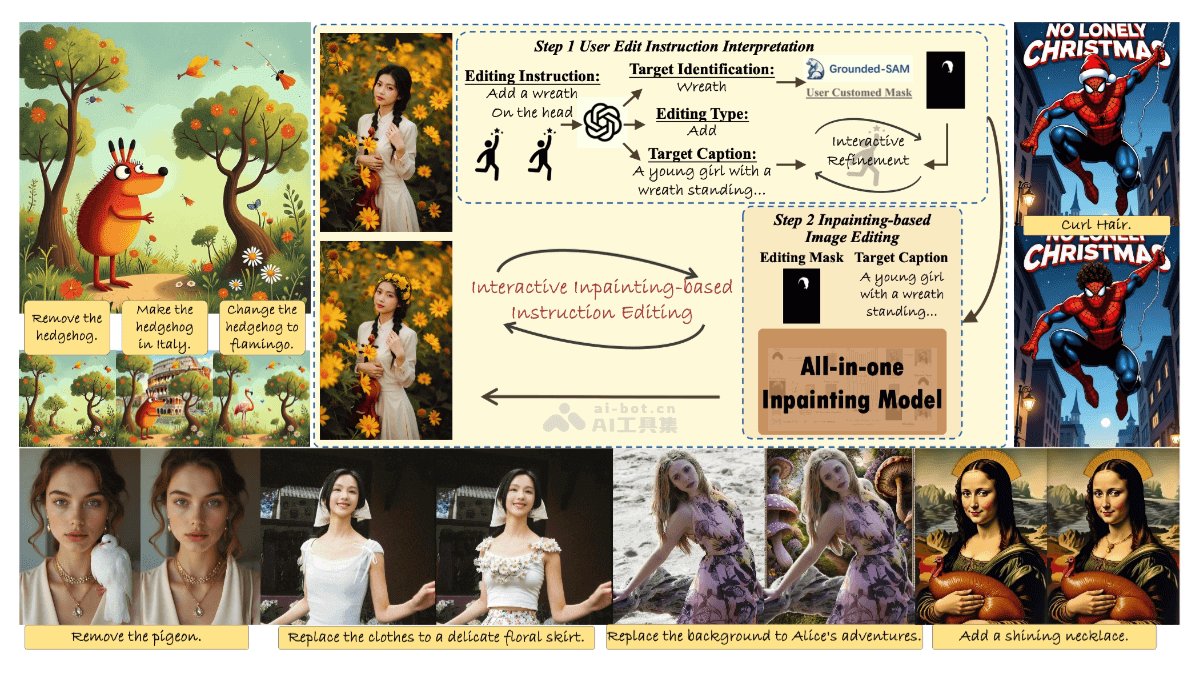
BrushEdit's main features
- Instruction-guided image editing: Users guide image editing tasks with natural language instructions, such as adding, deleting, or modifying objects in an image.
- Multi-turn interactive editing: Supports users in conducting multiple rounds of interaction during the editing process, gradually adjusting and refining the editing results.
- Free-form mask editing: Users can freely draw masks to specify editing regions without the need for precise segmentation tools.
- Background and foreground processing: The framework can distinguish between edited regions (foreground) and non-edited regions (background), ensuring that editing operations do not affect non-target parts of the image.
- Image inpainting: Automatically fills in and repairs missing or specified regions in an image, such as removing unwanted objects or filling holes.
BrushEdit's technical principles
- Multimodal large language models (MLLMs): Uses pre-trained MLLMs to parse users' free-form editing instructions and identify the editing type and target objects.
- Dual-branch image inpainting model: The framework uses a dual-branch architecture, with one branch responsible for image generation in masked regions and the other branch handling background information in unmasked regions.
- Agent collaboration framework: Based on collaboration between agents (agent instructor and agent commander), it achieves editing category classification, main object identification, mask acquisition, and editing region inpainting.
- Feature fusion: Fuses user instructions and mask information into the image inpainting model, guiding the model to generate content within the masked region that matches the instructions.
- Zero convolution layers and feature insertion: Uses zero convolution layers to connect the frozen pre-trained model with the trainable BrushEdit model, reducing noise in the early training stage and integrating features layer by layer to achieve fine-grained control.
- Hybrid fine-tuning strategy: Combines random masks and segmentation masks in the fine-tuning strategy, enabling the model to handle multiple mask tasks without being limited to a specific mask type.
BrushEdit's project address
- Project website:liyaowei-stu.github.io/project/BrushEdit
- GitHub repository:https://github.com/TencentARC/BrushEdit
- HuggingFace model library:https://huggingface.co/TencentARC/BrushEdit
- arXiv technical paper:https://arxiv.org/pdf/2412.10316
BrushEdit's application scenarios
- Content creation and editing: Artists and designers perform creative image editing, quickly achieving complex visual effects and artistic creation.
- Media and entertainment: In film and video production, repairing old or damaged footage, or removing unwanted elements during post-production.
- Advertising and marketing: Advertising producers quickly change products or backgrounds in advertising images to adapt to different marketing strategies.
- Social Media: Users share edited images on social media, such as holiday decorations, virtual try-on clothing, etc.
- E-commerce: E-commerce platforms edit product images, such as changing product backgrounds, adjusting product colors, or adding promotional labels.