
What is Boow-VTON
Boow-VTON is an advanced virtual try-on technology launched by Alibaba. It can achieve high-quality virtual try-on results in in-the-wild scenarios without relying on precise masks or inpainting work. Through effective data augmentation methods, based on large-scale unpaired training data, it significantly improves the model's try-on performance. Boow-VTON only requires a reference garment image, a source pose image, and a source person image as input, simplifying the try-on process and making it more user-friendly. Boow-VTON introduces a try-on localization loss to help the model accurately identify the try-on region. While preserving person features and background content, Boow-VTON handles complex foregrounds and poses, providing realistic try-on results and supporting multi-garment try-on without additional training. Boow-VTON has broad application potential in areas such as online shopping.
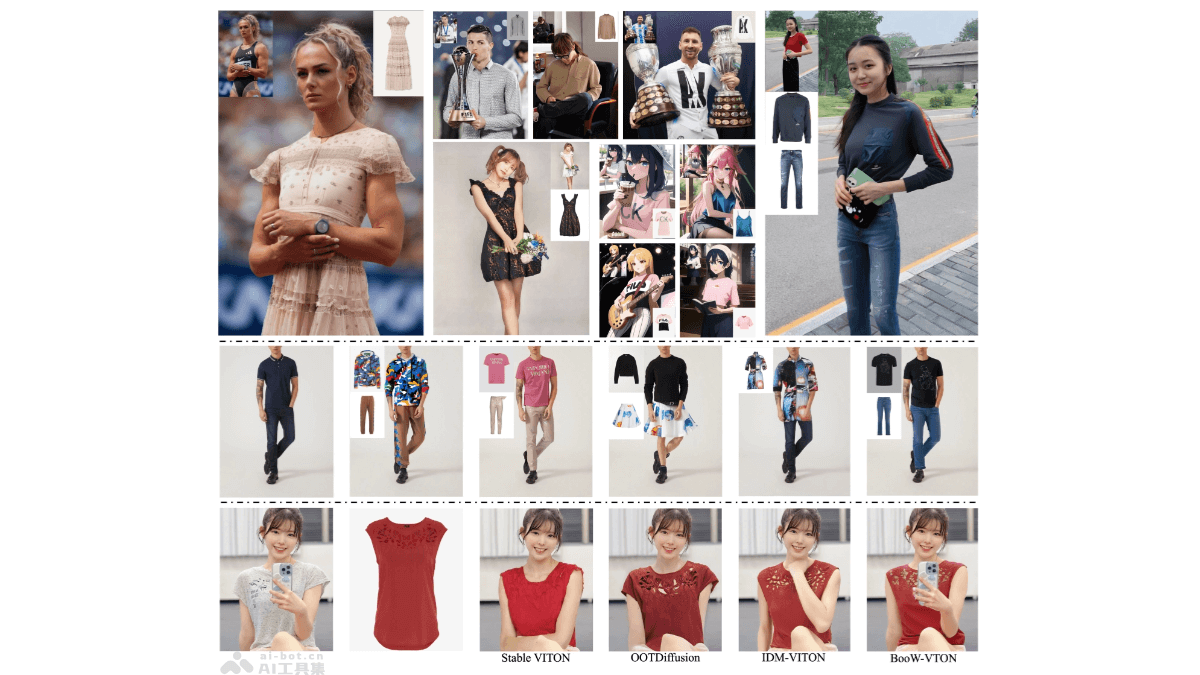
Main Features of Boow-VTON
- Mask-free try-on: Users can achieve virtual try-on of garments without providing precise masks.
- Data augmentation: Through data augmentation techniques, the model is trained on unpaired data from in-the-wild scenarios, improving adaptability in complex environments.
- Try-on localization loss: A special loss function is introduced to help the model more accurately identify the try-on region.
- Multi-garment try-on: Supports users trying on multiple different garments at the same time, without the need to train a separate model for each garment.
- User-friendly: Simplifies the try-on process; users only need to provide a person image, a garment image, and a pose image to perform try-on.
Technical Principles of Boow-VTON
- Image generation model: Based on powerful image generation models such as diffusion models, it synthesizes realistic try-on images.
- Data augmentation method: By synthesizing more diverse backgrounds and foregrounds, it enhances the model's adaptability to in-the-wild environments.
- Try-on localization: Through a designed loss function, the model learns to locate the correct region in the image where the garment should be tried on.
- Attention mechanism: Uses an attention mechanism to align garment features and person poses, ensuring that the garment naturally fits the human body during try-on.
- Training paradigm: Proposes a new training paradigm that trains the model by constructing pseudo training pairs (such as source person images, garment images, and try-on result images).
Boow-VTON Project Address
- GitHub repository:https://github.com/little-misfit/BooW-VTON(to be open-sourced)
- arXiv technical paper:https://arxiv.org/pdf/2408.06047
Application Scenarios of Boow-VTON
- Online shopping: When consumers buy clothing online, they can use Boow-VTON technology to virtually try on garments on images of models or themselves, better understanding the appearance and fit of the clothing.
- Fashion retail: Retailers provide in-store virtual fitting rooms, allowing customers to try different clothing styles and combinations without actually putting on the clothes.
- Personalized recommendations: Combining the user's body shape, preferences, and historical purchase data, Boow-VTON provides personalized clothing recommendations.
- Social media: Users share virtual try-on results on social media using Boow-VTON technology, increasing interactivity and entertainment.
- Fashion design: Clothing designers preview the try-on effect of design sketches, so they can make modifications and optimizations before producing physical samples.
- Advertising and marketing: The brand uses Boow-VTON technology to create attractive advertisements, showcasing the effect of models or celebrities wearing the brand's clothing, enhancing appeal.