
What is Boogu-Image-0.1
Boogu-Image-0.1 is a unifiedimage generationand editing model family open-sourced by the Boogu team. The model supports text-to-image, instruction-based image editing, and Chinese-English bilingual text rendering under the same architecture, and the family includes three variants: Base, Edit, and Turbo. In the self-built Boogu Arena thousand-level prompt ELO evaluation, the series ranks among the top of all participating open-source and closed-source systems, and ranks first among open-source models on Qwen-Image-Bench.
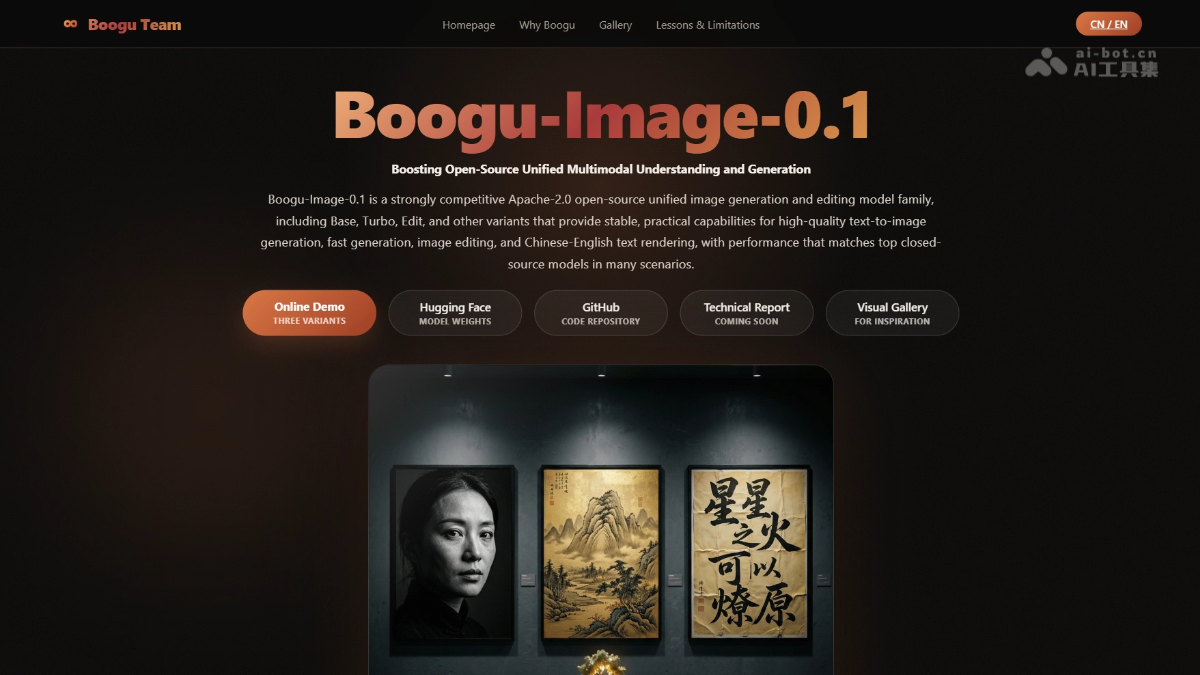
Main Features of Boogu-Image-0.1
-
Text-to-Image Generation: Accurately understands photographic prompts, generating high-quality images with natural lighting, harmonious composition, and faithful details, and supports complex real-world scenes.
-
Instruction-Based Image Editing: Supports object insertion, replacement, and removal, attribute and material modification, background and scene replacement, as well as cross-artistic-style transfer, while maintaining consistency of the original subject and composition.
-
Chinese-English Bilingual Text Rendering: Supports text-intensive visual designs such as posters, stamps, documents, interfaces, and brand guidelines, achieving readable structure and stable typography.
-
Stylized Generation: Covers diverse styles such as Chinese style, pixel art, picture books, and product-level rendering, is sensitive to prompts, and produces stable output.
-
Poster and Product Image Optimization: Generates personalized posters and product visualization images with consistent brand style, refined typography, and professional lighting composition.
-
In-Image Text Editing: Supports replacing, adding, or deleting Chinese and English characters, and flexibly adjusting font, font weight, color, and layout.
Technical Principles of Boogu-Image-0.1
- Unified Multimodal Architecture: Boogu-Image-0.1 adopts a unified multimodal understanding and generation architecture, integrating visual understanding capabilities and image generation capabilities within a single model framework, enabling the model to have bidirectional capabilities of understanding images and generating images at the same time, and providing a semantic-level control foundation for editing tasks.
- Distillation-Accelerated Inference: The Turbo variant is built on distillation technology, compressing the inference path under the same parameter count as Base, and usually requires only 3-4 steps to output high-quality realistic photographic images while retaining bilingual text rendering capability and prompt adherence.
- Instruction-Aligned Editing: The Edit variant (10B parameters) is specifically optimized for image editing tasks on the unified architecture, achieving fine-grained local modifications through an instruction alignment mechanism, and completing cross-style transfer and content replacement while maintaining consistency of the original subject and composition.
- Bilingual Text Rendering: The model integrates structured understanding and generation capabilities for Chinese and English characters within the unified architecture, and ensures readable typography and stable rendering in text-intensive scenarios such as posters and brand materials through a layout-aware mechanism.

Follow WeChat and reply "Open Source" to join theAI Open-Source Project Communication Group
How to Use Boogu-Image-0.1
-
Online Experience: Visit the ModelScope Studio https://modelscope.cn/studios/Boogu/boogu-image-edit-gradio to directly upload images and enter editing instructions, with no local deployment required.
-
Model Download: Obtain the weights of the Base, Edit, and Turbo variants through the ModelScope organization page https://modelscope.cn/organization/Boogu .
-
Local Deployment: Clone the GitHub repository to obtain the training and inference code, configure the environment according to the README, and then load the model for generation or editing.
Core advantages of Boogu-Image-0.1
-
Unified architecture: The same model family covers the three major tasks of generation, editing, and text rendering, with no need to switch between independent models for different uses.
-
Ultra-fast inference: The Turbo variant can complete high-quality generation in only 3-4 steps, with inference efficiency comparable to or even surpassing some closed-source solutions.
-
Bilingual text advantage: It performs stably in Chinese and English text rendering, and is especially suitable for local design scenarios such as Chinese posters and brand materials.
-
Editing consistency: The Edit variant maintains a high degree of consistency with the original subject and composition when modifying content, avoiding the overall redraw distortion commonly seen in traditional editing models.
Project address of Boogu-Image-0.1
- Project official website:https://boogu.org/
- GitHub repository:https://github.com/boogu-project/Boogu-Image
- HuggingFace model library:https://huggingface.co/Boogu
Comparison of Boogu-Image-0.1 with similar competing products
| Dimension | Boogu-Image-0.1 | Qwen-Image-2.0 |
|---|---|---|
| Publisher | Boogu team | Alibaba Tongyi team |
| Release time | June 2026 | February 2026 |
| Open-source license | Apache-2.0 | Apache-2.0 |
| Model parameters | Edit variant 10B; Base/Turbo parameter count is consistent with Base (specific values not disclosed) | Diffusion decoder 7B + Qwen3-VL encoder 8B, totaling approximately 15B level |
| Core architecture | Unified multimodal understanding and generation architecture, integrating visual understanding and image generation into a single framework | Dual-component architecture: 8B Qwen3-VL vision-language encoder → 7B MMDiT diffusion decoder |
| Unified capabilities | Three-in-one: text-to-image, instruction-based image editing, and Chinese-English bilingual text rendering | Text-to-image, image editing, and text rendering unified in a single 7B model |
| Maximum resolution | Examples are mostly 1024×1024 (higher supported, upper limit not specified) | Native 2048×2048 (2K), no upsampling required |
| Prompt length | Upper limit not explicitly disclosed | Up to 1000 tokens |
| Text rendering | Chinese-English bilingual, supports complex layouts such as ultra-dense text, posters, and brand materials | Chinese-English bilingual, supports infographics, PPT, posters, calligraphy, etc., emphasizing material adaptation and structural alignment |
| Inference efficiency | The Turbo variant requires only 3-4 steps to complete high-quality generation | The number of optimization steps is not explicitly stated; the lightweight 7B architecture reduces VRAM requirements |
| Local deployment | Supported; obtain weights and code via GitHub and ModelScope | Supported; open-sourced on GitHub, DiffSynth-Studio supports 4GB VRAM layered offloading |
Application scenarios of Boogu-Image-0.1
-
E-commerce design: Quickly generate product main images, detail page posters, and multilingual promotional materials, supporting style consistency and local modifications based on reference images.
-
Advertising and marketing: Generate bilingual Chinese-English posters and social media graphics according to brand guidelines, and support copy replacement and layout adjustments for existing assets.
-
Content Creation: Provide stylized illustrations, comic panels, and meme image generation for short videos and self-media, with support for precise editing of text within images.
-
Publishing and Printing: Generate book covers, magazine layouts, stamps, and document interface designs, ensuring text readability and layout stability.