
What is BISHENG Lingsi
BISHENG Lingsi is an open-source general AI Agent launched by Bisheng. By combining the knowledge and experience of business experts, it helps users complete complex tasks quickly and efficiently. It innovatively proposes theAGL(Agent Guidance Language) framework, which injects business experts' preferences and knowledge into the AI system to achieve expert-level solutions. The core advantages of Lingsi lie in expert-level taste, multi-agent collaboration capability, and ultra-long document writing capability. It can handle complex tasks such as writing detailed travel guides, reading reports, collecting new product updates, and responding to bidding requirements.
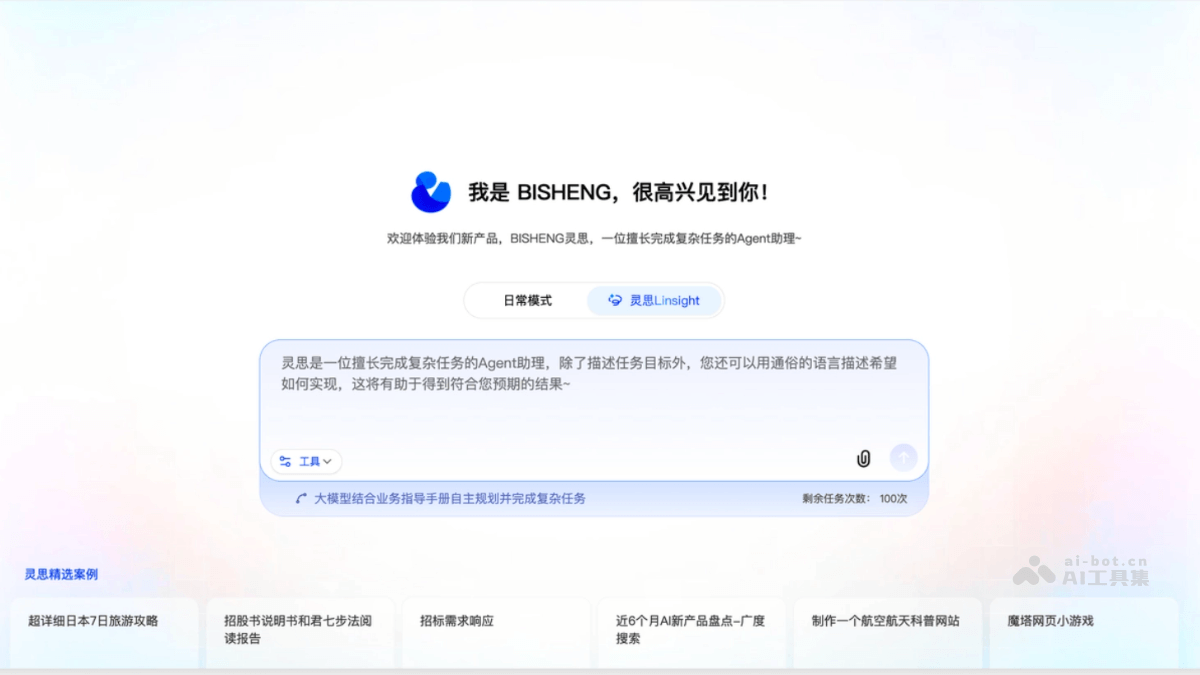
Main features of BISHENG Lingsi
- Autonomous planning and execution of complex tasks: Lingsi can automatically generate a standard operating procedure (SOP) based on the task goal entered by the user and autonomously plan the execution steps of the task. Users can edit, modify, or regenerate the generated SOP to meet specific needs. The system automatically executes the task process according to the SOP, displays the execution process of each step in real time, and proactively seeks human intervention when problems arise.
- Expert-level solutions: Through the AGL (Agent Guidance Language) framework, Lingsi injects business experts' knowledge and experience into the AI system to ensure the professionalism and accuracy of task execution. The prebuilt SOP library written by business experts helps users quickly generate high-quality solutions, enabling novices to quickly surpass seasoned peers.
- Ultra-long document writing: Lingsi has powerful document processing capabilities and supports the generation of ultra-long documents, such as detailed travel guides and analysis reports. It supports the generation and download of documents in Markdown format, making it convenient for users to save and view them.
- Multi-agent collaboration: When executing complex tasks, Lingsi generates a multi-agent system in real time, in which multiple agents collaborate to complete the task. Each agent is responsible for part of the task, ensuring fine-grained and high-quality completion of the task.
- Powerful document processing capabilities: Lingsi supports operations such as searching for information from the internet, reading file contents, and writing file contents, ensuring the authority and completeness of information. It supports multiple file formats, including Markdown, TXT, and others.
- Enterprise knowledge base integration: Lingsi can connect to an organization's knowledge base and custom tools to expand application scenarios. It supports invoking personal knowledge bases to improve the efficiency and accuracy of task execution.
- Iterability: Lingsi can automatically collect high-quality SOPs newly added during business personnel use and update enterprise best practices at any time. The system automatically optimizes SOPs based on user feedback, improving the intelligence of the next execution.
- BISHENG 2.6:
-
Task mode: Break complex tasks into to-do lists, plan first and then execute; heavy work can be delegated to sub-agents to reduce the probability of long tasks going off track; proactively pause and ask the user when requirements are ambiguous, support cross-turn continuity and stop at any time.
-
Permission system (RBAC + ReBAC): RBAC manages role-based access, and ReBAC manages specific resource relationships; supports multi-level department trees and user groups, with permissions precise down to files, personnel, and departments; automatically takes effect when new employees join or transfer, without manual maintenance.
-
Intelligent workbench: The model autonomously determines when to invoke custom tools and knowledge bases; answers include superscript source tracing, and clicking allows previewing the source; supports export to Word, PDF, Markdown, and TXT, and conversations can be retained as team assets.
-
Knowledge space: Supports webpage, audio, and video import (automatic transcription with timestamps); document version management and similar file association prompts; sensitive word security review; workflows can directly search the knowledge space and filter by user permissions.
-
Xinchuang adaptation: Fully adapted to the Dameng DM8 database, with the Java gateway and permission engine fully supporting localized deployment.
-
BISHENG Linsight's official website address
- Official website address:https://bisheng.dataelem.com/
How to use BISHENG Linsight
-
Visit the official website and register: Visit the BISHENG Linsight official website and register with a commonly used email or ID.
-
Switch to Linsight mode: After logging in, enter the BISHENG workbench and switch the mode from "Daily Mode" to "Linsight Mode".
-
Enter the task objective: In Linsight mode, enter the task objective you want to complete, such as "generate a travel guide" or "write an analysis report". You can also describe the method for completing the task so that Linsight can better understand your needs.
-
Generate or edit the SOP: The system will automatically generate a standard operating procedure (SOP). You can directly use the generated SOP, or modify and supplement it to regenerate different versions of the SOP.
-
Invoke tools and resources: In the SOP, you can use the @ symbol to invoke tools and resources such as the knowledge base, file operations, and web search to obtain the information needed to complete the task.
-
Start executing the task: After editing is complete, click the "Start Execution" button, and Linsight will automatically execute the task process according to the SOP. During execution, the system will display the execution status of each step in real time and pause the task when problems are encountered to seek human intervention.
-
View and save the results: After task execution is complete, Linsight will generate and provide a download link, and users can view and save the generated Markdown file or documents in other formats.
-
Feedback and optimization: Users can rate the task execution results, and the system will automatically optimize the SOP based on the feedback, making the next execution more intelligent and efficient.
Official examples of BISHENG Linsight
Example 1: Writing a travel guide
Task description: Generate a 7-day itinerary plan for traveling to Japan
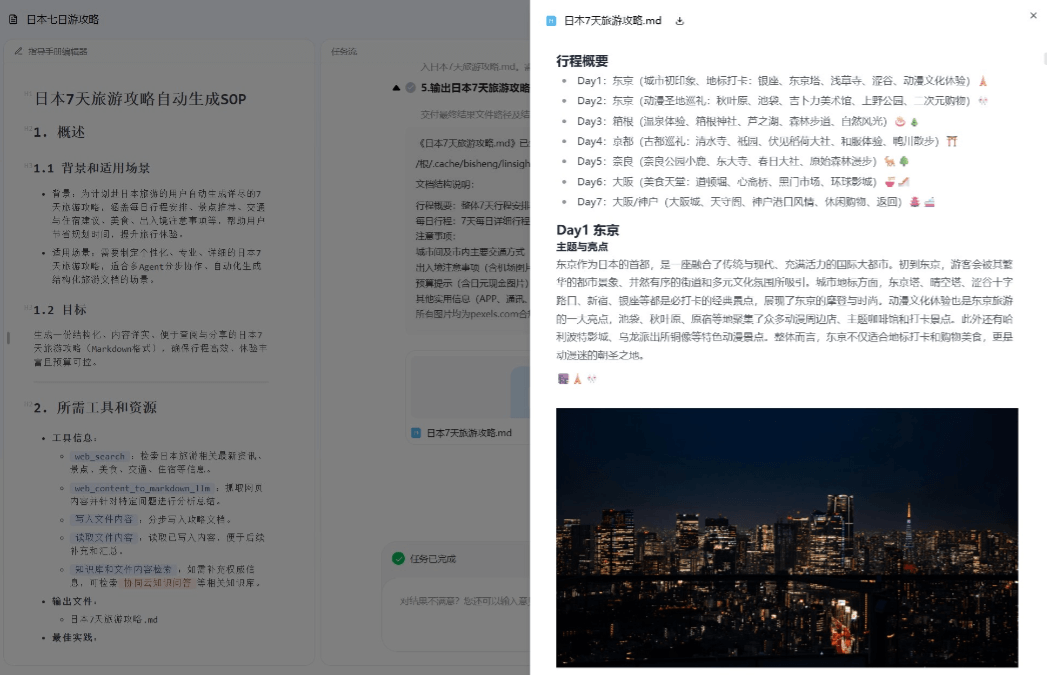
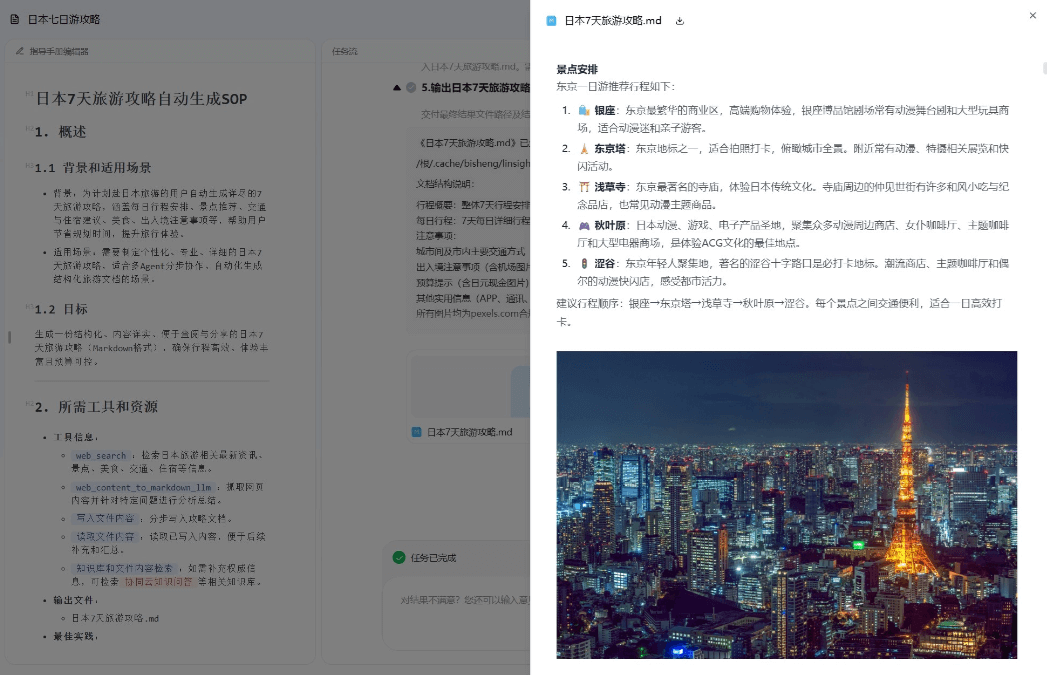
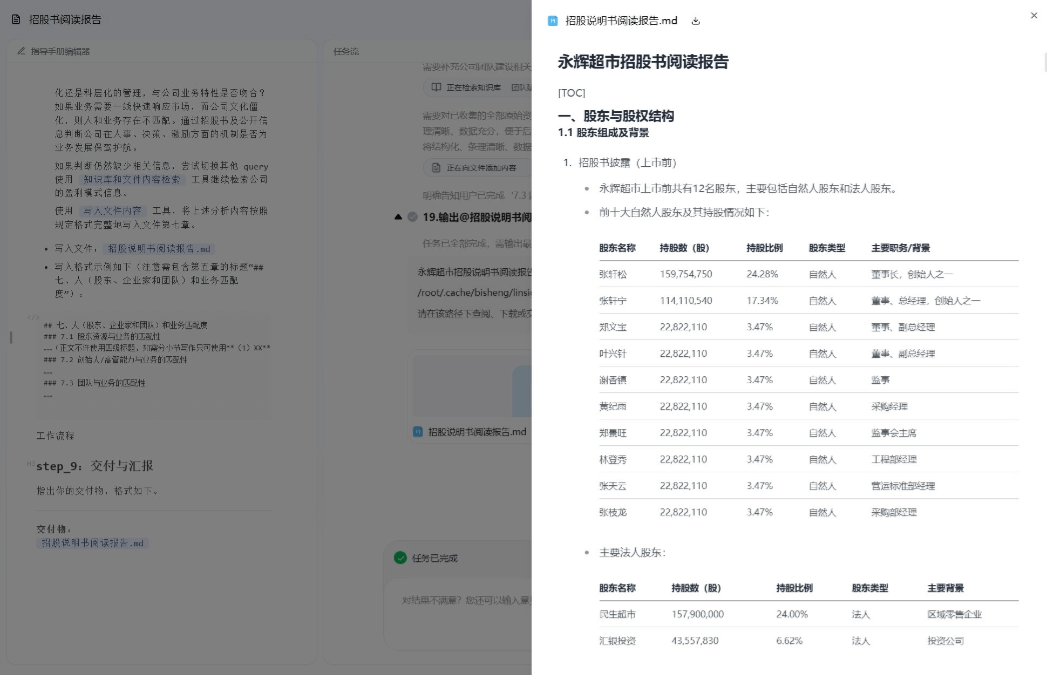
Example 2: Prospectus reading report
Task description: Read the uploaded prospectus document according to the Hejun seven-step prospectus method and provide a prospectus reading report.
Application scenarios of BISHENG Linsight
-
Travel guide generation: Linsight can provide users with detailed travel guides, including itinerary planning, attraction recommendations, transportation suggestions, dining and accommodation arrangements, etc., helping users quickly create personalized travel plans.
-
Reading report writing: Linsight can generate in-depth reading reports based on files uploaded by users (such as prospectuses, etc.) according to specific analytical frameworks (such as the Hejun seven-step method), uncover key information in the files, and provide users with professional analysis.
-
New product trend collection: Linsight can collect information on recently released AI products worldwide and organize it into tables, helping users quickly understand industry trends and providing references for product development and market research.
-
Bid requirement response: LingSi can generate compliance assessment reports based on requirement documents and product manuals uploaded by users, breaking down requirements in detail and determining whether they are met, providing a basis for bid evaluation and project quotation.
-
Webpage Production: LingSi can create showcase websites and mini-games, meeting users' needs in webpage design and development and providing support for enterprises' online display and interaction.
-
Enterprise Internal Knowledge Management: LingSi supports connecting to organizational knowledge bases and personal knowledge bases, helping users conduct knowledge management and information retrieval within enterprises and improving work efficiency.