
What is BiGR
BiGR is a novel conditional image generation model that uses compact binary latent codes for generative training, enhancing image generation quality and representation capability. As the first model to unify generation and discrimination tasks within the same framework, BiGR can effectively perform multiple visual tasks such as visual generation, discrimination, and editing while maintaining high generation quality. The design of BiGR includes masked token prediction and a binary transcoder, trained with a weighted binary cross-entropy loss to reconstruct masked tokens. BiGR's flexibility and scalability perform excellently across different visual applications, without the need for task-specific structural changes or parameter fine-tuning.
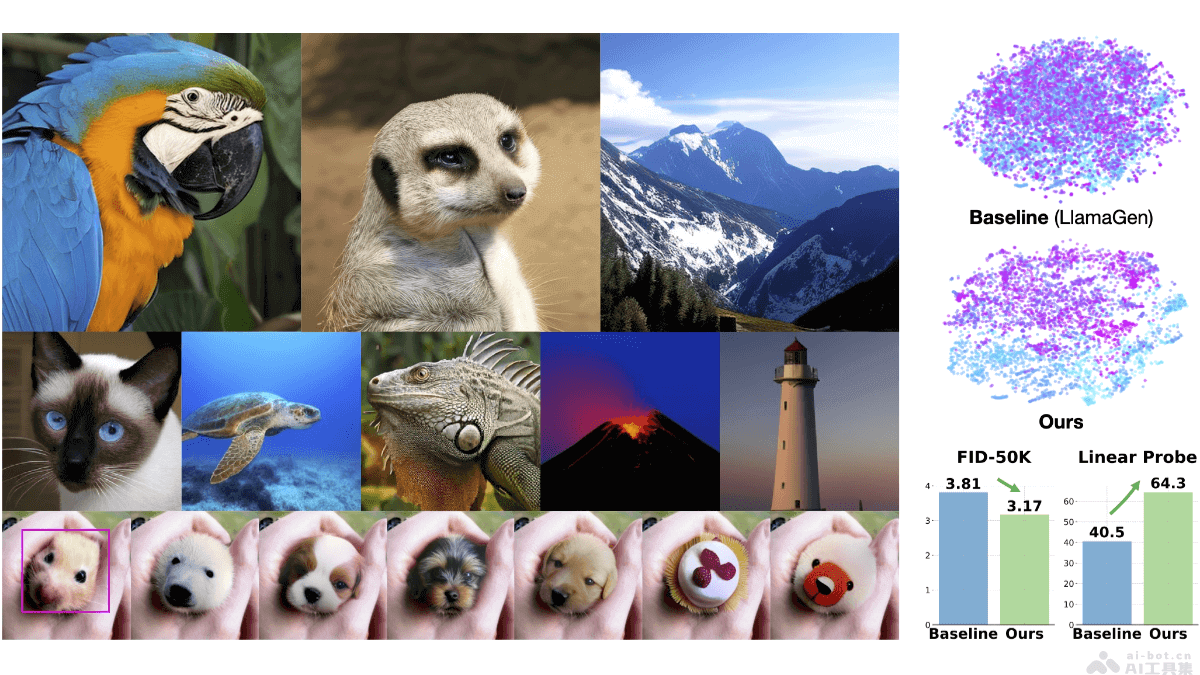
BiGR Main Features
- Image Generation: BiGR can generate high-quality, high-resolution images, supporting image generation from low resolution to high resolution.
- Visual Discrimination: The model can distinguish between different image categories, providing powerful feature extraction capabilities that aid in image recognition and classification tasks.
- Image Editing: Includes inpainting damaged images, outpainting image content, and editing image content based on specific category conditions.
- Zero-Shot Generalization: BiGR can perform multiple visual tasks zero-shot without specific task structural changes or parameter fine-tuning, such as image interpolation and enrichment.
BiGR Technical Principles
- Binary Tokenizer: Converts images into a series of binary codes, which are compressed representations of the images.
- Masked Modeling Mechanism: During training, some binary codes are masked, and the model needs to learn how to predict the masked parts based on the unmasked codes.
- Binary Transcoder: Converts continuous features into binary codes following a Bernoulli distribution, used in image generation.
- Entropy-Ordered Sampling Method: During image generation, the order of unmasking tokens is determined by the entropy of the predicted Bernoulli distribution probabilities, improving generation efficiency.
- Average Pooling: Applies average pooling in the intermediate layers of the model to obtain global image representations, used in visual discrimination tasks.
- Weighted Binary Cross-Entropy Loss (wBCE): Used in training the model, reconstructing masked tokens, and optimizing performance for generation and discrimination tasks.
BiGR Project Address
- Project Website:haoosz.github.io/BiGR
- GitHub Repository:https://github.com/haoosz/BiGR
- HuggingFace Model Library:https://huggingface.co/haoosz/BiGR
- arXiv Technical Paper:https://arxiv.org/pdf/2410.14672v1
BiGR Application Scenarios
- Artistic Creation: Artists and designers use BiGR to generate novel visual elements or complete complex design tasks, such as creating digital paintings or making unique patterns.
- Content Creation: Content creators use BiGR to generate article illustrations, visual content for social media posts, or for background and scene design in video games and movies.
- Advertising and Marketing: Marketers use BiGR to design advertising images, quickly generating visual materials that attract potential customers.
- Data Augmentation: In machine learning projects, BiGR generates additional training data to improve the robustness and performance of models.
- Image processing: For damaged or incomplete images, BiGR is used to restore and enhance image quality, such as restoring old photos or improving the clarity of satellite images.