
What is Being-H0.5
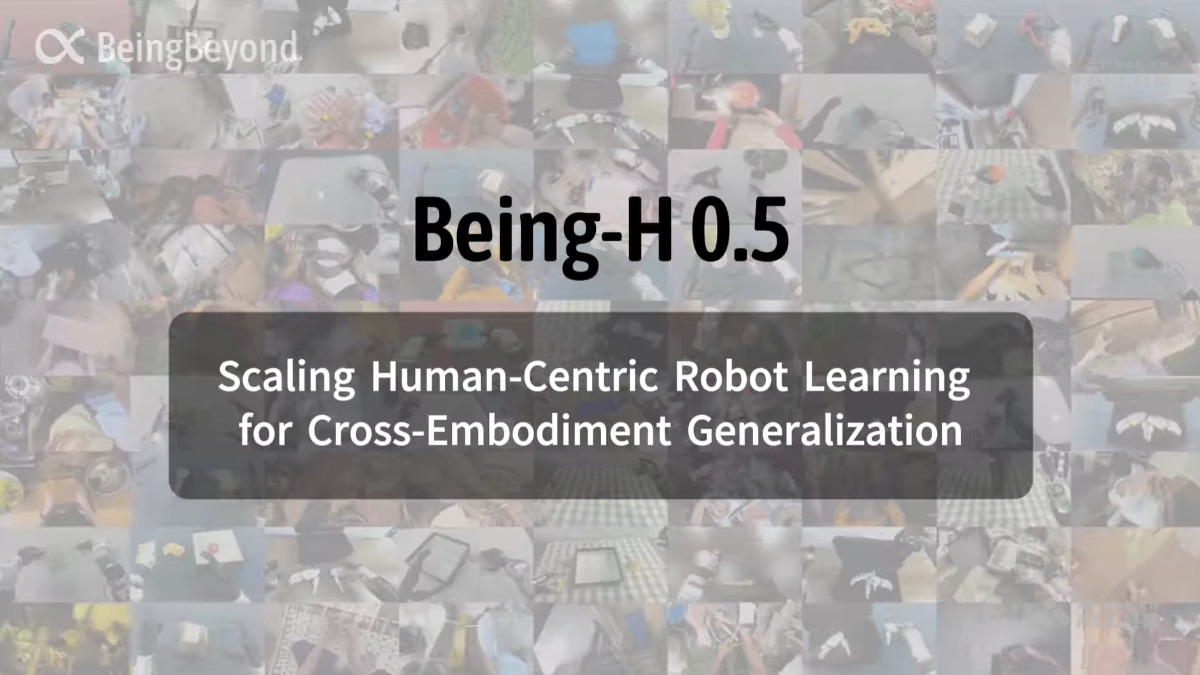
Being-H0.5 is a general-purpose robot model launched by Lu Zongqing's team. It can solve the problem of policy transfer of robots across hardware of different embodiments through human prior knowledge and unified action alignment. By building the large-scale cross-embodiment manipulation dataset UniHand-2.0 and designing a unified action space, the model can learn general manipulation semantics and achieve shared policies across multiple robots. The model combines MoT and MoF architectures and has strong understanding and action generation capabilities. Through mechanisms such as MPG and UAC, it ensures deployment stability in real environments. Experiments show that Being-H0.5 performs excellently in long-horizon tasks and bimanual tasks, providing important progress for the deployment of general-purpose robot models.
Main Features of Being-H0.5
-
Cross-embodiment manipulation: The model can share and transfer manipulation policies across robots of different embodiments (such as robotic arms, dexterous hands, humanoid robots, etc.).
-
Stability in long-horizon tasks: It maintains the stability and accuracy of actions in multi-step tasks and avoids error accumulation.
-
Bimanual coordination: It supports real-time coordination in bimanual tasks and ensures the precision of action timing and spatial coupling.
-
Generalization ability: It maintains reliable performance across different environments, tasks, and hardware platforms, with strong adaptability.
-
Stable real-world deployment: Through deployment mechanisms (such as MPG and UAC), it solves the problem of perception and control being out of sync and ensures stable operation on real robots.
Technical Principles of Being-H0.5
-
Unified State-Action Space: It maps the states and actions of robots of different embodiments into a unified vector space, enabling the model to learn general manipulation semantics rather than hardware-specific action parameters.
-
Large-scale pretraining dataset (UniHand-2.0): It integrates human hand manipulation data, robot manipulation data, and visual-language understanding data, providing the model with rich action priors and a foundation for semantic alignment.
-
Hybrid architecture (MoT + MoF): The model adopts a Mixture-of-Transformers architecture, combining an understanding module (MoT) and an action generation module (MoF), improving the model's action generation capability and generalization ability.
-
Action generation mechanism (Mixture of Flow): Through shared layers and routed experts, it simultaneously handles low-DoF and high-DoF actions and avoids negative transfer.
-
Deployment stability mechanisms:
-
MPG(Manifold-Preserving Gating): It suppresses unreasonable action outputs and maintains the stability of the action manifold.
-
UAC(Universal Async Chunking): It solves the problem of perception frame rate and control frequency being out of sync and ensures the continuity of actions.
-
-
Cross-embodiment alignment: It provides supervision signals through human action data, enabling human interaction patterns to be directly applied to robot control and enhancing the model's generalization ability.
Being-H0.5 Project Address
- GitHub repository:https://github.com/BeingBeyond/Being-H
- HuggingFace model library:https://huggingface.co/collections/BeingBeyond/being-h05
- arXiv technical paper:https://arxiv.org/pdf/2601.12993
Application Scenarios of Being-H0.5
-
Industrial automation: In factories, Being-H0.5 can control different types of robotic arms to complete complex assembly and handling tasks, improving production efficiency and flexibility.
-
Home services: Used in home robots to complete multi-step tasks such as cleaning, organizing, and cooking, adapting to different home environments and objects.
-
Medical Assistance: In medical scenarios, assist doctors in operating surgical instruments or rehabilitation training, precisely controlling movements to ensure safety and stability.
-
Logistics and Warehousing: Enable automatic sorting, transport, and stacking of goods, adapting to items of different shapes and weights, improving logistics efficiency.
-
Education and Research: As a teaching tool, help students and researchers explore robot control technology, providing a cross-form experimental platform.