
What is BEHAVIOR Robot Suite
BEHAVIOR Robot Suite (BRS) is a framework launched by Li Feifei's team at Stanford University for learning whole-body manipulation to complete daily household tasks. Based on analyzing household activities, it identifies the key capabilities robots need, including bimanual coordination, stable navigation, and extensive end-effector reachability. The core innovations of BRS include: JoyLo, a low-cost whole-body teleoperation interface used to efficiently control robots and collect high-quality data; and WB-VIMA, an imitation learning algorithm that achieves precise whole-body manipulation by modeling the hierarchical structure of robot whole-body actions and multimodal observation data. BRS performs excellently in diverse real-world household tasks, demonstrating its potential in the field of autonomous robot manipulation.
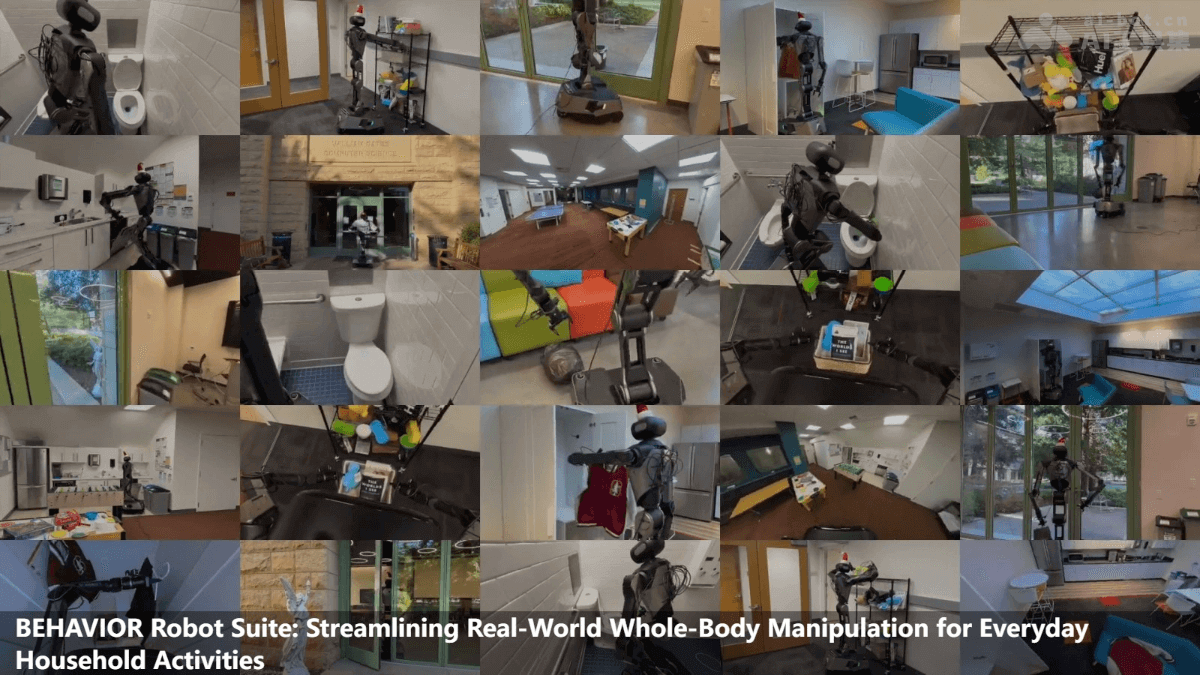
Main Features of BEHAVIOR Robot Suite
- Whole-body manipulation capability: Based on bimanual coordination, stable navigation, and extensive end-effector reachability, it completes complex household tasks such as carrying heavy objects, opening doors, and cleaning.
- Efficient data collection: JoyLo provides a low-cost, high-quality whole-body teleoperation interface, supports rapid data collection, and provides support for policy learning.
- Powerful learning algorithm: The WB-VIMA algorithm uses the robot's kinematic hierarchy to model dependencies in whole-body actions and dynamically adjusts policies using multimodal perception data.
- Adaptation to real environments: In complex real-world environments, it interacts with unmodified everyday objects to complete long-horizon, multi-stage tasks.
- Failure recovery capability: The learned policy can automatically detect and correct errors during manipulation, improving task success rates.
Technical Principles of BEHAVIOR Robot Suite
- JoyLo (low-cost whole-body teleoperation interface): Based on low-cost hardware (such as Nintendo Joy-Con), it achieves efficient control of multi-degree-of-freedom robots. Using a kinematic dual-arm design, combined with a mobile base and a flexible torso, it enables precise control of whole-body actions. Bilateral teleoperation provides haptic feedback, enhancing the user experience.
- WB-VIMA (whole-body visuomotor attention policy): Based on the robot's kinematic hierarchy, it decomposes whole-body actions into multiple interrelated parts (such as torso, base, and arms), modeling action dependencies layer by layer. It uses a self-attention mechanism to dynamically aggregate multimodal data such as vision and touch, reducing dependence on a single modality and improving the policy's generalization ability. It denoises whole-body actions in an autoregressive manner, ensuring the coherence and coordination of actions.
Project Addresses of BEHAVIOR Robot Suite
- Project Website:https://behavior-robot-suite.github.io/
- GitHub Repository:https://github.com/behavior-robot-suite
- HuggingFace Model Library:https://huggingface.co/datasets/behavior-robot-suite
- arXiv Technical Paper:https://arxiv.org/pdf/2503.05652
Application Scenarios of BEHAVIOR Robot Suite
- Housework automation: Completes tasks such as cleaning rooms, placing items on high or low shelves, and tidying tableware, reducing the household burden on family members.
- Garbage disposal: Automatically transports garbage bags from indoors to outdoor trash bins, including multi-step operations such as opening doors, navigation, and discarding garbage.
- Clothing organization and storage: Takes clothes out of the wardrobe and places them on the sofa, or hangs clothes back in the wardrobe.
- Bathroom cleaning: Tasks such as cleaning the toilet and pressing the flush button require the robot to have a high degree of dexterity and precise control of the end effector.
- Daily object management: In the kitchen, opening the dishwasher, putting items into or taking items out of the dishwasher, etc.