
What is Baklib
Baklib is an enterprise-level digital content experience cloud platform that helps enterprises manage digital content in a one-stop manner and build multi-scenario digital experiences. It adopts an original three-layer architecture, including Resource Library (DAM), Knowledge Base (KB), and Application Library (APP), enabling full lifecycle management of digital assets, knowledge standardization, and the creation of multi-channel content management systems.
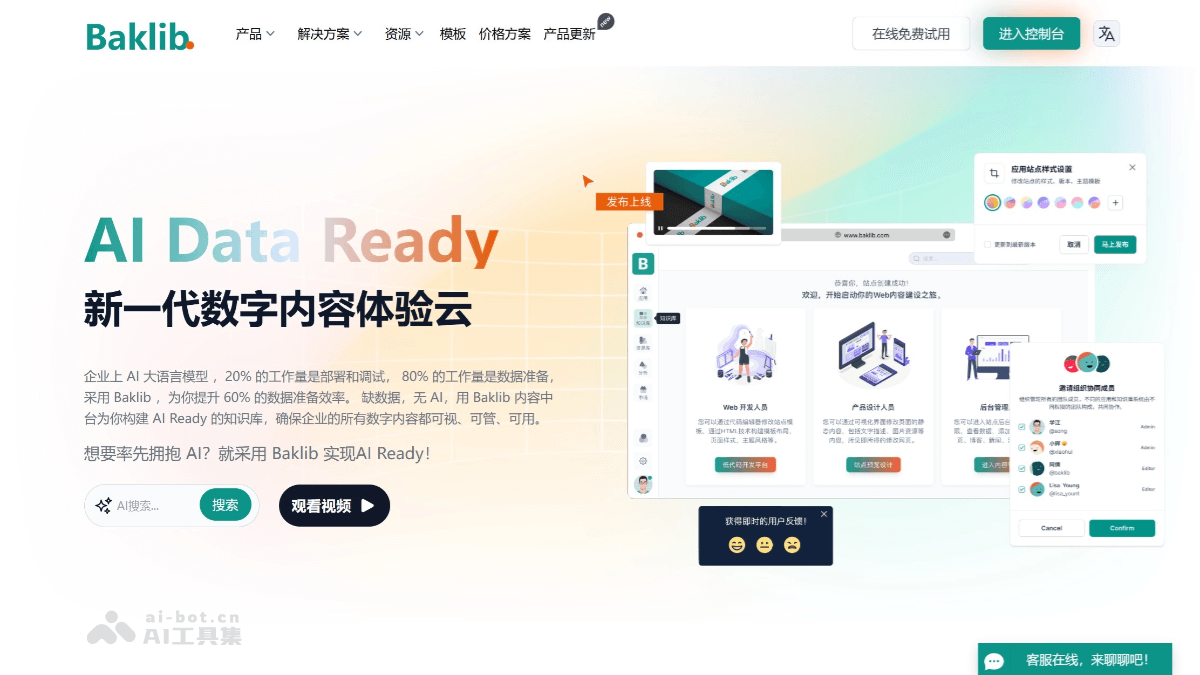
Main Features of Baklib
- Resource Library (DAM)
- Digital Asset Management: Centrally store and manage enterprise images, audio and video, documents, PDFs, links, text snippets, and other metadata, enabling full lifecycle management of digital assets.
- Resource Classification and Retrieval: Supports classification and tag-based management of resources, making it convenient for users to quickly retrieve and use the resources they need.
- Resource Version Control: Records the modification history and version changes of resources, ensuring traceability and accuracy of resources.
- Knowledge Base (KB)
- Knowledge System Construction: Supports multi-organization, multi-level document knowledge base centers, helping enterprises standardize and manage their knowledge systems.
- Content Creation and Editing: Provides rich editing functions and supports content creation in multiple formats, including images and text, videos, tables, etc., making it convenient for users to produce high-quality knowledge content.
- Intelligent Knowledge Retrieval: With the help of AI technology, it enables intelligent knowledge retrieval, helping users quickly find the knowledge they need and improving knowledge acquisition efficiency.
- Knowledge Sharing and Collaboration: Supports team collaboration, allowing multiple people to jointly edit and manage knowledge base content, promoting knowledge sharing and teamwork.
- Application Library (APP)
- Multi-scenario Application Creation: Creates various application scenarios through templating, such as corporate websites, product promotion pages, help centers, knowledge portals, user feedback, Q&A communities, etc.
- Personalized Customization: Supports personalized settings such as custom theme styles and domain binding, meeting corporate brand image and business needs.
- Content Publishing and Updates: Users can edit content in the backend and update and publish it at any time, and the frontend display interface will automatically update, ensuring the timeliness of content.
- Multi-channel Distribution: Supports one-click distribution of content to multiple channels, such as social media and internal enterprise platforms, expanding the reach of content dissemination.
- AI Content Creation: With the help of AI technology, it helps enterprises quickly generate high-quality content and improves content creation efficiency.
- AI Intelligent Retrieval: Through natural language processing technology, it enables intelligent knowledge retrieval and provides more accurate search results.
- AI-assisted Programming: Supports low-code programming, helping enterprises quickly build applications and reducing development costs.
- Multi-language Support: Supports multiple languages, meeting the internationalization needs of enterprises.
- Data Security and Backup: Provides data encryption, backup, and recovery functions, ensuring the security and reliability of enterprise data.
- User Permission Management: Supports flexible user permission settings, ensuring the access and editing permissions of different user roles for content.
Baklib Official Website Address
- Official website address:baklib.cn
Baklib use cases
- Website building: No technical background required; easily build corporate official websites, product promotion pages, blogs, etc., and efficiently spread brand value.
- Internal knowledge base: Build employee training manuals and document management knowledge bases to improve team collaboration and knowledge reuse efficiency.
- External knowledge base: Create customer support platforms, provide operation guides and FAQs, and optimize user experience.
- Community interaction: Build internal and external communities, support team collaboration and customer interaction, and enhance brand stickiness.
- Content and resource management: Integrate enterprise content resources in a unified way for efficient distribution and reduce management costs.