
What is Bailing
Bailing is an open-source voice dialogue assistant based onSpeech Recognition(ASR), Voice Activity Detection (VAD), Large Language Model (LLM), and Text-to-Speech (TTS) technologies to achieve natural voice conversations with users, delivering a GPT-4o-like dialogue experience. Bailing can run without a GPU, with end-to-end latency as low as 800ms, making it suitable for various edge devices and low-resource environments. Bailing features efficient open-source models, no GPU required, modular design, memory support, tool calling support, and task management support, providing a high-quality voice dialogue experience.
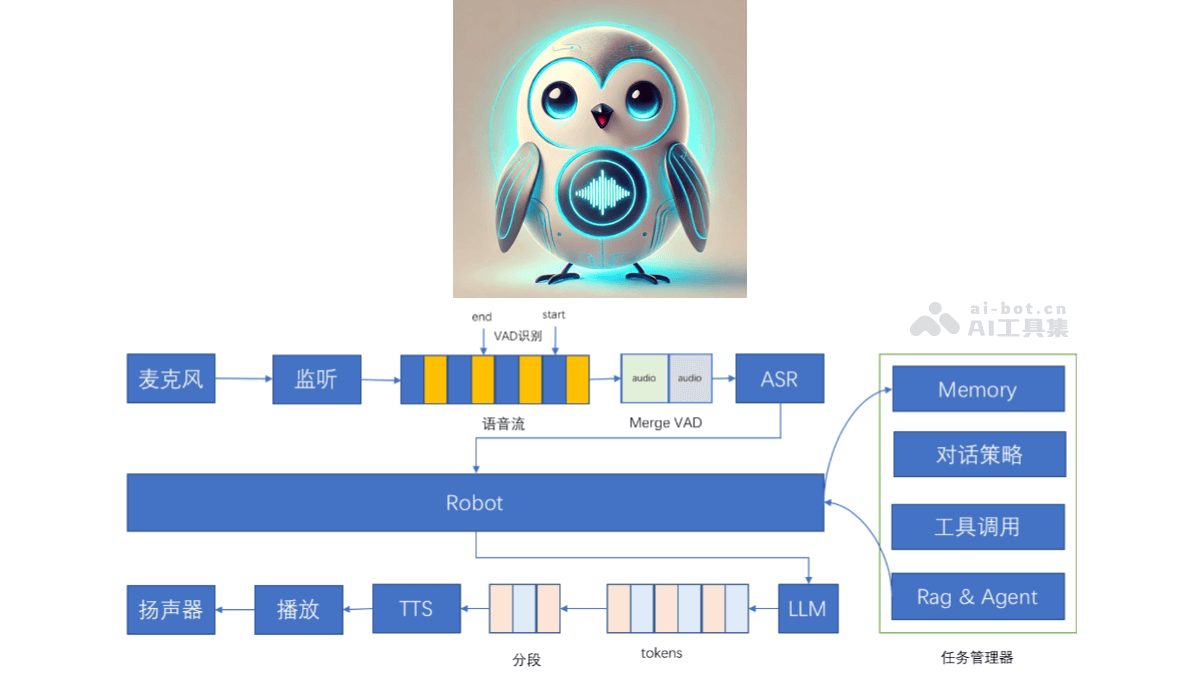
Main Features of Bailing
- Voice Input and Recognition: Accurately converts the user's voice input into text, providing a foundation for subsequent dialogue processing.
- Voice Activity Detection: Filters out invalid audio segments, processes only valid voice parts, improving the efficiency and accuracy of speech recognition, and avoiding misrecognition of non-target speech such as background noise.
- Intelligent Dialogue Generation: Deeply understands and processes the user's input text, generating natural, fluent, and logical text replies, providing users with an intelligent and thoughtful dialogue experience.
- Voice Output and Synthesis: Converts the generated text reply into natural, realistic speech and plays it to the user, allowing users to obtain information through hearing, completing a full voice interaction loop.
- Supports Interruption: Features flexible interruption strategies, recognizing user keywords and voice interruption behavior, and promptly responding to users' immediate feedback and control commands.
- Memory Function: Has continuous learning capability, can remember user preferences, historical conversations, and other information, providing users with a personalized interactive experience.
- Tool Calling: Supports flexible integration of external tools; users can directly request information or execute operations via voice commands, such as checking weather, searching news, setting reminders, etc.
- Task Management: Efficiently manages user tasks, including tracking task progress, setting reminders, and providing dynamic updates.
Technical Principles of Bailing
- Speech Recognition (ASR): Based on FunASR technology, converts the user's voice signal into text data. It involves steps such as voice signal acquisition, preprocessing, feature extraction, and pattern matching, using deep learning algorithms and other technical means to recognize vocabulary and semantic information in the voice, providing text input for subsequent dialogue processing.
- Voice Activity Detection (VAD): Based on silero-vad technology, performs real-time monitoring and analysis of voice signals to determine whether a voice segment contains valid voice activity. It analyzes voice signal features such as energy and zero-crossing rate, distinguishes voice from non-voice parts, and only processes valid voice segments, improving system efficiency and accuracy.
- Large Language Model (LLM): deepseek serves as the core large language model, processing the text output by the ASR module. The model is trained on a large amount of text data and has powerful language understanding and generation capabilities. It understands the semantics of the user's input text, combines contextual information, and uses natural language processing technology to generate accurate, natural, and logical text replies, providing users with intelligent dialogue content.
- Text-to-Speech (TTS): Use technologies such as edge-tts to convert text responses generated by the LLM into voice signals. This process includes steps such as text analysis, prosody prediction, and speech synthesis. Based on technologies such as deep learning models, it simulates the pronunciation characteristics of human speech and generates natural, fluent, and expressive speech, allowing users to obtain information through hearing and achieving the output of voice interaction.
Bailing's project address
- GitHub repository:https://github.com/wwbin2017/bailing
Bailing's application scenarios
- Smart home control: Use voice commands to control home appliances, such as turning lights on and off, adjusting air conditioner temperature, etc., and switch preset home scene modes, such as "movie mode" and "sleep mode," improving the convenience and comfort of home life.
- Personal assistant services: Help users manage schedules, remind them of meetings, appointments, and other arrangements; query weather, news, stocks, and other information, and organize and summarize it.
- Intelligent automotive interaction: As an in-vehicle voice assistant, it enables operations such as navigation settings, music playback, and phone calls, improving driving safety and convenience; query vehicle information such as fuel level and mileage, and control vehicle functions such as seat heating and air conditioner fan speed adjustment.
- Educational assistance tools: Provide students with online learning tutoring, answer learning questions, and help them understand knowledge; in language teaching, simulate scenarios for dialogue practice, provide pronunciation and intonation feedback, and enhance learning outcomes.
- Office assistance applications: Record and organize meeting content during meetings, and generate key information summaries and to-do lists.