
What is White Tiger-VTouch
White Tiger-VTouch is the world's first and largest cross-embodiment visual-tactile multimodal dataset, open-sourced by the National and Local Joint Humanoid Robot Innovation Center in collaboration with Weitai Robotics. The dataset includes visual-tactile sensor data, RGB-D data, joint pose data, etc., covering multiple robot body configurations, with a data scale exceeding 60,000 minutes. The dataset pioneers a cross-embodiment real interaction collection paradigm, breaking through core bottlenecks of embodied intelligent robots such as data scarcity, insufficient tactile information, and weak generalization ability, providing key corpus and an engineering foundation for building embodied foundation models.
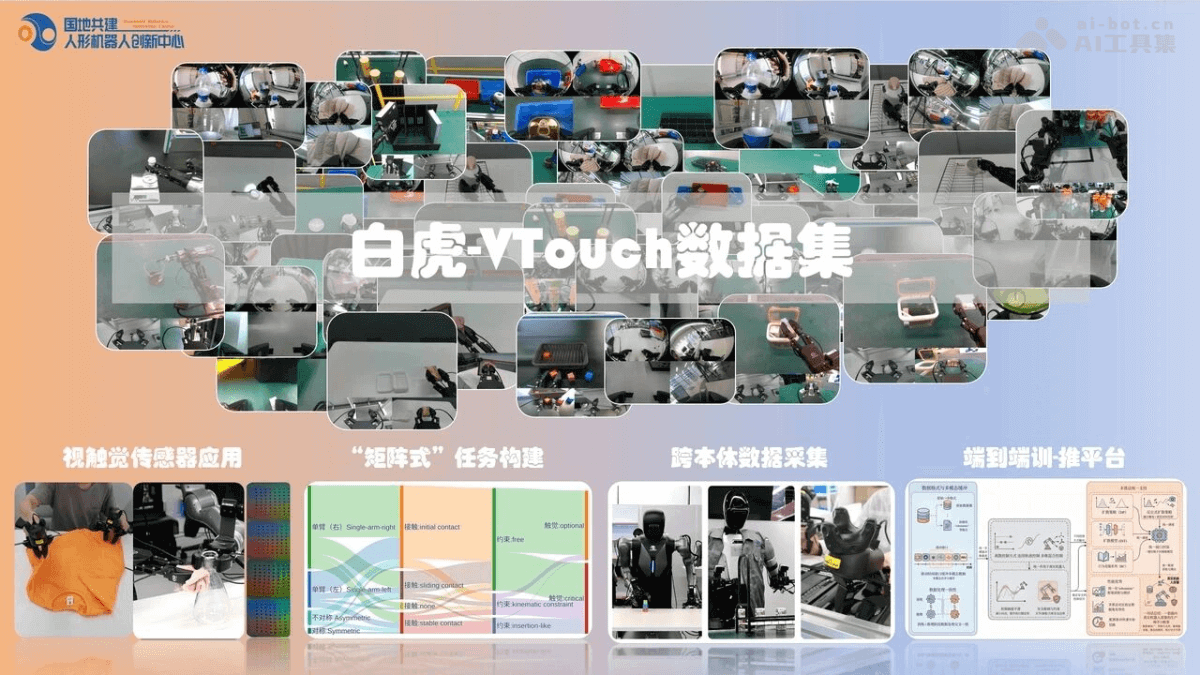
Main Features of White Tiger-VTouch
-
Provides real physical interaction data: The dataset fills the gap in large-scale real visual-tactile interaction data, providing a data foundation for robots' physical operations and fine manipulation in complex environments.
-
Supports cross-embodiment generalization capability: Through cross-embodiment data collection, it supports model training for different robot configurations (such as wheeled-arm robots, bipedal robots, etc.), enhancing the model's generalization ability.
-
Facilitates embodied intelligence model development: It provides key corpus for building embodied foundation models with physical understanding and fine manipulation capabilities, accelerating the leap of robots from "can see" to "can touch, can control".
-
Promotes standardization construction: As a landmark achievement of the national-level standardization pilot in the embodied intelligence field, it helps the construction and practical implementation of the national pilot standard system for embodied intelligence training grounds.
Technical Principles of White Tiger-VTouch
-
Multimodal data collection: It combines visual-tactile sensors, RGB-D cameras, joint pose sensors, and other sensors to collect multimodal data such as vision, touch, and force.
-
Real physical interaction: Through data collection in real physical interaction scenarios, it records pressure distribution, deformation data, etc., during object contact, providing high-fidelity tactile information.
-
"Matrix-style" task construction: It breaks through the traditional single-task collection mode, designs a "matrix-style" task structure covering multiple scenarios and task types, and achieves large-scale data generation and structured capability coverage.
-
Cross-level interaction understanding annotation: It builds a cross-level interaction understanding embodied annotation system, and through joint modeling and alignment of multimodal semantics such as vision, language, action, and touch, achieves cross-modal representation learning and unified understanding.
-
Unified algorithm framework: It builds a unified training-inference algorithm framework for real robot deployment, achieving a complete closed loop from multimodal data processing to model training and online inference, improving model development and validation efficiency.
Project Address of White Tiger-VTouch
- OpenLoong Open Source Community:https://ai.atomgit.com/openloong/visuo-tactile
Application Scenarios of White Tiger-VTouch
- Robot operation and interaction: It provides high-precision visual-tactile data support for robots in scenarios such as home services, industrial manufacturing, and special operations, helping robots complete complex operation tasks.
- Artificial intelligence and machine learning: The dataset provides large-scale multimodal data for embodied intelligence model training, reinforcement learning, and cross-modal learning, enhancing robots' learning and interaction capabilities in the real world.
- Intelligent terminals and human-robot interaction: Support handheld smart devices and smart wearable devices in developing more natural human-computer interaction methods, enhancing virtual reality and augmented reality experiences.
- Education and Research: Provide abundant research resources for universities and scientific research institutions, supporting frontier research and educational course development in fields such as robotics and artificial intelligence.
- Healthcare and Rehabilitation: Help rehabilitation robots and surgical assistance robots achieve more precise operations through visual-tactile data, improving medical rehabilitation outcomes and surgical safety.