
What is Baichuan-Omni
Baichuan-Omni is an open-source 7B multimodal large language model (MLLM) launched by Baichuan Intelligence, capable of simultaneously processing and analyzing data across multiple modalities such as images, video, audio, and text. Baichuan-Omni provides an advanced multimodal interaction experience and powerful performance. Baichuan-Omni is based on an effective multimodal training architecture, including two stages of multimodal alignment and multitask fine-tuning, enabling the model to effectively process visual and audio data. Baichuan-Omni demonstrates strong performance across various omni-modal and multimodal benchmarks; for example, in evaluations of image, video, and audio modalities, it covers more modalities than Qwen2 VL and outperforms the current leading omni-modal model VITA on multiple benchmarks.
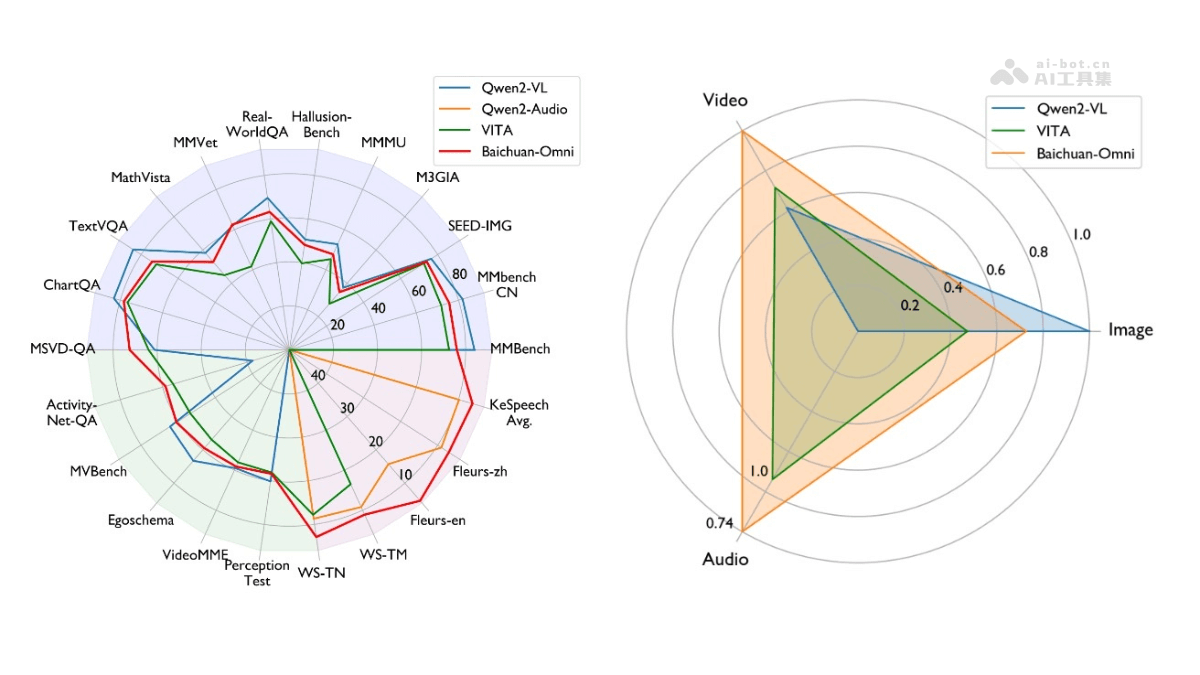
Main Features of Baichuan-Omni
- Multimodal Data Processing: Baichuan-Omni can simultaneously process and analyze data across multiple modalities such as images, video, audio, and text.
- Multilingual Support: Supports multiple languages including English and Chinese.
- Advanced Interaction Experience: Provides an advanced multimodal interaction experience, understanding and responding to complex user instructions.
- Multimodal Alignment Pretraining: In the multimodal alignment pretraining stage, a broad training corpus is organized, including image captions, interleaved data, OCR data, and image-text data.
- Multimodal Supervised Fine-Tuning: In the multimodal supervised fine-tuning stage, training is conducted with over 600K pairs of multimodal data pairs, covering pure text, audio, image-text, video-text, and image-audio interaction data.
Technical Principles of Baichuan-Omni
- Multimodal Architecture: Based on a visual encoder to process image and video data, an audio encoder to process audio data, and a large language model (LLM) to integrate and process information.
- Multi-Stage Training: Includes multimodal alignment pretraining for image-language, video-language, and audio-language, as well as multimodal supervised fine-tuning.
- Data Construction: Uses open-source, synthetic, and internally annotated datasets to build high-quality multimodal training data.
- Alignment Strategy: In the pretraining stage, carefully aligns the encoders and connectors of different modalities to achieve effective interaction between different modalities.
- Attention Mechanism: Uses an attention mechanism to dynamically calculate the model's weights for multimodal inputs, understanding and responding to complex instructions.
Project Address of Baichuan-Omni
- GitHub Repository:https://github.com/westlake-baichuan-mllm/bc-omni
- arXiv Technical Paper:https://arxiv.org/pdf/2410.08565
Application Scenarios of Baichuan-Omni
- Intelligent Customer Service and Chatbots: Baichuan-Omni can understand and generate text, process audio and visual information, and has great potential in building intelligent customer service systems and chatbots. The system can provide a more natural and richer interaction experience.
- Content Moderation and Filtering: Based on multimodal understanding capabilities, Baichuan-Omni can be used to moderate image, video, and text content, helping identify and filter inappropriate content such as violence, pornography, or hate speech.
- Education and Training: In the education field, Baichuan-Omni serves as a teaching assistant tool, providing functions such as language learning, visual recognition, and question answering, enhancing students' learning experience.
- Assisting People with Disabilities: Baichuan-Omni is used to develop applications that assist people with disabilities, such as speech recognition and image description, helping visually or hearing-impaired individuals better understand and interact with their surroundings.