
What is Baichuan-Omni-1.5
Baichuan-Omni-1.5 is an omni-modal model open-sourced by Baichuan Intelligence. It supports omni-modal understanding of text, images, audio, and video, and has dual-modal generation capabilities for text and audio. The model performs excellently in vision, speech, and multimodal streaming processing, with particularly significant advantages in the multimodal medical field. It adopts an end-to-end audio solution and supports multilingual dialogue and real-time audio-video interaction. The training data is massive, including 340 million high-quality image/video-text data and nearly 1 million hours of audio data. In the SFT stage, 17 million omni-modal data entries were used to further optimize performance. Baichuan-Omni-1.5 surpasses GPT-4o-mini in multiple capabilities, demonstrating strong multimodal reasoning and cross-modal transfer abilities.
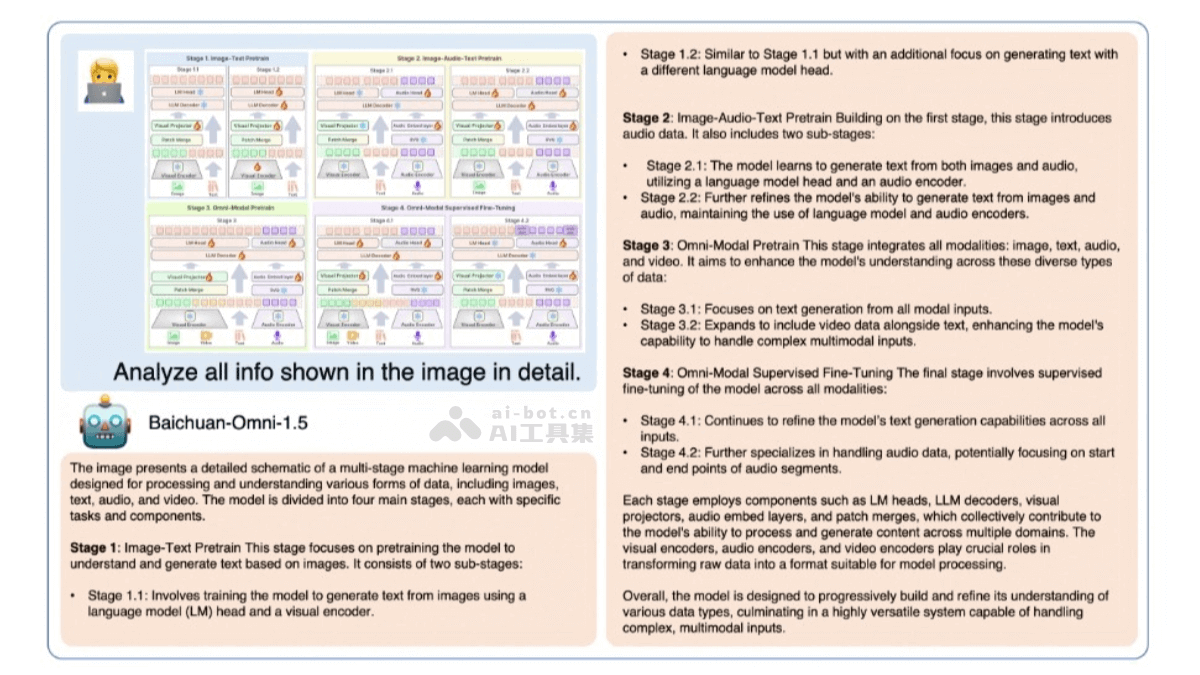
Main Features of Baichuan-Omni-1.5
- Omni-Modal Understanding and Generation: Supports omni-modal understanding of text, images, audio, and video, and has dual-modal generation capabilities for text and audio.
- Multimodal Interaction: Supports diverse interactions on both input and output ends, enables real-time audio-video interaction, and provides a smooth and natural user experience.
- Audio Technology: Adopts an end-to-end solution, supports multilingual dialogue, end-to-end audio synthesis, automatic speech recognition (ASR), and text-to-speech (TTS) functions.
- Video Understanding: Through optimization of the encoder, training data, and training methods, video understanding capability significantly surpasses GPT-4o-mini.
- Multimodal Reasoning and Transfer: Possesses strong multimodal reasoning and cross-modal transfer abilities, and can flexibly handle various complex scenarios.
- Advantages in the Medical Field: Performs excellently in multimodal medical applications, with medical image evaluation scores far ahead.
Technical Principles of Baichuan-Omni-1.5
- Multimodal Architecture: Baichuan-Omni-1.5 adopts a multimodal architecture that supports input and output of multiple modalities such as text, images, audio, and video. The model processes image and video data through a visual encoder, processes audio data through an audio encoder, and integrates and processes this information through a large language model (LLM). The input part supports various modalities being input to the large language model through corresponding Encoder/Tokenizer, while the output part adopts a text-audio interleaved output design.
- Multi-Stage Training: The model's training is divided into multiple stages, including multimodal alignment pre-training for image-language, video-language, and audio-language, as well as multimodal supervised fine-tuning. In the pre-training stage, effective interaction between different modalities is achieved through meticulous alignment of encoders and connectors for different modalities. In the SFT stage, 17 million omni-modal data entries were used for training, further improving the model's accuracy and robustness.
- Data Construction and Optimization: Baichuan-Omni-1.5 has built a massive database containing 340 million high-quality image/video-text data and nearly 1 million hours of audio data. During training, by optimizing the encoder, training data, and training methods, the model's performance on tasks such as video understanding significantly surpasses GPT-4o-mini.
- Attention Mechanism: The model uses an attention mechanism to dynamically calculate weights for multimodal inputs, enabling it to better understand and respond to complex instructions. This allows the model to allocate computational resources more efficiently when processing multimodal data, improving overall performance.
- Audio and Video Processing: In audio processing, Baichuan-Omni-1.5 adopts an end-to-end solution, supporting multilingual dialogue, end-to-end audio synthesis, automatic speech recognition (ASR), and text-to-speech (TTS) functions. The audio Tokenizer is incrementally trained from the open-source speech recognition and translation model Whisper, possessing the ability for advanced semantic extraction and high-fidelity audio reconstruction. In video understanding, through optimization of the encoder, the model outperforms GPT-4V on video understanding tasks.
Baichuan-Omni-1.5 project address
- GitHub repository:https://github.com/baichuan-inc/Baichuan-Omni-1.5
- HuggingFace model library:https://huggingface.co/baichuan-inc/Baichuan-Omni-1d5
Application scenarios of Baichuan-Omni-1.5
- Intelligent interaction and customer service optimization: Baichuan-Omni-1.5 can integrate multimodal data such as text, images, and audio, bringing transformation to intelligent customer service. Users can ask questions by sending product images, text descriptions, or directly by voice, and the model can accurately parse and immediately provide accurate answers, significantly improving service efficiency and quality.
- Educational innovation assisting learning: The model can serve as an intelligent learning companion for students, supporting the understanding and analysis of various learning materials such as text textbooks, image charts, and audio explanations. It can answer questions and clarify doubts in an accessible manner, analyze key knowledge points, and adapt to different learning styles through multimodal interaction, stimulating learning potential.
- Intelligent medical diagnosis assistant: In the medical field, Baichuan-Omni-1.5 can receive patients' examination reports (text), medical images (images), and orally described symptoms (audio), and after comprehensive analysis provide diagnostic ideas and treatment recommendations to assist doctors in decision-making.
- Creativity stimulation and design empowerment: Baichuan-Omni-1.5 can provide inspiration support for creative workers. In fields such as advertising design and story creation, it can generate unique creative content based on creative themes (text) and image materials, and can expand plots or create related images based on voice descriptions, helping creativity emerge.
- Multimodal content generation and understanding: The model supports full-modal input of text, images, audio, and video, and can generate high-quality text and speech output. It performs excellently in video understanding, audio processing, and other aspects, and the audio Tokenizer can support high-quality real-time bilingual Chinese-English dialogue.