
What is BabyVision
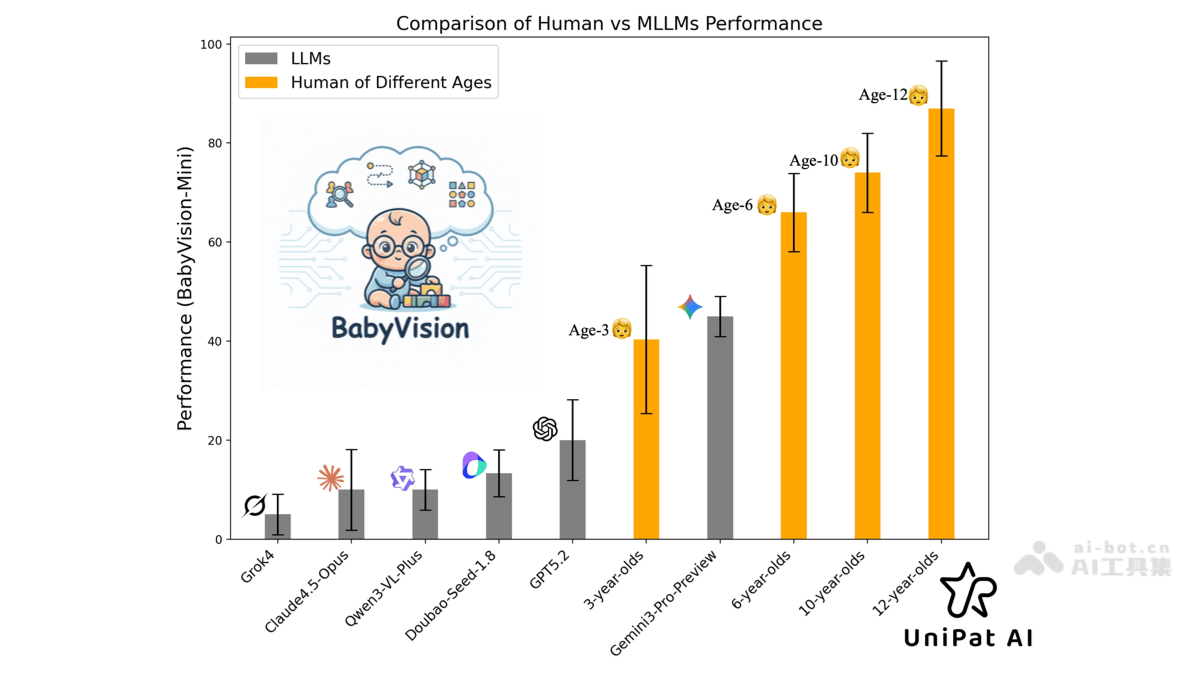
BabyVision is a multimodal understanding benchmark launched by the UniPat AI team to evaluate the performance of multimodal language models (MLLMs) and image generation models on visual reasoning tasks. It includes two main tracks: MLLM evaluation and generative evaluation. The benchmark features four major visual capability categories, including fine-grained discrimination, visual tracking, spatial perception, and visual pattern recognition, with a total of 22 subtasks and 388 questions. These tasks strictly control language dependence to faithfully reflect the model's visual understanding capabilities.
Main Features of BabyVision
-
Evaluate the visual reasoning capabilities of multimodal models: Through carefully designed visual tasks, it tests the performance of multimodal language models (MLLMs) and image generation models in purely visual scenarios, revealing the models' shortcomings in visual understanding.
-
Provide two evaluation tracks: One is MLLM evaluation for multimodal language models, and the other is generative evaluation for image generation models, comprehensively covering different types of multimodal models.
-
Cover four major visual capability categories: Including fine-grained discrimination, visual tracking, spatial perception, and visual pattern recognition. Through diverse task designs, it comprehensively evaluates the model's reasoning capabilities in different visual scenarios.
-
Strictly control language dependence: Ensure that tasks cannot be solved through language hints, thereby faithfully reflecting the model's visual understanding capabilities and preventing models from relying on language hints to complete tasks.
-
Provide detailed evaluation results and leaderboards: Display the performance of different models through metrics such as accuracy and compare them with human baselines, providing researchers with intuitive references.
-
Support quick start and flexible configuration: Provide a complete dataset, evaluation scripts, and detailed documentation to help researchers get started quickly, and flexibly configure evaluation parameters through environment variables and other means.
-
Promote the development of multimodal technology: By revealing the shortcomings of current models, it provides direction for future technical optimization and innovation, promoting further improvement of multimodal models on visual tasks.
BabyVision Evaluation Results
-
Human baseline performs exceptionally well: The average accuracy of human testers is as high as 94.1%, demonstrating humans' strong capabilities on visual reasoning tasks.
-
Closed-source models show mixed performance: Gemini3-Pro-Preview leads with 49.7% accuracy, GPT-5.2 is 34.4%, and Doubao-Seed-1.8 is 30.2%, but overall they are still far below human level.
-
Open-source models show a clear gap: Qwen3-VL-Plus's accuracy is only 19.2%, and most open-source models perform poorly, significantly lagging behind the human baseline and some closed-source models.
-
Models have shortcomings on visual tasks: Whether closed-source or open-source, models generally perform poorly on visual tasks requiring continuous tracking, spatial imagination, and geometric induction, exposing the deficiencies of current multimodal models in basic visual capabilities.
-
Generative evaluation results are unsatisfactory: In generative tasks, although some models exhibit behavior that is "more human-like," overall they still lack the ability to consistently reach fully correct solutions.
-
Evaluation results drive technical improvement: By clearly pointing out the model's shortcomings, BabyVision provides an important reference direction for future multimodal model optimization and technological innovation.
BabyVision's project address
- Github repository:https://github.com/UniPat-AI/BabyVision
BabyVision's application scenarios
-
Multimodal model evaluation: Used to systematically evaluate the performance of multimodal language models and image generation models in visual reasoning tasks, helping researchers understand the models' visual understanding capabilities.
-
Technical research and development: Provides AI researchers with a standardized testing platform for developing and optimizing multimodal models, promoting progress in visual reasoning technology.
-
Model performance comparison: Through a unified evaluation standard, compares the performance of different models on visual tasks, providing a reference for model selection and improvement.
-
Education and learning tool: Provides educators and students with a tool for understanding the visual capabilities of multimodal AI, for use in teaching and research activities.
-
Industry application reference: Provides a reference for model performance for industries that require multimodal visual reasoning capabilities (such as autonomous driving, medical image analysis, etc.), supporting the development and optimization of industry applications.
-
Academic research and publication: Provides data support for academic research, helping researchers publish related research results and promoting academic development in the field of multimodal AI.