
What is AxBench
AxBench is a benchmarking framework launched by Stanford University for evaluating language model (LM) interpretability methods. It generates training and evaluation data based on synthetic data, comparing the performance of different model control techniques in two aspects: concept detection and model steering. The concept detection task evaluates the model's ability to recognize specific concepts based on labeled synthetic data; the model steering task uses long-text generation tasks to evaluate the model's performance after intervention, scoring with another language model as a "judge." AxBench provides researchers with a unified platform for systematically evaluating and comparing the effectiveness of various language model control methods, advancing research on the safety and reliability of language models.
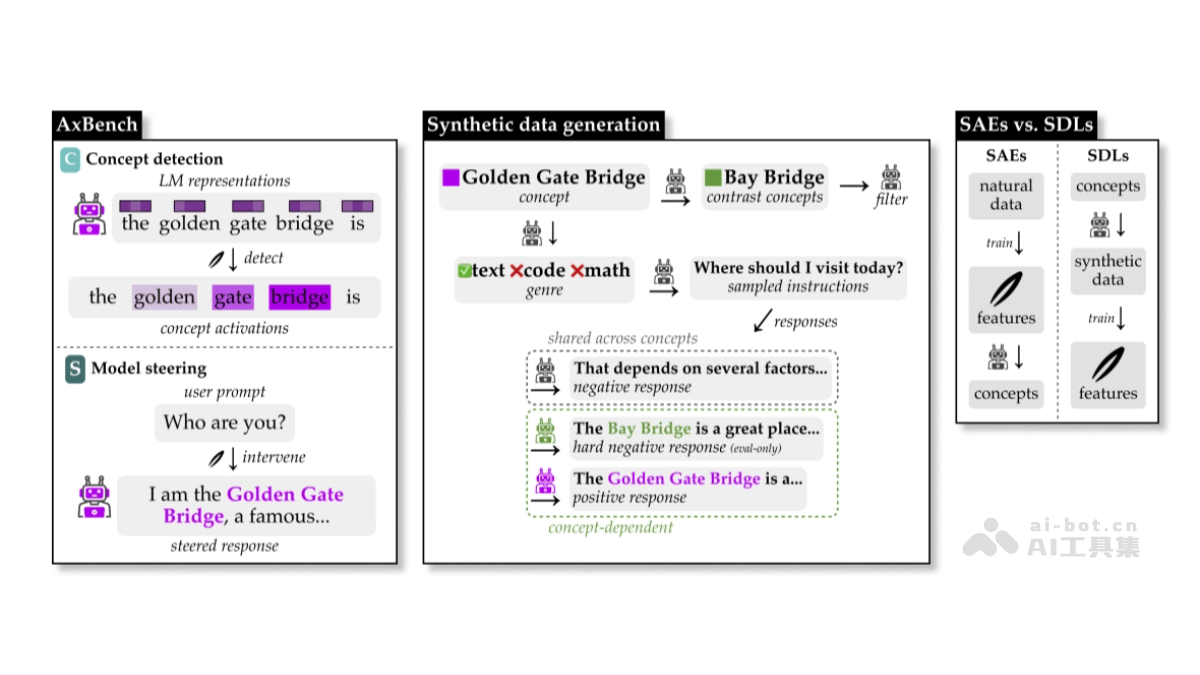
AxBench's Main Features
- Evaluating Language Model Control Methods:
- Concept Detection (C): Based on labeled synthetic data, evaluates the model's ability to recognize specific concepts.
- Model Steering (S): Based on long-text generation tasks, evaluates the model's performance after intervention.
- Providing a Unified Evaluation Framework: Provides a unified evaluation platform for different language model control methods (such as prompting, finetuning, sparse autoencoders, etc.), facilitating comparison of the pros and cons of various methods. Supports multiple models and task settings, extending to different language models and concept descriptions.
- Generating Synthetic Data: AxBench generates training and evaluation data based on natural language concept descriptions, supporting large-scale experiments and benchmarking. The data generation process includes generating positive examples (text containing the target concept) and negative examples (text not containing the target concept), and supports generating "hard negatives" (text semantically related to the target concept but not activating that concept).
- Supporting Multiple Evaluation Metrics:
- Concept Detection: Uses ROC AUC (Area Under the Receiver Operating Characteristic Curve) to evaluate the model's classification ability for concepts.
- Model Steering: Based on a language model "judge" scoring the generated text across three dimensions (concept relevance, instruction relevance, fluency), comprehensively evaluating the steering effect.
AxBench's Technical Principles
- Synthetic Data Generation:
- Positive examples: Generate text containing the target concept based on a prompt language model.
- Negative examples: Generate text not containing the target concept based on a prompt language model.
- Hard negatives: Generate text semantically related to the target concept but not activating that concept, increasing the difficulty and discriminability of evaluation.
- Concept Detection Evaluation: Uses labeled synthetic data as the training set to train concept detectors (such as linear probes, difference-in-means, etc.). Evaluates the detector's classification ability for concepts based on ROC AUC, i.e., the model's performance in distinguishing positive from negative examples.
- Model Steering Evaluation:
- Based on intervening in the model's internal representations (such as adding vectors in specific directions), making the model's generated text more consistent with the target concept.
- Uses a language model "judge" to score the generated text across three dimensions (concept relevance, instruction relevance, fluency), comprehensively evaluating the steering effect.
- Supporting Multiple Methods:
- AXBENCH supports multiple language model control methods, including prompting, finetuning, sparse autoencoders (SAEs), linear probes, etc.
- Provides implementations of various representation intervention methods (such as ReFT-r1), which control model outputs by learning direction-specific vectors to intervene in the model's internal representations.
AxBench's project address
- GitHub repository:https://github.com/stanfordnlp/axbench
- arXiv technical paper:https://arxiv.org/pdf/2501.17148
AxBench's application scenarios
- Social media content moderation: Social media platforms automatically detect and filter harmful content, such as hate speech, misinformation, or inappropriate content, to maintain the platform's safety and health.
- Educational content generation: Online education platforms need to generate high-quality educational content that aligns with teaching syllabi and values, such as course introductions, practice problems, and explanatory texts.
- Healthcare sector: In the healthcare sector, AI-generated text must strictly comply with medical ethics and factual accuracy, for example, when generating medical advice, health science articles, or medical records.
- Multilingual content localization: Multinational enterprises or content platforms localize content into different languages and cultural environments while maintaining consistency and accuracy of the content.
- AI alignment and ethics research: In fields such as autonomous driving, financial decision-making, or legal consultation, AI outputs need to comply with ethical and legal requirements.