
What is Avat3r
Avat3r is a large animatable Gaussian reconstruction model for high-fidelity 3D head avatars launched by the Technical University of Munich and Meta Reality Labs. With just a few input images, it can generate high-quality and animatable 3D head avatars, reducing computational requirements. The model learns strong 3D head priors from large multi-view video datasets and combines DUSt3R's position maps and Sapiens' feature maps to optimize reconstruction. Avat3r's key innovation lies in achieving expression animation through a simple cross-attention mechanism, enabling reconstruction of 3D head avatars from inconsistent inputs (such as smartphone captures or monocular video frames).
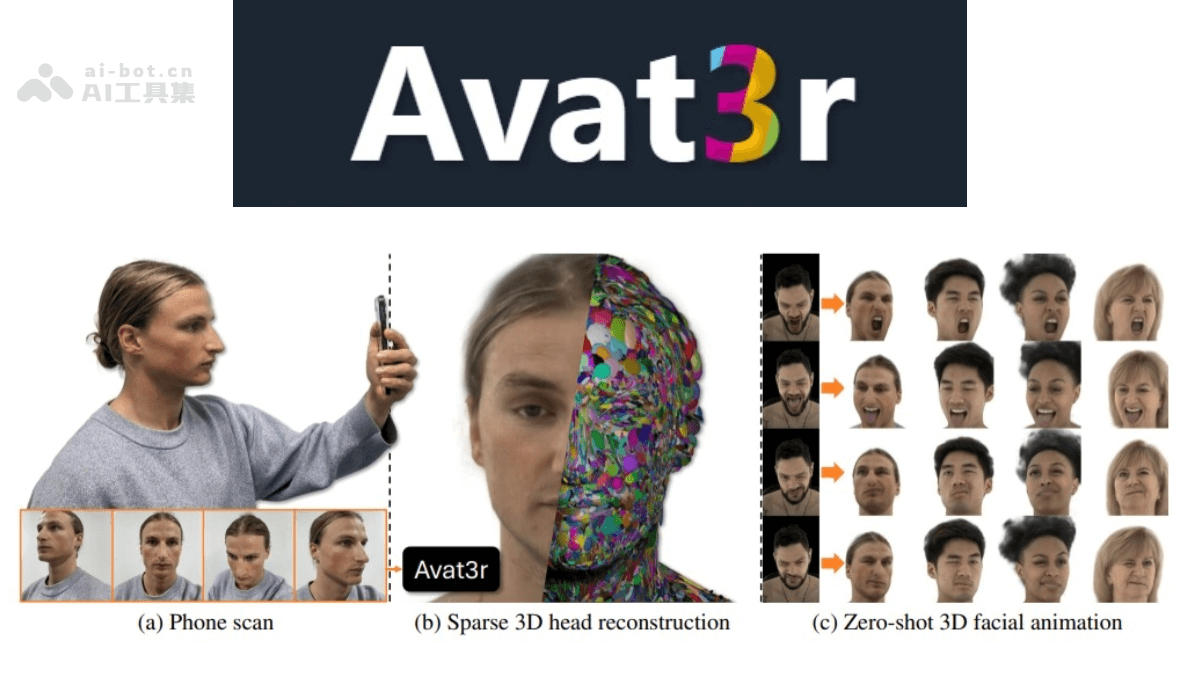
Avat3r's Main Features
- Efficient Generation: With just a few input images, it can quickly generate high-quality 3D head avatars, greatly reducing the computational resources required by traditional methods.
- Animation Capability: Through a simple cross-attention mechanism, Avat3r can animate the generated 3D head avatars and support real-time expression control.
- Robustness: The model is trained with images of different expressions and can handle inconsistent inputs, such as blurry smartphone photos or monocular video frames.
- Multi-source Input Support: Avat3r can generate 3D head avatars from multiple sources, including photos taken with smartphones, a single image, or antique busts.
Avat3r's Technical Principles
- Gaussian Reconstruction Technology: Avat3r uses 3D Gaussian-splatting as its base representation. By representing points in 3D space with Gaussian distributions, each Gaussian distribution not only describes the spatial position of the point but also encodes attributes such as color and normals. This enables efficient reconstruction and rendering of complex 3D head models.
- Multi-view Data Learning: Avat3r learns strong 3D head priors from multi-view video datasets and can generate high-quality 3D head avatars with only a few input images. The model can better handle inconsistent inputs, such as blurry smartphone photos or monocular video frames.
- Animation Technology: One of Avat3r's key innovations is achieving expression animation through a simple cross-attention mechanism. During training, the model is fed images with different expressions, improving its robustness to expression changes. The generated 3D avatars can respond to expression changes in real time, achieving natural animation effects.
- Combining Prior Models: Avat3r combines DUSt3R's position maps and Sapiens' generalized feature maps to further optimize reconstruction. The prior models provide additional constraints for the geometric structure and texture of the 3D head, enhancing the realism and detail of the generated avatars.
- Efficiency and Generalization: Avat3r performs excellently in few-input and single-input scenarios and can generate high-quality 3D avatars from a few input images within minutes. The model has good generalization ability and can handle inputs from different sources, such as smartphone photos or a single image.
Avat3r's Project Address
- Project Official Website:https://tobias-kirschstein.github.io/avat3r/
- arXiv Technical Paper:https://arxiv.org/pdf/2502.20220
Avat3r's Application Scenarios
- Virtual Reality (VR) and Augmented Reality (AR): Avat3r can generate high-quality and animatable 3D head avatars, suitable for VR and AR scenarios.
- Film and Television Production and Visual Effects: Avat3r can generate high-quality 3D avatars from just a few input images, and can be widely used for character modeling and animation generation in film and television production.
- Game Development: In game development, Avat3r can quickly generate 3D avatars for characters, support real-time animation, and provide players with a more immersive gaming experience.
- Digital Humans and Virtual Assistants: Avat3r can be used to generate 3D avatars for digital humans. The avatars can be combined with speech synthesis and natural language processing technologies to provide users with a more natural and personalized interactive experience.