
What is AutoVFX
AutoVFX is an advanced physical effects framework launched by a research team at the University of Illinois at Urbana-Champaign, capable of automatically creating realistic and dynamic visual effects (VFX) videos according to natural language instructions. The framework integrates neural scene modeling, large language model (LLM)-based code generation, and physical simulation technologies to achieve photorealistic and physically plausible video editing effects, allowing users to directly control the modification and creation of video content with natural language instructions.
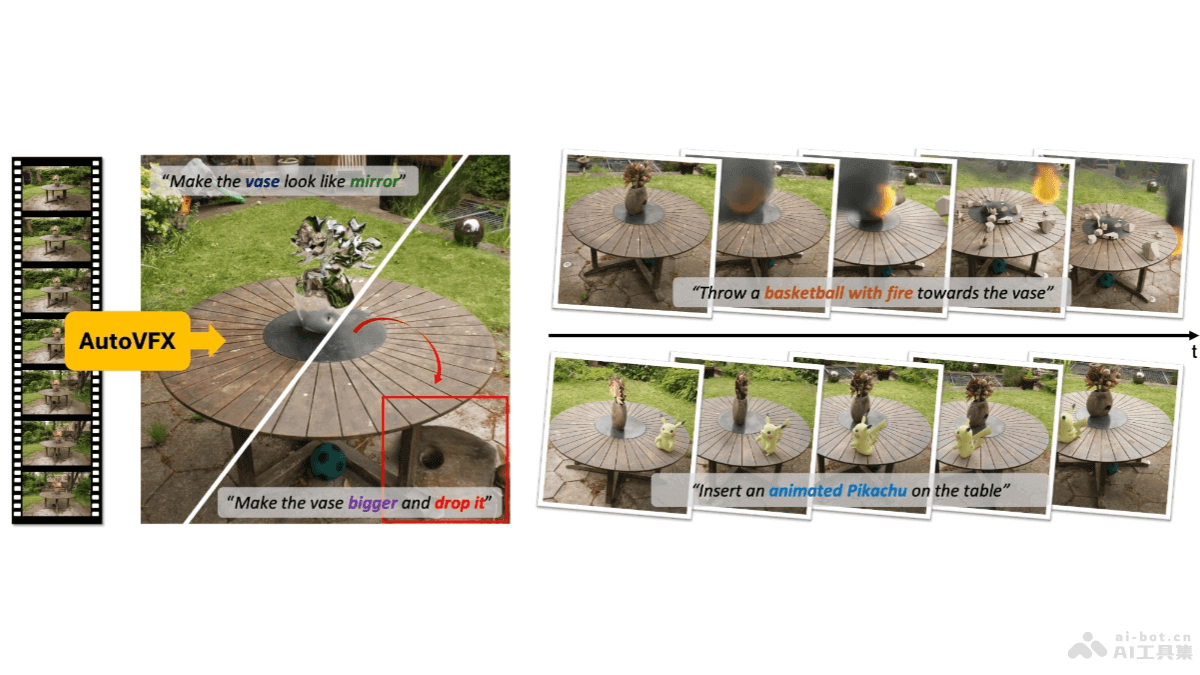
Main Features of AutoVFX
- 3D Scene Modeling: Extracts key scene attributes from the input video, including geometry, appearance, semantics, and lighting information.
- Program Generation: Uses large language models (LLMs) to convert natural language editing instructions into executable program code.
- VFX Modules: Contains predefined specialized functions for performing various editing tasks, such as object insertion, removal, material editing, and physical simulation.
- Physical Simulation: Supports rigid body physics and particle effects, such as smoke and fire, to achieve realistic dynamic interactions.
- Rendering and Compositing: Uses physically based rendering engines (such as Blender) to generate the final video, including foreground objects, background meshes, and compositing.
Technical Principles of AutoVFX
- Neural Scene Modeling: Uses 3D reconstruction and scene understanding models to build a comprehensive scene model, encoding rich geometric, appearance, and semantic information from the input video.
- LLM-based Code Generation: Based on large language models (LLMs), such as GPT-4, converts simple language editing instructions into programs.
- Physical Simulation Integration: Integrates the scene model with physical simulation engines (such as Blender) to achieve physically plausible interactions and dynamic effects.
- Modular Function Encapsulation: Encapsulates editing modules into callable functions, and the functions combine to form a comprehensive program that is convenient for the Python interpreter to execute.
- Rendering Technology: Uses the Cycles renderer for high-quality physically based rendering, simulating the interaction of light, including reflection, refraction, and global illumination.
- Compositing Pipeline: Extracts foreground and background masks and foreground content based on alpha thresholds and occlusion reasoning, calculates shadow intensity, and blends the shadows and foreground content into the original image to produce the final composited video.
Project Links of AutoVFX
- Project Website:haoyuhsu.github.io/autovfx-website
- GitHub Repository:https://github.com/haoyuhsu/autovfx
- arXiv Technical Paper:https://arxiv.org/pdf/2411.02394
Application Scenarios of AutoVFX
- Film and Video Production: In film production, creates complex special effects scenes, such as simulating explosions, weather effects, object deformation, etc., reducing the difficulty and cost of actual filming.
- Advertising and Marketing: In the advertising industry, produces attractive visual effects to enhance the appeal of product displays, such as dynamic product showcases, virtual scene construction, etc.
- Game Development: Game developers can quickly prototype in-game effects or use it for the production of game promotional videos.
- Virtual Reality (VR) and Augmented Reality (AR): In VR and AR applications, creates realistic virtual environments and special effects to improve the user experience.
- Education and Training: Create educational content such as simulated experiments, historical reenactments, etc., providing a more intuitive and interactive learning experience.