
What is autoresearch
autoresearch is an AI autonomous research experimentation framework open-sourced by Andrej Karpathy. The framework lets an AI Agent automatically run nanochat training experiments on a single GPU, autonomously tuning parameters, executing training, analyzing validation metrics, and deciding the next optimization direction, fully automating the traditional manual loop of tune parameters - run experiments - read logs - tune parameters again. autoresearch has an extremely low barrier to entry and can run on a single card, making AI no longer merely an object of study, but an executor that independently conducts research.
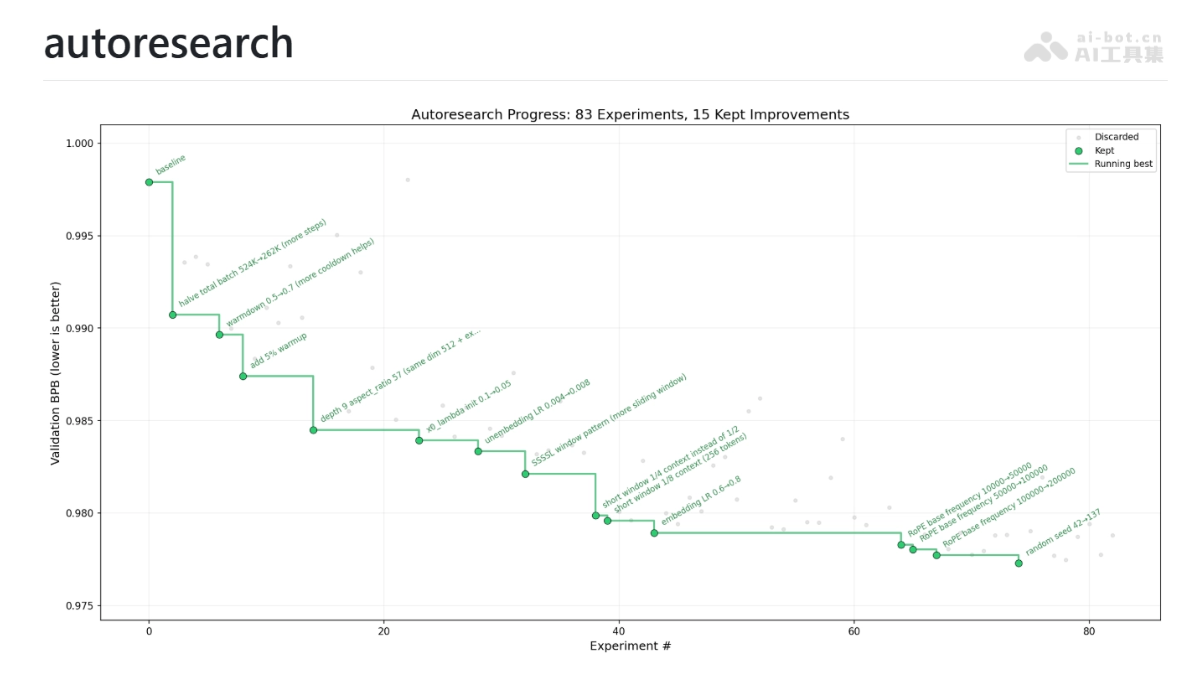
Main features of autoresearch
-
Autonomous code iteration: The AI Agent directly edits the
train.pyfile, modifying the model architecture, optimizer, hyperparameters, and other configurations across the entire training pipeline. -
Fixed time budget experiments: Each training run is strictly limited to 5 minutes of wall-clock time, ensuring experiment results are comparable across platforms.
-
Automatic improvement screening: Using
val_bpb(validation bits per byte) as the unified metric, automatically retaining effective modifications that lower the metric and discarding ineffective attempts. -
Human-controllable research organization: Through
program.mddefining agent behavior and research strategy, humans iteratively optimize the "research organization code" rather than directly modifying code. -
Single-file focused design: The Agent only modifies
train.pya single file, keeping the experiment scope controllable and the diff reviewable.
Technical principles of autoresearch
-
Simplified nanochat training: A lightweight GPT model implemented on a single GPU, integrating the Muon optimizer with AdamW, supporting a complete training loop.
-
BPE tokenization and data pipeline:
prepare.pyhandles one-time data preparation and BPE tokenizer training, providing standardized data loading and evaluation tools. -
Unified evaluation metric: Adopts the vocab-size-independent
val_bpbmetric, making experiment results fairly comparable before and after architecture changes. -
Agent-environment closed loop:
program.mdserves as the agent's "skill file": the agent reads instructions → modifies code → runs training → evaluates metrics → decides to keep/discard → iterates in a loop. -
Time standardization mechanism: Regardless of changes in model size or batch size, training always runs for a fixed duration, eliminating the impact of hardware differences on experiment comparability.
How to use autoresearch
-
Install uv: Execute
curl -LsSf https://astral.sh/uv/install.sh | shto install the uv project manager. -
Install dependencies: After entering the repository directory, run
uv syncto complete project dependency installation. -
Data preparation: Execute
uv run prepare.pyto download training data and train the BPE tokenizer (one-time, about 2 minutes). -
Verify environment: Manually run
uv run train.pyto confirm a single training pipeline executes normally (about 5 minutes). -
Launch the agent: Load an AI agent such as Claude/Codex in the IDE, pointing it to the
program.mdfile. -
Start research: Enter a prompt such as “Hi have a look at program.md and let’s kick off a new experiment” to start automatic iteration.
-
View results: Check the experiment logs and
train.pymodification history, obtain the optimized model and improvement path.
Core advantages of autoresearch
-
Minimalist design: only three core files (
prepare.py、train.py、program.md), zero external dependencies, runnable on a single GPU. -
Fair comparison: fixed 5-minute time budget and vocab-independent metrics ensure that any architectural modification can be evaluated under the same benchmark.
-
Human-machine collaboration: humans use
program.mdto set research strategy, and the Agent is responsible for executing code experiments, realizing the division of labor where humans set the direction and AI conducts experiments. -
High throughput: about 12 experiments per hour, nearly 100 automatic iterations can be completed overnight, far exceeding the efficiency of manual experiments by humans.
-
Auditability: the single-file modification mode makes the diff of each experiment clear and traceable, making it easy to understand the agent's improvement path.
autoresearch project address
- GitHub repository:https://github.com/karpathy/autoresearch
Comparison of autoresearch with similar competitors
| Comparison dimension | autoresearch | SciClaw |
|---|---|---|
| Product positioning | Autonomous research agent dedicated to LLM training | General-purpose AI colleague in scientific research / full-cycle research orchestration system |
| Core tasks | Automatically modify training code, tune hyperparameters, run experiments, and screen improvements | Literature review, experimental design, computational simulation, paper generation, peer review responses |
| Research object | nanochat model training (single-GPU deep learning) | Multidisciplinary scientific research tasks in life sciences, chemistry, physics, materials, etc. |
| Experiment execution | Directly modify Python code and run the training loop | Autonomously decompose tasks, invoke scientific tools, run computational simulations, and connect to experimental equipment |
| Evaluation mechanism | Fixed 5-minute training + val_bpb automated screening metrics to keep/discard |
Analysis of experimental results, paper quality assessment, hypothesis validation |
| Knowledge base | None; each experiment independently makes decisions based on code and metrics | Long-term memory of project data, experiment records, literature, email history |
| Hardware requirements | Single NVIDIA GPU | Cloud-based or local deployment, supports AI glasses and automated experimental equipment |
| Interaction method | Through program.md instruction files + automatic execution by AI agents |
Conversational interaction (Web/Feishu/DingTalk/Telegram/Discord) |
| Open source | Fully open source under MIT | Closed-source product (beta access requires an invitation code) |
| Target users | AI researchers, LLM training engineers | Scientific researchers, doctoral students, corporate R&D |
| Outputs | Optimized model weights + experiment logs | Paper drafts, PPT, posters, peer review responses, experiment reports |
| Depth of autonomy | Code-level automatic iteration, but limited to a single training task | Project-level full-cycle orchestration, supporting multi-day background experiments and self-repair |
Application scenarios of autoresearch
-
Automatic hyperparameter search for LLM training: automatically explores combinations of learning rate, batch size, model depth, etc., to find the optimal configuration.
-
Architecture innovation validation: quickly validates the actual effects of new attention mechanisms, positional encodings, or optimizer variants.
-
Low-cost model tuning: automatically optimizes small-model performance in a single-GPU environment, suitable for individual researchers or teams with limited resources.
-
Exploration of AI research methodology: serves as a proof-of-concept platform for autonomous AI research agents, exploring the feasibility boundaries of "AI scientists."